You set a stop-loss, so your risk is capped — right? Not quite. A stop limits your loss most of the time, but not all of the time, and the exception is gap risk. When price "gaps" over your stop — jumping past it with no trading in between — you're filled at the next available price, which can be far worse than your stop level, so your loss can exceed what you planned. This is one of the most underappreciated risks in trading, and a sobering reminder that the comfort of a stop has limits. This guide explains gap risk: what gaps are, why a stop is not a guaranteed exit price, the chastening examples, and how to manage the risk.
It's a crucial qualification to the stop-loss, a key reason for prudent position sizing, and closely related to tail risk and slippage.
Key takeaways
Q: What is gap risk in forex?
A: Gap risk is the danger that price 'jumps' from one level to another with no trading in between — a gap — most commonly over a weekend or around major news. If price gaps past your stop-loss, the stop is filled at the next available price, which can be far worse than your stop level, so your loss can exceed what you planned.
Q: Does a stop-loss guarantee my exit price?
A: No. A normal stop executes when price reaches it, but if price gaps over the stop level (jumping past it), the order is filled at the next available price — potentially much worse, a form of slippage. A standard stop limits your loss most of the time, but not in a gap or fast market; only a guaranteed stop fills at your exact price.
Q: How do you manage gap risk?
A: Be aware that stops aren't guaranteed; size positions so even a bad gap wouldn't be catastrophic; consider reducing or closing positions before weekends or major scheduled events if you can't tolerate a gap; and, where available, use guaranteed stop-loss orders (which fill at your price for a fee) on positions where gap risk is unacceptable.
What gaps are
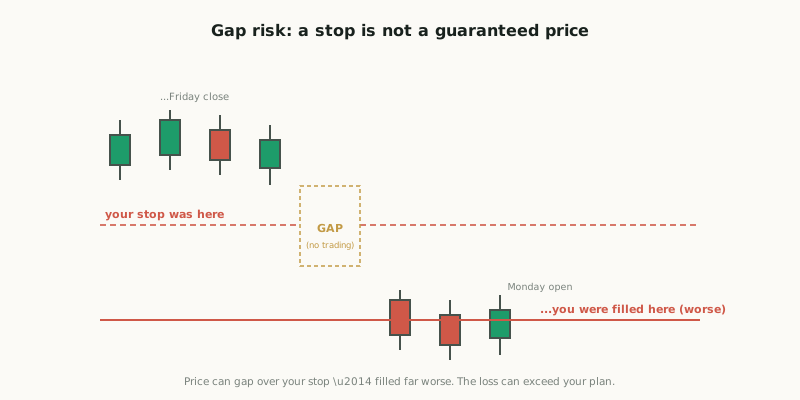
A gap occurs when price "jumps" from one level to another with no trading in between, leaving a visible gap on the chart — the market simply reopens (or re-prices) at a level away from where it last traded, skipping the prices in between. In forex, the most common gap is the weekend gap. The forex market closes for the weekend (late Friday) and reopens Sunday evening/Monday; if significant news breaks over the weekend — an election result, a geopolitical event, a policy announcement — price can open at a very different level than the Friday close, gapping across the intervening prices that never traded. Gaps also occur around major scheduled news (a central bank decision, key data) where price lurches, and in low-liquidity periods or sudden shocks (flash events), where price can move violently with little trading at the levels in between.
Gaps matter enormously for risk because of what they do to stops. Normally, a stop-loss works by executing when price reaches your stop level — price trades down to your stop, and you're filled at (roughly) that price. But a gap means price doesn't trade at the intervening levels — it jumps over them. If price gaps past your stop level (the new price is well beyond your stop), your stop is triggered but cannot be filled at your stop price (no one traded there); instead, it's filled at the next available price — which can be far worse than your stop. This is the crux of gap risk, and it deserves to be stated plainly.
A stop is not a guaranteed price
This is critical and often misunderstood: a normal stop-loss does not guarantee you'll exit at your stop price. It guarantees that, once price reaches your level, your order becomes a market order to exit — but in a gap (or a fast, illiquid market), there may be no trading at your level, so you're filled at the next available price, which can be far worse (a form of slippage). The result: your actual loss can exceed your intended stop loss, sometimes by a lot. A stop limits your loss in normal conditions, but in a gap it can blow straight through, and you bear the worse fill. Never assume your stop caps your risk absolutely — it doesn't.
The implications are sobering. If you're holding a position and price gaps through your stop — over a weekend, on a shock — you can lose considerably more than the amount you carefully calculated as your risk when you set the stop. The classic, extreme example is the 2015 Swiss franc shock: when the Swiss National Bank abruptly abandoned its cap on the franc, the currency gapped enormously in moments, blowing through stops far beyond their levels and causing catastrophic losses — some traders (and even brokers) suffered losses so large they wiped out accounts and more, because stops simply could not be filled anywhere near their intended prices in the violent, gapping move. Flash crashes and other shocks have produced similar (if usually less extreme) gap-throughs. These events are reminders that the neat, capped risk a stop seems to promise is, in the tail, not guaranteed — which is precisely why gap risk must be respected, not assumed away. (This connects directly to tail risk and the danger of overleverage: a gap is exactly the kind of extreme event that destroys an over-leveraged trader whose "capped" risk turns out not to be capped.)
Managing gap risk
Gap risk can't be eliminated entirely — it's inherent to markets — but it can be managed, and prudent traders take it seriously. The most important protection, as ever, is position sizing: size your positions so that even a bad gap beyond your stop wouldn't be catastrophic to your account. If your risk management relies solely on the stop level holding, a gap can ruin you; but if you've sized the position modestly (so that even a loss several times your intended stop wouldn't blow up your account), a gap hurts but doesn't destroy you. This is the ultimate backstop, and it's why sane position sizing (and avoiding overleverage) is the real protection against gap risk — don't rely on the stop level alone to define your maximum risk; account for the possibility of slippage and gaps beyond it.
Beyond sizing, several practical measures help. Manage weekend and event exposure: be aware that holding over a weekend (or over a major scheduled event like an election, referendum or central bank decision) carries gap risk, and consider reducing or closing positions before such events if you can't tolerate a gap — many traders deliberately avoid holding large positions over high-risk weekends/events. Use guaranteed stops where available: some brokers offer guaranteed stop-loss orders (GSLOs) that do fill at your exact price even through a gap, in exchange for a fee or wider spread — a tool to eliminate gap-slippage risk on a specific position where it matters (worth the cost for some). And be aware of correlations: a single shock can gap several correlated positions at once (the correlation-risk point), compounding the damage — so account for gap risk across your whole book, not position by position. The honest, risk-first framing: gaps are an inherent risk in forex (especially over weekends and around events), a standard stop-loss does not guarantee your exit price, and your actual loss can exceed your planned risk when price gaps through your stop. The protections are awareness (never assume the stop caps your risk absolutely), prudent position sizing (so a gap isn't catastrophic), managing weekend and event exposure, and guaranteed stops where the risk warrants. Above all, this is why the site's recurring insistence on sensible position sizing and avoiding overleverage matters so much: it's the defence against the day your "capped" risk turns out not to be capped.
Where gaps come from
It helps to know the main situations that produce gaps, so you can anticipate when gap risk is elevated. The most common in forex is the weekend gap, already noted: the market closes for the weekend, and if news breaks while it's shut — a weekend election or referendum, a geopolitical flare-up, an emergency policy move — price reopens at a different level, gapping across the closed period. This is why holding positions over the weekend carries inherent gap risk that holding intraday does not. Second are major scheduled events: central bank decisions, key data releases, elections, and the like can cause price to lurch on the announcement, effectively gapping as it leaps to a new level with little trading in between — so even within market hours, gap-like risk spikes around known event times.
Third are low-liquidity periods: when few participants are trading — the gap between sessions, holidays, the rollover period, or thin hours — there's less to absorb orders, so price can jump more easily, and an unexpected order or news in a thin market can cause a sharp, gap-like move. Fourth are shocks and flash events: sudden, severe surprises (the 2015 Swiss franc shock being the extreme case) can cause violent, near-instant gaps even in normally liquid conditions, and "flash crashes" — brief, sharp dislocations — can blow through levels in moments before partially recovering. The practical upshot is that gap risk is not uniform: it's highest over weekends, around scheduled high-impact events, in thin-liquidity windows, and during shocks — and lowest in normal, liquid, event-free trading. A risk-aware trader therefore pays special attention to position size and exposure precisely in those elevated-risk situations (especially weekends and big events), where the chance of a damaging gap through a stop is greatest. Knowing where gaps come from is the first step to managing when you're most exposed to them.
A gap is when price jumps from one level to another with no trading in between — most often the weekend gap (news over the weekend moves the Monday open), but also around major events and shocks. Gap risk is crucial because a standard stop-loss is not a guaranteed exit price: if price gaps past your stop, you're filled at the next available price — potentially far worse (slippage) — so your loss can exceed your planned risk. The 2015 Swiss franc shock is the classic example (stops blown through, accounts wiped out). Manage it by: prudent position sizing (so even a bad gap isn't catastrophic — the key protection, and why avoiding overleverage matters), reducing/closing positions before risky weekends or events, using guaranteed stops where available, and accounting for correlations. Never assume a stop caps your risk absolutely — in a gap, it doesn't.