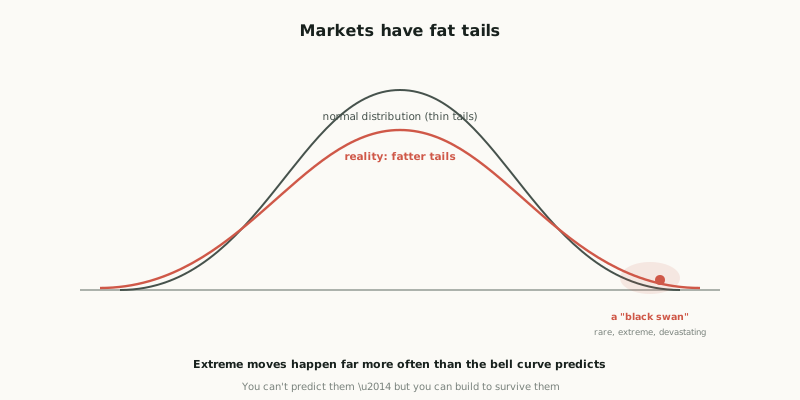
The market move that "can't happen" eventually does. Financial markets have fat tails — extreme events occur far more often than the textbook bell curve predicts — and a single black swan can undo years of careful gains in an afternoon. This isn't pessimism; it's an empirical fact about markets that has humbled traders, funds, and even Nobel laureates. The crucial point for risk management is this: you cannot predict black swans, but you can build to survive them — and surviving the unpredictable is, in a deep sense, the entire purpose of risk management. This guide explains black swans and tail risk: what they are, why markets have fat tails, why it matters, and how to be robust to the inevitable extreme.
It's the deep "why" behind risk of ruin and avoiding overleverage, and closely tied to gap risk (gaps are tail events in action).
Key takeaways
Q: What is a black swan event?
A: A black swan is a rare, unpredictable, high-impact event — a term popularised by Nassim Taleb. In markets, black swans are extreme, unforeseen moves (crashes, currency shocks, sudden crises) that fall in the 'tails' of the distribution of outcomes and can cause losses far beyond normal expectations.
Q: What does 'fat tails' mean in trading?
A: It means extreme market moves happen far more often than a normal (bell-curve) distribution predicts. Financial returns are not normally distributed — the tails of the distribution are 'fatter', so events that statistical models treat as near-impossible occur with surprising regularity. Assuming normality dangerously underestimates the risk of extremes.
Q: How do you manage tail risk?
A: You can't predict black swans, but you can be robust to them: avoid overleverage, size positions so no single event can ruin you, recognise that stops can fail in gaps, avoid strategies with hidden tail risk, and favour robustness over optimisation. The goal is to survive the inevitable extreme event, not to forecast it.
Black swans and fat tails
A black swan (a term popularised by Nassim Taleb) is a rare, unpredictable, high-impact event — something that lies outside normal expectations, is very hard to foresee, and has outsized consequences when it occurs. Tail risk is the risk of these extreme, rare events in the "tails" of the distribution of possible outcomes — the far ends, away from the normal, everyday range of results. In markets, black swans are the extreme moves: crashes, sudden currency shocks (like the 2015 Swiss franc move), flash crashes, geopolitical shocks, pandemics, crises that appear from nowhere and move prices violently.
The core technical insight is that financial returns are not normally distributed — and this matters enormously. Many statistical models (and much intuition) assume a normal distribution (the familiar bell curve), in which extreme events are vanishingly rare — a large move might be a "ten-sigma event," supposedly so improbable it shouldn't occur in the lifetime of the universe. But real markets have fat tails: the tails of the actual distribution are much fatter than the bell curve's, meaning extreme moves happen far more often than a normal distribution predicts. Events that "should" be near-impossible under the bell curve occur in markets with disturbing regularity — the supposed "ten-sigma" moves show up every few years. The reasons include the way fear, leverage, herding and feedback loops can cause cascading, self-reinforcing moves that the tidy bell curve never captures. The practical consequence is stark: relying on models (or assumptions) that treat extreme events as nearly impossible dangerously underestimates the real risk of extremes. The map (the normal distribution) is far calmer than the territory (real markets).
The assumption vs the reality
| Aspect | Normal-distribution assumption | Market reality (fat tails) |
|---|---|---|
| Extreme moves | Vanishingly rare | Happen regularly |
| "10-sigma" event | Near-impossible | Shows up every few years |
| Risk of extremes | Underestimated | Real and significant |
| Implication | False comfort | Plan to survive the tail |
Why it matters for risk management
Tail risk is not an abstract curiosity — it's central to why risk management exists. Because extreme events happen more than expected, and can cause losses far beyond "normal" expectations, a single tail event can wipe out a trader who isn't prepared for it. A strategy that performs beautifully in normal conditions can be destroyed in an instant by the move it never accounted for — and history is littered with traders, funds, and strategies that blew up not from ordinary losses but from a single extreme event they'd assumed away. The 2015 Swiss franc shock destroyed accounts (and brokers); the collapse of the famous fund Long-Term Capital Management (run partly by Nobel laureates) came from extreme events their models deemed impossible; carry trades that earned steadily for years have been wiped out in days when risk-off panics struck (the carry-trade guide's "picking up pennies in front of a steamroller").
This reframes the purpose of risk management. Much of what this site preaches — prudent position sizing, sensible stops, avoiding overleverage, not betting the account, respecting correlation and gap risk — exists precisely to ensure you survive the inevitable tail events. You cannot predict when a black swan will strike or what it will be (that's the nature of the unpredictable), but you can structure your trading so that, when one inevitably comes, it hurts but doesn't ruin you. The goal is not to forecast black swans — a fool's errand — but to be robust to them: to ensure no single extreme event can destroy you. This is the deepest justification for risk management: in a fat-tailed world, the rare disaster will eventually happen, so the trader's job is to be standing when it does. The connection to risk of ruin is direct — tail events are how ruin most often arrives, and surviving them is how ruin is avoided.
Being robust to the unpredictable
Since you can't predict black swans, the entire strategy is robustness — building a trading approach that survives the unexpected rather than one that's optimised for normal conditions and shatters in the tail. Several principles follow directly. Don't overleverage: leverage amplifies tail losses into ruin — a move that a modestly-leveraged trader survives can destroy a highly-leveraged one, so sane leverage is the first defence (the overleverage guide). Size so no single event can ruin you: position sizing should ensure that even an extreme, beyond-expectations loss on any trade or correlated group of trades cannot wipe you out — this is the practical meaning of "survive the tail." Recognise that stops can fail in tail events: as the gap-risk guide shows, a stop may not save you in a violent gap, so don't rely on stops alone — sizing must account for losses beyond the stop. Avoid strategies with hidden tail risk: be wary of approaches that earn small, steady gains while quietly accumulating exposure to a catastrophic tail — naive carry trades, selling options, martingale-style averaging into losers — the "pennies in front of a steamroller" that blow up when the tail arrives. And favour robustness over optimisation: a system finely tuned to past "normal" data may fail catastrophically when conditions break that mould, whereas a robust, conservative approach survives a wider range of futures (including the ugly ones).
The honest, risk-first framing — and arguably the philosophical core of this whole site — is this: markets have fat tails, extreme events are more common and more severe than intuition or simple models suggest, and you cannot predict them. Therefore, assume extreme events will happen, and build your trading to survive them through sane leverage, prudent position sizing, awareness that stops can fail, avoidance of hidden tail risk, and a preference for robustness over fragile optimisation. This isn't fearmongering — it's realism, and it's empowering: you don't need to foresee the next crisis to be protected from it, you only need to never be in a position where any single event can ruin you. Respect uncertainty, expect the unexpected, and make survival the non-negotiable foundation. In a fat-tailed world, the trader who survives the tails is the one who's still trading years later — and that survival, not any clever forecast, is what risk management ultimately buys you.
Tail events in markets
The case for taking tail risk seriously is made most powerfully by history, which offers a long and recurring list of "impossible" events that nonetheless happened. The 1987 stock-market crash ("Black Monday") saw a single-day fall so large that, under normal-distribution assumptions, it should essentially never have occurred in the history of markets — yet it did. The 2008 global financial crisis produced cascading moves and correlations that models had deemed wildly improbable, and brought down storied institutions. In currencies specifically, the 2015 Swiss franc shock saw the franc move an enormous distance in minutes when the central bank abandoned its cap — gapping through stops, wiping out traders and even bankrupting brokers. The collapse of Long-Term Capital Management, a fund run partly by Nobel laureates, came from extreme events their sophisticated models treated as virtually impossible. Flash crashes have dislocated prices in seconds; the COVID shock convulsed markets globally in early 2020. The list goes on — and new entries keep arriving.
What these episodes teach is consistent and sobering. First, extreme events are not once-in-a-lifetime curiosities — they recur every few years, each time surprising those who'd assumed the previous one was a freak. Second, they often involve cascades: leverage, forced selling, herding and correlations all amplifying the initial shock, so things break faster and further than expected (and "diversified" positions turn out to be correlated in a crisis — the correlation-risk link). Third, the victims are typically not the unsophisticated but the over-confident and over-leveraged — those who assumed away the tail, or whose models said it couldn't happen, precisely because they were the least prepared to survive it. And fourth, those who survived these events did so not by predicting them — almost no one did — but by being robust: modestly leveraged, prudently sized, never betting the firm on conditions staying normal. The lesson isn't to live in fear of the next crash, but to internalise that there will be one (you just don't know when or what), and to ensure, through sane leverage and sizing, that when it comes you're hurt but not destroyed. The traders still standing after each of these events were the ones who'd respected the tail in advance.
A black swan is a rare, unpredictable, high-impact event; tail risk is the risk of such extremes. The key fact: markets have fat tails — financial returns aren't normally distributed, so extreme moves happen far more often than the bell curve predicts (supposed "10-sigma" events recur every few years). Assuming normality badly underestimates risk. This matters because a single tail event can wipe out an unprepared trader — and surviving the inevitable extreme is the deepest purpose of risk management. You can't predict black swans, so be robust to them: don't overleverage, size so no single event can ruin you, know stops can fail in gaps, avoid strategies with hidden tail risk (naive carry, martingale, "pennies in front of a steamroller"), and favour robustness over optimisation. Expect the unexpected; make survival non-negotiable.