You click "buy" at one price — and get filled at another. That gap is slippage, and it's a normal, usually small part of real trading that backtests and demo accounts often hide. When you place an order, the price you see and the price you actually get can differ, because the market moves in the fraction of a second between your click and the fill. Understanding execution — how orders actually get filled — and slippage keeps your expectations realistic, helps you avoid nasty surprises (especially around news), and reminds you that even a stop-loss isn't a guaranteed exit price. This guide explains execution and slippage, what causes them, the important point about stops, and how beginners should manage it.
It builds on how a trade works and order types, and is closely tied to news trading (where slippage is worst) and demo vs live (demos often hide it).
Key takeaways
Q: What is slippage in forex?
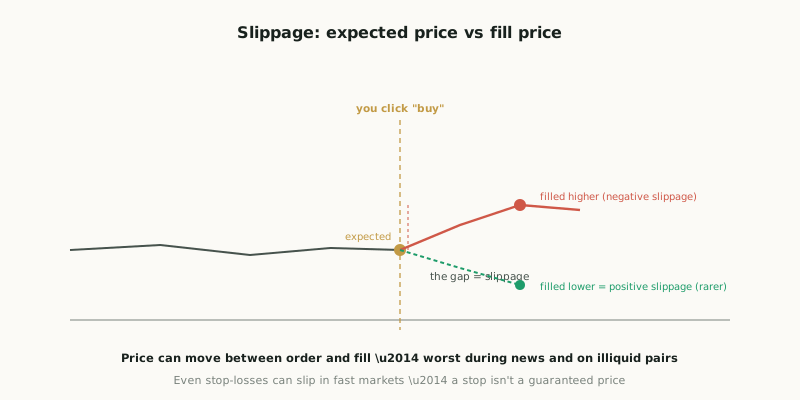
A: Slippage is the difference between the price you expected (when you placed an order) and the price at which the order was actually filled. Negative slippage means a worse fill (a cost to you); positive slippage means a better one. It's caused by price moving in the moment between placing and executing the order.
Q: What causes slippage?
A: Slippage is caused by price moving in the brief time between placing an order and its execution, and by limited liquidity at the requested price. It's most common and largest during fast-moving markets (such as major news releases) and on illiquid pairs or quiet trading times.
Q: Can a stop-loss slip?
A: Yes. In a fast-moving or gapping market, a stop-loss can be filled at a worse price than its level — it triggers a market order that fills at the next available price, which may be beyond your stop. So a stop is not a guaranteed exit price, unless you use a (usually paid) guaranteed stop.
Execution and slippage
When you place a market order, you're asking to trade now at the best available price — and execution is the process of that order actually being filled. The key reality is that the fill price may differ from the price you saw when you clicked, because in the brief moment between placing the order and its execution, the market can move, and the price you actually get is whatever is available at the instant of the fill. This isn't a glitch; it's the nature of a live, constantly-moving market where prices change continuously and your order takes a small but non-zero time to reach the market and execute.
Slippage is precisely this difference — the gap between the price you expected (when you placed the order) and the price at which it was actually filled. Slippage can go either way. Negative slippage means you were filled at a worse price than expected (you paid more buying, or received less selling) — a cost to you, and the more common concern. Positive slippage means you were filled at a better price than expected — it does happen, though traders notice the negative kind more. In normal, liquid conditions slippage is usually small (a fraction of a pip, or none at all), and it's simply part of how real execution works. It's worth distinguishing slippage from a requote: on some "instant execution" systems, if the price has moved when your order arrives, the broker offers you a new price to accept or reject (a requote) rather than filling with slippage; on "market execution" systems, the order simply fills at the available price (with possible slippage) rather than requoting. Either way, the underlying reality is the same — in a moving market, the price you get may not be exactly the price you saw.
What causes it — and why stops can slip
Slippage is caused by two related factors: price movement in the time between your order and its execution, and limited liquidity at your requested price. When the market is moving fast, the price can change meaningfully in the split second your order takes to fill, producing slippage. When liquidity is thin (not enough orders available at your exact price), your order fills at the next available prices, which may be worse. Both factors are worst in the same conditions: fast-moving, volatile markets — above all around major news releases (where prices can leap and liquidity briefly vanishes, causing large slippage) — and on illiquid pairs or quiet times (exotic pairs, or the low-liquidity hours between sessions), where thin liquidity means worse fills. In calm, liquid conditions (major pairs, active sessions, no news), slippage is typically minimal; in volatile or illiquid conditions, it can be significant. This is a key reason the news-trading guide warns against trading the moment of major releases — slippage (and spread-widening) then is at its worst.
This catches many beginners out. A stop-loss triggers a market order when price hits your level — and in a fast or "gapping" market, that order can fill beyond your stop, at a worse price. So your stop defines where you try to exit, not a guaranteed exit price; in violent moves (often around news, or on a weekend gap), the actual loss can exceed what the stop level implied. Stops are still essential — they work well in normal conditions and are vital risk control — but don't assume they're a perfect guarantee. (Some brokers offer guaranteed stops, which do guarantee the price, usually for an extra fee.)
Managing slippage as a beginner
Slippage is an unavoidable part of real trading, but it's manageable with the right awareness and habits. First, accept that slippage is normal and usually small — don't be alarmed by minor differences between expected and actual fills in normal conditions; that's simply how live execution works, and it mostly evens out (with occasional positive slippage too). Second, be especially cautious around news and volatility — since slippage is worst then, this reinforces the wisdom of not trading the immediate moment of major releases, and of being aware that positions held through volatile events face slippage risk (on entries, exits and stops). Third, trade liquid pairs and active sessions for better execution — major pairs in busy sessions have deep liquidity and minimal slippage, while exotic pairs and quiet hours have more; sticking to liquid conditions (good general beginner advice anyway) reduces slippage. Fourth, don't expect exact fills — build a small allowance for slippage into your expectations rather than assuming you'll always get precisely the price you see. And fifth, remember stops can slip — size your risk with a little margin for the possibility that a stop fills slightly worse than its level, especially if holding through volatile periods or weekends (when gaps can occur).
A final, important point connects slippage to realistic expectations: backtests and demo accounts often hide slippage. A backtest may assume perfect fills at exact prices, and a demo account may fill you flawlessly — neither fully captures the slippage (and spread-widening) of real, live trading with real money in real conditions. This is one reason demo results and backtests can flatter a strategy: real execution is slightly worse than idealised fills, so live results often fall a little short of demo or backtested ones. Being aware of this keeps your expectations grounded when you move from demo or backtesting to live trading (the demo-vs-live guide makes the broader point). The honest, beginner-friendly takeaway: slippage — the gap between your expected and actual fill price — is a normal, usually small part of real trading, caused by price moving and liquidity limits, and worst around news and on illiquid pairs. Even stop-losses can slip, so a stop isn't a guaranteed price. Manage it by accepting it as normal, being cautious around volatility, trading liquid pairs and sessions, not expecting exact fills, and allowing a little margin on stops — and remember that backtests and demos often hide it, so live results may differ slightly. Realistic expectations about execution are part of trading the real market, not the idealised one.
Slippage and your choice of order
One practical lever you have over slippage is your choice of order type (from the order-types guide), because different orders behave differently. A market order prioritises certainty of execution over price: it fills now, at whatever's available — so it will always get you in or out, but is exposed to slippage (you take the going price, good or bad). A limit order does the opposite: it fills only at your specified price or better, so it cannot suffer negative slippage — you either get your price (or an improvement) or you don't trade at all. The trade-off is that a limit order may not fill if the market never reaches your price, or moves away too fast. So limit orders give you price control at the cost of possible non-execution, while market orders give you certain execution at the cost of possible slippage.
This gives you a choice depending on what matters more for a given trade. If getting filled is essential (you need to be in, or urgently out), a market order ensures it, accepting slippage risk. If a specific price matters more than certainty of filling (you'd rather not trade than trade at a worse price), a limit order protects you from negative slippage. Stop orders (including stop-losses), importantly, behave like market orders once triggered — they fill at the next available price, so they can slip (the key warning above). This is worth bearing in mind: while you can use limit orders to control entry price, your protective stop will still fill at market when hit, with possible slippage in fast conditions. Understanding how each order type relates to slippage lets you make deliberate choices — using limit orders where price precision matters and you can tolerate a missed fill, and accepting that market and stop orders trade slippage risk for execution certainty. It's a modest but real degree of control over the otherwise unavoidable reality of slippage.
Slippage is the difference between your expected price and your actual fill — negative (worse, a cost) or positive (better, rarer). It's caused by price moving between order and execution, and by limited liquidity, and is worst in fast/volatile markets (especially major news) and on illiquid pairs/quiet times; in calm liquid conditions it's minimal. Crucially, a stop-loss isn't a guaranteed price — in a fast or gapping market it can fill beyond your level (guaranteed stops, for a fee, excepted). Your order choice matters: market orders guarantee execution but risk slippage; limit orders fill only at your price or better (no negative slippage) but may not fill; stop orders fill at market when triggered, so they can slip. Manage it: accept it as normal, be cautious around news/volatility, trade liquid pairs and sessions, don't expect exact fills, allow margin on stops. Backtests and demos often hide slippage, so live results can fall slightly short — keep expectations realistic.