
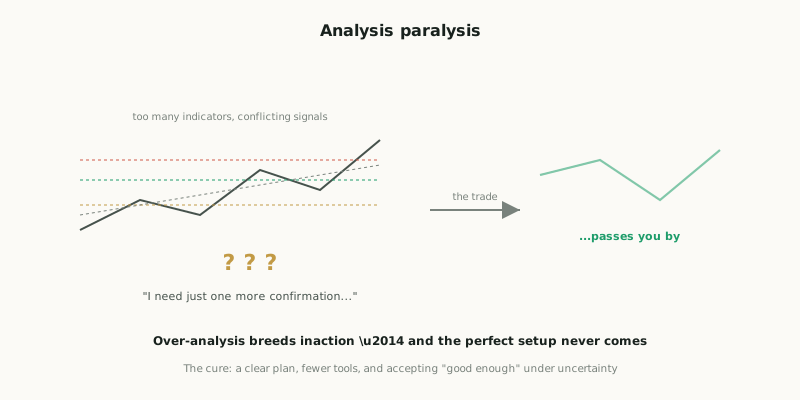
More information should mean better decisions — until it doesn't. When the indicators pile up, the signals start conflicting, and you keep hunting for just one more confirmation, the result isn't a better trade; it's analysis paralysis: the setup passes by while you deliberate, and the "perfect" entry you were waiting for never quite arrives. It's a common affliction, especially for beginners and perfectionists, and the cure is counterintuitive — not more analysis, but less, paired with a clear plan and an acceptance of uncertainty. This guide explains analysis paralysis: what it is, what causes it, what it costs, and how to overcome it.
It's intimately tied to dealing with uncertainty (the root cause is the impossible wish for certainty), cured largely by discipline and a plan, and distinct from healthy patience.
Key takeaways
Q: What is analysis paralysis in trading?
A: Analysis paralysis is being so overwhelmed by analysis, information or conflicting signals that you can't make a decision or pull the trigger on a trade. Over-analysing leads to hesitation and inaction, so valid setups pass by unacted-upon while you keep seeking more confirmation that never feels sufficient.
Q: What causes analysis paralysis?
A: Information overload (too many indicators and sources, often conflicting), fear of being wrong or of losing, perfectionism (wanting certainty or the perfect entry), the lack of a clear trading plan (so every decision is agonised from scratch), and the impossible desire for certainty in an inherently uncertain market.
Q: How do you overcome analysis paralysis?
A: Accept that trading is probabilistic and certainty is impossible, build a clear plan with defined entry rules so you act when criteria are met, simplify to a few well-chosen tools to avoid conflicting-signal overload, accept 'good enough' setups rather than hunting for perfection, and practise decisive execution at small size.
What analysis paralysis is
Analysis paralysis is being so overwhelmed by analysis, information or conflicting signals that you can't make a decision or pull the trigger on a trade. It's over-analysing to the point of inaction — the mind, swamped with data and "what ifs," freezes rather than acting. The symptoms are recognisable: piling on too many indicators and tools (which inevitably give conflicting signals, since no two agree perfectly); an endless search for "more confirmation" before entering; hesitation and a fear of pulling the trigger; missing trades that actually fit your plan because you couldn't commit; chronic second-guessing; never feeling "ready"; and waiting for the "perfect" setup that, of course, never comes. The trader caught in it watches good opportunities pass, then often watches them work out exactly as their analysis suggested — a frustrating, confidence-eroding experience.
It's worth distinguishing analysis paralysis from healthy patience (the patience guide). Patience is waiting for a valid setup that meets your criteria — a virtue. Analysis paralysis is failing to act on a setup that does meet your criteria — a problem. The patient trader waits, then acts decisively when the conditions are met; the paralysed trader's conditions are met, but they still can't act, hunting for ever more confirmation. So paralysis isn't about being selective or disciplined; it's about an inability to commit even when your own rules say "go." It can also, ironically, flip into its opposite: a trader frustrated by repeated inaction sometimes lurches into impulsive overtrading (the overtrading link), swinging from too cautious to too reckless. Both are failures of disciplined decision-making.
What causes it (and what it costs)
Several intertwined causes drive analysis paralysis. Information overload: too many indicators, charts, timeframes and sources, generating a flood of (often conflicting) signals that the mind can't resolve into a clear decision — more inputs past a point create more noise, not more clarity. Fear: fear of being wrong, or of losing money, makes pulling the trigger feel dangerous, so hesitation sets in (better to not act than to act and be wrong, the anxious mind reasons). Perfectionism: the wish for the perfect entry, or for certainty before committing — a setup with no doubt attached. Lack of a clear plan: without pre-defined rules, every decision must be agonised over from scratch, with no framework to resolve it — a recipe for paralysis. And underlying all of these, the impossible desire for certainty in an inherently uncertain domain (the dealing-with-uncertainty link): the paralysed trader is, fundamentally, trying to achieve a certainty that markets can never offer.
The cost of analysis paralysis is real and double-edged. The obvious cost is missed opportunities — the trade passes while you deliberate, so valid, plan-conforming setups go untaken, and an edge you can't act on is worthless. The subtler cost is that over-analysis doesn't even improve outcomes beyond a point: because markets are irreducibly uncertain, no amount of additional analysis delivers the certainty the paralysed trader seeks — past a reasonable threshold, more analysis just adds noise, confusion and delay without making decisions any better (and often makes them worse, as conflicting signals muddy a once-clear read). There's also a psychological cost: the stress, frustration and eroding confidence of repeatedly freezing and watching trades pass. So analysis paralysis is doubly self-defeating: it costs you the trades and the extra analysis it's built on doesn't help. Recognising this — that beyond a point, more analysis is not a path to better decisions but to no decisions — is the key to the cure.
How to overcome it
The root of analysis paralysis is seeking certainty in a domain that offers none. Trading is probabilistic: you can never be certain, never have "enough" confirmation, never find the perfect setup — because the perfect, certain setup doesn't exist. Waiting for certainty means waiting forever. The cure is to aim for good decisions under uncertainty, not perfect ones: a setup that meets your defined criteria is a good enough reason to act, and acting on good-enough setups (with risk controlled by a stop) is exactly what skilled trading is. Accept uncertainty, accept "good enough," and act.
From that core insight flow the practical cures. The biggest is a clear, defined trading plan with specific rules: when your pre-defined entry criteria are met, you act — the decision is made in advance, calmly, so you're not agonising from scratch in the moment. A good plan converts "should I take this?" into "do the criteria say yes?" — a far less paralysing question, and the single most effective fix. Next, simplify: use fewer, well-chosen indicators and tools, so you're not drowning in conflicting signals — a clean, simple setup (a couple of tools you trust) beats a cluttered chart screaming contradictions, and dramatically reduces the overload that feeds paralysis. Embrace "good enough" (satisficing): accept a setup that meets your criteria rather than hunting for the mythical perfect one. Reframe the fear of loss: accept that taking some losers (and missing some trades) is a normal cost of trading, and that a stop caps each loss — which defuses the fear of being wrong that drives the hesitation. And practise decisive execution: like any skill, pulling the trigger gets easier with practice — trading in demo or at small size builds the habit of acting on valid setups, breaking the freeze.
One balancing note: this is not an argument against analysis. You do need to analyse, to have a basis for trades — the point is that there's a threshold beyond which more analysis stops helping and starts paralysing. The skill is doing enough analysis to make a sound, plan-based decision, then acting — not endlessly seeking the certainty that more analysis can never provide. The honest framing: analysis paralysis is over-analysis causing inaction — missed trades, stress, and no better decisions — rooted in fear, perfectionism and the impossible wish for certainty. The cure is a clear plan with defined rules (act when criteria are met), simplification (fewer tools, less conflicting noise), accepting uncertainty and "good enough," reframing the normal cost of losses, and practising decisive execution. Aim to make good decisions and act on them, rather than chasing a perfect certainty that markets will never give. Decisiveness, grounded in a plan, is the antidote to the freeze.
Finding the balance: analysis versus action
Since the cure for analysis paralysis is "less analysis," it's worth being clear about the balance — because the answer is not "no analysis," and swinging to the opposite extreme (impulsive, analysis-free trading) is its own failure. The goal is the right amount: enough analysis to make a sound, plan-based decision, and then action. Every trader has a threshold beyond which additional analysis stops adding clarity and starts adding doubt, delay and conflicting noise. The skill is learning where your threshold is — the point at which you've checked what your plan requires and further staring at the chart is just feeding the wish for certainty. A defined plan helps locate that threshold precisely: once your specified criteria are checked and met, you've done enough; more is procrastination.
A useful test for distinguishing healthy diligence from paralysis is to ask why you're still analysing. If you're working through your plan's checklist — confirming the setup meets your criteria — that's diligence, and it should reach a clear conclusion. If you're hunting for additional confirmation beyond your criteria, re-checking what you've already checked, or waiting to feel certain rather than to meet your rules, that's paralysis — the search for a certainty that doesn't exist. Diligence converges on a decision; paralysis never does, because no amount of evidence satisfies the underlying need for certainty. The practical discipline, then, is to define what "enough" looks like in advance (your criteria/checklist), do that analysis, and the moment it's complete, commit — treating the urge to keep analysing past that point as the bias to resist. Confidence in this comes from trusting your plan rather than your in-the-moment feelings: the plan, built calmly, already decided what a good trade looks like, so the live decision is just checking the boxes and acting. Balanced this way — diligent but decisive, analysis bounded by a plan — you avoid both the paralysis of endless analysis and the recklessness of none.
Analysis paralysis is over-analysing to the point of inaction — overwhelmed by too many (conflicting) indicators and an endless search for "more confirmation," you hesitate and miss valid setups. It's distinct from healthy patience (which waits for a valid setup, then acts): paralysis fails to act even when your criteria are met. Causes: information overload, fear of being wrong, perfectionism, no clear plan, and the impossible wish for certainty in an uncertain market. It costs missed trades and doesn't improve decisions (more analysis past a point is just noise). Cure: accept that trading is probabilistic (aim for good decisions, not perfect ones), build a plan with defined rules (act when criteria are met), simplify to a few tools, accept "good enough," reframe losses as a normal capped cost, and practise decisive execution. Analyse enough, then act.