
Discipline isn't willpower heroically summoned in the heat of the moment — it's built into habits beforehand, so that the right thing happens almost automatically. A trading routine is that scaffolding: a consistent cycle of preparation, execution, review and rest that turns good intentions into repeatable behaviour, reduces emotion's grip on your decisions, and supports a sustainable approach. Every high-performer in demanding fields — athletes, surgeons, pilots — relies on routine, and trading is no different. This guide explains building a trading routine: why it helps, the components of a good one, and how it underpins the discipline, consistency and wellbeing that good trading requires.
It's the practical scaffolding for discipline, incorporates the trading journal in its review phase, and supports sustainable, healthy trading through its rest and boundaries.
Key takeaways
Q: What is a trading routine?
A: A trading routine is a consistent, structured set of habits and processes around your trading — typically a cycle of preparation (before trading), execution (trading the plan), review (journaling and learning), and rest. It brings discipline and consistency, reduces impulsive and emotional decisions, and supports a sustainable approach.
Q: Why does a trading routine help?
A: It builds consistency (a repeatable process means consistent execution of your edge), reinforces discipline (structure counters impulsiveness), reduces decision fatigue (good habits become automatic), ensures preparation and built-in review for improvement, and — with defined hours and rest — supports wellbeing and guards against overtrading.
Q: What should a trading routine include?
A: Preparation (reviewing markets, the economic calendar, identifying setups and your plan, and checking your own state), execution (trading the plan and managing risk without impulsive deviation), post-trade review (journaling trades and noting lessons), rest between sessions, and periodic broader reviews of your performance and process.
Why a routine helps
A consistent routine helps in several reinforcing ways, all of which serve the disciplined, process-focused trading this site advocates. First, consistency: a repeatable process means you execute your edge consistently — a trading strategy only works if applied reliably over many trades, and a routine ensures you apply it the same way each time, rather than improvising differently each day. Second, discipline: structure counters impulsiveness. When trading follows a set process, there's far less room for the emotional, impulsive decisions (revenge trades, FOMO entries, abandoning the plan) that wreck results — the routine is the channel that keeps behaviour disciplined. Third, reduced decision fatigue: routines automate good habits, so you're not expending willpower deciding whether to journal, check the calendar, or follow your rules — they're simply what you do, freeing mental energy for the decisions that matter.
Fourth, preparation: a routine ensures you come to each session ready — aware of the day's events, your setups, and your plan — rather than reacting blindly. Fifth, built-in review and improvement: a routine bakes in reflection (journaling, reviewing), which is how a trader actually improves over time, rather than repeating the same mistakes. And sixth, wellbeing and sustainability: a routine with defined hours and rest protects you from the 24/7 over-engagement that leads to overtrading and burnout (the stress-and-burnout link) — it builds in boundaries and recovery. In short, a routine is how discipline becomes habit: it's the practical mechanism that converts the good intentions everyone has ("I'll be disciplined, I'll follow my plan, I'll manage risk") into the consistent behaviour that actually produces those things. Intentions without a routine tend to dissolve under emotional pressure; a routine holds them in place.
The components of a routine
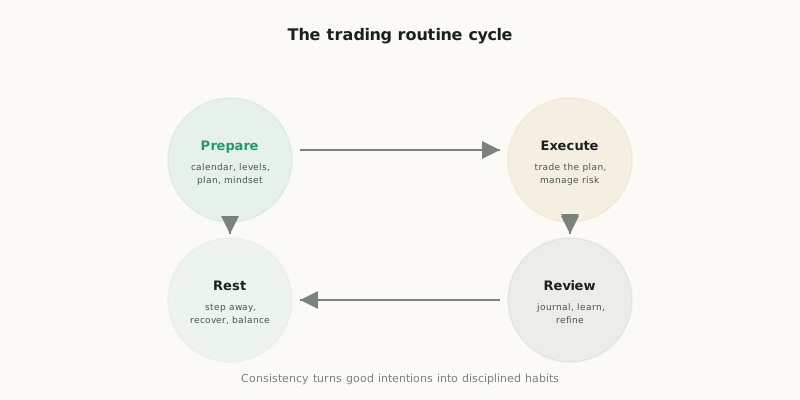
A good trading routine cycles through four phases — prepare, execute, review, rest — plus periodic broader review. The table outlines them.
The phases of a trading routine
Preparation (before trading) sets you up for the session: review the markets and conditions, check the economic calendar for the day's events (so you're not blindsided — the economic-calendar material), identify your setups and key levels, define your plan for the session, and — importantly — check your own mental and physical state (am I rested, calm and fit to trade today, or stressed, tired and likely to make poor decisions?). A pre-trade checklist is a powerful tool here, enforcing that each step is done and that a trade meets all your criteria before you take it. Execution (during) is straightforward in principle: trade the plan, follow your rules, manage positions and risk per your plan, avoid impulsive deviations, and take breaks to stay fresh. The discipline here is to execute the decisions made in preparation, not to improvise new ones under live pressure.
Review (after trading) is where improvement happens: journal your trades (the trading-journal link — recording what you did and why), review what went well and badly in terms of process (not just profit and loss), and note lessons for next time. This reflective step is what turns experience into learning rather than mere repetition. Rest (between sessions) is genuinely part of the routine, not an absence of it: step away, don't overtrade, recover, and maintain balance — protecting your energy and judgement (the wellbeing link). And a periodic broader review (weekly or monthly) of your overall performance and process keeps you on track at a higher level. Practically, a good routine also includes defined trading hours (not a constant vigil), a clean environment with minimised distractions, and consistent habits — the conditions that make disciplined execution easier. The exact shape should be tailored to your style (a scalper's routine differs from a swing trader's), but the principle is universal: have a routine, and follow it. The honest framing: a consistent routine — prepare, execute the plan, review and journal, rest — is the practical scaffolding that builds the discipline and consistency good trading requires, reduces impulsive and emotional decisions, drives improvement through review, and supports wellbeing through boundaries and rest. It's how the abstract virtues this site preaches (discipline, consistency, process focus) become concrete daily behaviour. Build a routine that fits you, and the disciplined trading that's so hard to summon by willpower alone starts to happen by habit instead.
Building and keeping your routine
Knowing the components is one thing; actually building a routine you'll stick to is another. The best advice is to start simple. A routine you'll actually follow beats an elaborate one you abandon after a week, so begin with the essentials — a brief pre-trade preparation (check the calendar, mark your levels, note your plan and your state), disciplined execution of that plan, and a short post-session journal entry — and let it grow from there. An over-engineered routine with a dozen steps is itself a source of friction and is easily dropped; a lean, repeatable one becomes a habit. Once the simple version is genuinely habitual, you can add refinements (a more detailed checklist, a weekly review, pre-market analysis rituals) as they prove useful.
Second, tailor it to your style and life. A scalper's routine, built around intense focus during specific high-liquidity sessions, looks nothing like a swing trader's, which might involve a daily end-of-day review of charts and a few minutes' planning rather than hours at the screen. Your timeframe, your strategy, and the realities of your schedule (a full-time job, family commitments) should all shape the routine — a routine that ignores your actual life won't survive contact with it. The aim is a routine that fits, so that following it is natural rather than a constant battle against your circumstances. A particularly valuable component to build in early is a pre-trade checklist: a short, fixed list of conditions a trade must meet before you take it (the setup criteria, the risk defined, the calendar checked, your state acceptable). A checklist enforces discipline mechanically — it's much harder to take an impulsive, rule-breaking trade when you've committed to ticking every box first — and it directly counters the emotional, in-the-moment decisions that routines exist to prevent.
Third, keep it — and let it evolve. The benefit of a routine is cumulative: it's the consistency over hundreds of sessions, not any single day, that builds the discipline, the habit, and the body of journal data you learn from. So the real challenge isn't designing a routine but sticking to it, especially when emotions run high — ironically, the moments you're most tempted to skip your routine (after a big loss, during a hot streak, when you're rushed) are exactly when it protects you most. Commit to following it precisely because those are the moments discipline matters. At the same time, a routine isn't set in stone: through your periodic reviews, refine what isn't working and reinforce what is, so the routine improves alongside you. A routine that evolves with your experience stays relevant; one frozen in place can become stale. The honest, practical summary: build a simple routine tailored to your style (anchored by a pre-trade checklist), make following it a non-negotiable habit — most of all in emotional moments — and let it evolve through periodic review. Done this way, the routine quietly does what willpower alone can't: it makes disciplined, consistent, sustainable trading your default, day after day. That default, compounded over time, is worth more than any single clever decision.
A trading routine is a consistent cycle of prepare → execute → review → rest (plus periodic broader review) that turns good intentions into disciplined habits. It helps by building consistency (reliable execution of your edge), reinforcing discipline (structure counters impulsiveness), reducing decision fatigue (good habits become automatic), ensuring preparation and built-in review for improvement, and supporting wellbeing (defined hours and rest guard against overtrading and burnout). Components: prepare (markets, calendar, setups, plan, your own state — ideally a checklist), execute (trade the plan, manage risk, no impulsive deviation), review (journal trades, note process lessons), rest (step away, recover, balance), plus periodic performance reviews. Tailor it to your style, but have one: a routine is how discipline becomes habit rather than a willpower struggle in the moment.