Trading asks a lot of you: financial risk, constant uncertainty, an emotional rollercoaster, and hours in front of screens making decisions. Left unmanaged, that strain doesn't just stay constant — it builds, and can tip into burnout, a state of exhaustion and depleted motivation in which decisions get worse and trading stops being sustainable (or healthy). Looking after yourself — your stress, your rest, your wellbeing — isn't a soft afterthought to trading; it's part of trading well, and part of trading for the long run rather than burning out. This guide covers trading stress and burnout: why trading is stressful, the warning signs to watch for, and the healthy practices that keep it sustainable. Throughout, the spirit is supportive: your wellbeing comes first, and no trade is worth your health.
It connects closely to handling losses (a major stressor), to sound risk management (the biggest stress-reducer of all), and to a sustainable routine.
Key takeaways
Q: Why is trading stressful?
A: Trading involves financial risk and the possibility of loss, constant uncertainty, an emotional rollercoaster of wins and losses, long hours of screen time, pressure to perform, and continuous decision-making — often in isolation. Left unmanaged, this strain can build into chronic stress and burnout, which in turn worsens decision-making.
Q: What are the warning signs of trading burnout?
A: You might notice persistent exhaustion, difficulty concentrating, irritability, loss of motivation, sleep problems, trading feeling like a joyless grind, neglecting your health or relationships, or stress-driven revenge trading and overtrading. These are signs to step back and take care of yourself, not to push harder.
Q: How do you manage trading stress?
A: Sound risk management (trading within your means) removes much stress at its root; alongside that, keep realistic expectations, take regular breaks and rest, maintain work-life balance and physical health, follow a routine with boundaries, and lean on support from others. If stress is harming your wellbeing, step back and seek help from a professional.
Why trading is stressful
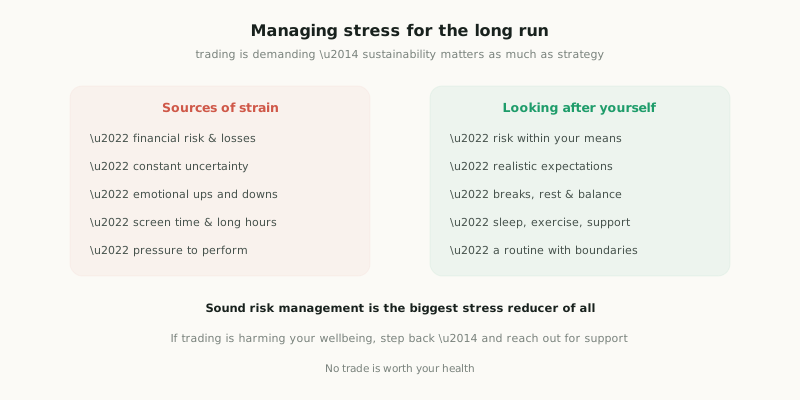
It helps to acknowledge plainly that trading is inherently stressful — this isn't a personal failing but a feature of the activity. The sources of strain are real and numerous: financial risk and the genuine possibility of loss (money is emotive, and risking it is stressful); constant uncertainty (you never know what the market will do, and living with that ambiguity is taxing — the dealing-with-uncertainty link); the emotional rollercoaster of wins and losses (the ups and downs wear on you); screen time and long hours (staring at charts, often for extended periods, is fatiguing); pressure to perform (especially if trading matters financially); the continuous decision-making (decision fatigue is real); and often isolation (trading is frequently solitary). Any one of these is demanding; together, sustained over time, they add up.
When this stress becomes chronic and unmanaged, it can lead to burnout — a state of physical and emotional exhaustion, with loss of motivation and focus, cynicism, and declining performance. Burnout matters for two reasons. First, and most importantly, for your wellbeing: chronic stress and exhaustion are genuinely harmful to your health and quality of life, full stop. Second, for your trading: a stressed, exhausted, burnt-out trader makes worse decisions — more emotional, more impulsive, less disciplined — which can create a vicious cycle (stress leads to poor decisions, which lead to losses, which create more stress). So managing stress isn't only about feeling better; it's also about decision quality and sustainability. The trader who burns out cannot trade well, and may not be able to trade at all — which is why looking after yourself is not separate from trading well, but part of it.
Recognising the warning signs
It's worth gently knowing the warning signs that stress may be tipping toward burnout — not to self-diagnose or to worry, but so you can notice early and take care of yourself. You might notice some of the signs in the table; if several resonate, it's a cue to step back and look after yourself, not to push harder.
Warning signs and healthy responses
You might notice persistent exhaustion (tired even after rest), difficulty concentrating, irritability, a loss of motivation, sleep problems, trading starting to feel like a joyless grind rather than something you chose, neglecting your health or relationships for trading, anxiety about trading, or stress spilling into revenge trading and overtrading (acting out of frustration — the revenge-trading and tilt links). None of these is a diagnosis, and noticing one on a hard day is normal; but if several persist, they're a gentle signal that something needs to change. The healthiest response to these signs is not to grind through them or trade harder — that deepens the cycle — but to step back, rest, and take care of yourself. Recognising the signs early, with self-compassion rather than self-criticism, is what lets you address stress before it becomes burnout. And, importantly: if you find that stress, anxiety, or low mood related to trading is seriously affecting your wellbeing or mental health, please step away from trading and seek support from a professional — a doctor or mental health professional. Trading is never worth your health, and reaching out for help is a sign of strength, not weakness.
Healthy practices for sustainable trading
The good news is that trading stress is highly manageable, and a sustainable, healthy approach is entirely achievable. The most powerful lever is, perhaps surprisingly, sound risk management: trading within your means — never risking money you can't afford to lose, never over-leveraging — removes an enormous amount of stress at its root, because much trading stress comes from having too much at risk. When your position sizes are sensible and a loss won't hurt your life, the emotional weight of each trade drops dramatically. This is why the site's recurring emphasis on prudent sizing and avoiding overleverage is also, quietly, advice for your wellbeing: it's the single biggest stress-reducer there is. Alongside it, realistic expectations help — accepting that losses and drawdowns are a normal, expected part of trading (the handling-losses link) takes much of the stress out of them, since they're no longer experienced as failures or surprises.
Beyond these, ordinary self-care matters as much for traders as for anyone in a demanding pursuit. Take breaks and rest: step away from the screens, especially after losses or when you feel tilt rising; don't trade exhausted; take time off — the markets will still be there. Maintain work-life balance: have a life, relationships, and interests outside trading; trading shouldn't be everything, and a rich life outside it is protective. Look after your physical health: sleep, exercise and good nutrition genuinely support better decision-making and resilience to stress — the basics matter. Keep a routine with boundaries: defined trading hours rather than a 24/7 vigil (the routine link) protect your time and energy. Stay connected: talk to others — a trading community, friends, family — to counter the isolation and share the load. And, to repeat the most important point: if trading is harming your wellbeing, it's entirely right to step back, and to seek support from a professional if you're struggling. The honest, caring framing: trading is demanding and stress is real, but burnout is not inevitable — sound risk management (the root-cause fix), realistic expectations, rest, balance, physical health, a bounded routine, and support keep trading sustainable and healthy. A rested, balanced trader makes better decisions and lives better; a burnt-out one does neither. Look after yourself first — it's the foundation everything else is built on.
Recovering and resetting
If you do recognise that stress has built up — that you're frazzled, exhausted, or that trading has stopped feeling sustainable — the kind and effective response is to recover, not to grind on. The most important step is often the simplest and hardest: take a genuine break. Stepping away from trading for a while — a few days, a week, longer if needed — lets you rest, gain perspective, and let the stress dissipate, and the markets will still be there when you return. There's no prize for trading through exhaustion; pushing on while burnt out tends only to produce poor decisions and deeper strain. Giving yourself permission to stop for a time is a sign of good self-management, not weakness, and it's frequently exactly what's needed to reset.
When you do return, doing so gradually helps: resuming at a smaller size, easing back into your routine, and rebuilding confidence and rhythm rather than diving straight back into full intensity. It's also worth using a reset as a chance to address the sources of the stress — if over-large positions were the root (as they often are), returning with more conservative sizing removes much of the strain at its source; if a lack of balance or rest was the issue, building those into your routine going forward protects you. Recovery isn't only about resting from the stress but about adjusting so it doesn't simply rebuild. And to repeat the most important point, gently but clearly: if the stress, anxiety or low mood runs deeper than ordinary tiredness — if it's affecting your sleep, your relationships, your health, or your sense of wellbeing in a serious or lasting way — please treat that as a reason to step back from trading and to reach out for support from a doctor or mental health professional. That's not a trading decision; it's a wellbeing one, and your health comes first, always. Trading is something you do; it should never become something that harms you. Approached with this care — resting when you need to, returning gradually, fixing the root causes, and seeking help if you're struggling — the occasional bout of stress need not become burnout, and trading can remain something sustainable and, ideally, something you continue to find worthwhile.
Trading is inherently stressful — financial risk, uncertainty, emotional swings, screen time, pressure — and unmanaged stress can build into burnout (exhaustion, lost motivation, worse decisions, a vicious cycle). Gently watch for warning signs (persistent exhaustion, poor focus, irritability, sleep problems, a joyless grind, neglecting health, stress-driven trading); if several persist, step back and care for yourself rather than pushing harder. Manage it with: sound risk management (trading within your means is the biggest stress-reducer of all), realistic expectations, regular breaks and rest, work-life balance, physical health (sleep, exercise), a routine with boundaries, and support from others. Most importantly, if trading is seriously affecting your wellbeing or mental health, step away and seek support from a professional. No trade is worth your health — looking after yourself is part of trading well, and lasting.