
Tilt is the state where emotion hijacks your judgement and your good rules go out the window. Borrowed from poker, the term describes the moment when frustration, anger or stress so degrade your decision-making that you start trading impulsively, abandoning the plan you would calmly follow in a clear state of mind. Tilt is where much of the real damage in trading happens — not from any single loss, but from the cascade of bad decisions that an emotionally compromised trader makes. The crucial truth is that you cannot stop yourself from feeling emotions; what you can learn is to recognise tilt and step away before it drives a decision you will regret. This guide explains what tilt is, what triggers it, how to recognise it, and how to control it.
It is the broader emotional-state version of the dynamics in handling losses and revenge trading, and it relies on the discipline systems covered elsewhere.
Key takeaways
Q: What is tilt in trading?
A: Tilt, a term borrowed from poker, is a state of emotional, compromised decision-making where frustration, anger or stress degrade your judgement, leading to impulsive, rule-breaking trades. On tilt, traders abandon their plan, overtrade, revenge trade and over-risk, compounding their losses.
Q: How do you recognise tilt?
A: Recognising tilt requires self-awareness of its signs: feeling frustrated, angry or desperate after a loss or missed trade; the urge to immediately 'win it back'; trading faster or larger than usual; and ignoring your rules. Noticing these emotional and behavioural signals is the first step to stopping tilt.
Q: How do you control tilt?
A: Use circuit breakers — predefined rules to stop, such as a maximum number of losses per day or stepping away after a big loss. Combine these with cooling-off periods, walking away from the screen, and prevention through conservative sizing and realistic expectations. The goal is to stop emotion from driving decisions.
What tilt is
Tilt is a state of emotionally compromised decision-making — a condition in which strong emotions (frustration, anger, desperation, stress) so impair your judgement that you make poor, impulsive decisions you would never make when calm. The concept comes from poker, where a player "on tilt" plays recklessly after a bad beat, but it applies perfectly to trading. On tilt, the rational, plan-following trader is effectively hijacked by an emotional one who abandons the rules, chases losses, and acts on impulse rather than analysis.
The behaviours that flow from tilt are precisely the destructive ones covered elsewhere on this site: abandoning the plan, overtrading, revenge trading, over-risking, ignoring stops, taking impulsive trades. Tilt is, in a sense, the common emotional state underlying many of these specific destructive behaviours — the compromised condition from which they spring. This is what makes it so important: tilt is the mechanism by which a normal setback (a loss, a missed trade, a frustration) gets converted into a series of damaging decisions. Understanding tilt as a recognisable state — rather than just a collection of separate mistakes — is valuable, because it lets you address the root condition (the emotional compromise) rather than just the individual symptoms, and because a state is something you can learn to notice and interrupt.
Triggers and the spiral
Tilt is set off by triggers — events that provoke the emotional arousal that compromises judgement. The most common is a painful loss, especially a large or unexpected one, or a string of losses that accumulates frustration. Other triggers include a missed opportunity (watching a move you should have caught), being proven wrong (a bruise to the ego), and external stress unrelated to trading that lowers your emotional threshold. Any of these can push a trader from a calm, rational state into the compromised state of tilt.
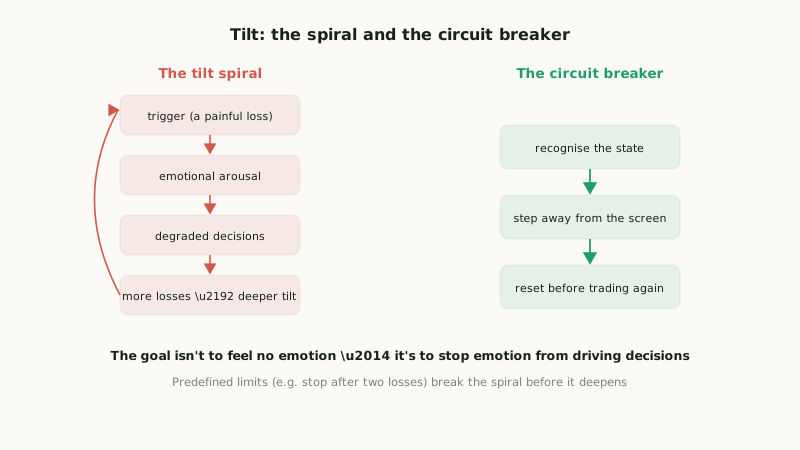
Once triggered, tilt tends to follow a self-reinforcing spiral: the trigger produces emotional arousal; the arousal degrades decision-making; the degraded decisions produce more losses; the losses deepen the emotional state; and round it goes, each loop intensifying the tilt and the damage. This spiral is the dangerous heart of tilt — it is why an emotionally compromised trader can do far more damage in a short period than any single bad trade, transforming one manageable trigger into a cascade of escalating losses. The spiral also explains why tilt is so destructive: it feeds on itself, with each emotion-driven loss providing fresh fuel for the next. Breaking this spiral — ideally before it gains momentum — is the central challenge of managing tilt, and it depends first on being able to recognise that you are on, or sliding into, tilt.
Recognising tilt
Because tilt compromises judgement, the most important and most difficult skill is recognising it — noticing that you are entering or in the tilted state, ideally early, before the spiral deepens. This is hard precisely because tilt impairs the very self-awareness needed to detect it; the emotionally compromised mind does not readily admit it is compromised. Developing the habit of self-monitoring — checking in on your emotional state, especially after triggers — is therefore a genuine skill that pays large dividends.
The signs of tilt are both emotional and behavioural. Emotionally: feeling frustrated, angry, desperate, anxious or vengeful, particularly after a loss or missed trade; a strong urge to "win it back" immediately; a sense of being keyed-up or out of control. Behaviourally: trading faster or more frequently than usual, increasing your size impulsively, ignoring or rationalising away your rules, taking setups you would normally skip, fixating on a single pair or recovering a specific loss. There may even be physical signs — tension, a racing heart, restlessness. Learning your own personal tilt signals — which emotions and behaviours signal that you are losing your calm — is invaluable, and the trading journal can help by recording your emotional state alongside your trades, revealing your patterns over time. The moment you can say to yourself "I am on tilt right now" is the moment you regain the power to interrupt it; recognition is the gateway to control.
You can't stop feeling emotions — the goal isn't to be a robot. The goal is to stop emotion from driving decisions: to recognise the tilted state and step away before you act on it. Recognition is the whole game — the moment you can say "I'm on tilt," you've regained the power to interrupt the spiral instead of feeding it.
Circuit breakers and control
The most effective tools for controlling tilt are circuit breakers — predefined rules that force you to stop, set in advance when you are calm so they bind you when you are not. The classic example is a daily loss limit or a maximum number of losing trades per day: after hitting it, you stop trading for the day, no exceptions. Because the rule is set in advance and is non-negotiable, it removes the in-the-moment decision (which a tilted mind would make badly) and physically prevents the spiral from compounding. Other circuit breakers include stepping away after a significant loss for a set cooling-off period, or stopping after any single trade that triggers strong emotion.
Beyond circuit breakers, cooling-off and stepping away are the core responses: when you recognise tilt, the most powerful action is simply to walk away from the screen — close the platform, take a break, go for a walk, do something else entirely — removing yourself from the situation until the emotional arousal subsides and your judgement returns. You cannot make good decisions while tilted, so the only good decision is to stop making decisions until you are calm. Simple emotional-regulation practices — deep breathing, a pause, a change of environment, restoring perspective — help the reset. And much tilt can be prevented: conservative position sizing means losses are smaller and less triggering; realistic expectations mean losses are less shocking; and the discipline systems and trading plan provide the structure that emotion erodes. The overarching goal, worth restating, is not to eliminate emotion — that is impossible and unnecessary — but to prevent emotion from driving decisions: to recognise the tilted state and remove yourself from trading until it passes. If you find that trading regularly provokes intense, hard-to-control emotions that affect your wellbeing or spill into the rest of your life, that is a sign to step back more substantially and, if needed, to seek support. Managing tilt well — recognising it, having circuit breakers, stepping away — protects both your account and your wellbeing, and it is one of the defining skills of a mature trader.
Routines and prevention
The best way to manage tilt is to reduce how often you reach it in the first place, and here routines and your overall state matter more than most traders realise. You bring your emotional condition to the screen, and a trader who sits down already stressed, tired, distracted or wound up is far more susceptible to tilt than one who arrives calm and centred. Trading well begins before the first trade, with the state you are in when you start.
A pre-trade routine helps establish the right state: a consistent process of preparation — reviewing the market, checking your plan, noting key levels and any news, and taking a moment to settle — that puts you in a calm, focused, deliberate frame of mind before you risk anything. This routine does double duty: it improves your analysis and it regulates your emotional state, lowering the baseline arousal that tilt feeds on. Equally important is honest self-assessment before trading: if you are exhausted, upset, stressed by something in your life, or otherwise not in a fit state, the wise choice is often not to trade that session at all. Recognising that you are not in a good state to trade, and stepping back, prevents tilt before it can start.
Broader life factors feed into this too. Adequate rest, managing external stress, and not trading at times when you are likely to be emotionally compromised all reduce your susceptibility to tilt. And the structural protections covered elsewhere — conservative position sizing (so losses are small and less triggering), realistic expectations (so setbacks are less shocking), and a solid trading plan with discipline rules — all lower the emotional stakes and the frequency of triggers. Prevention, in short, is about arriving in a good state, having routines that maintain it, and not trading when you are not fit to — which together mean you reach tilt far less often, and are better placed to recognise and interrupt it when you do. As always, if you find trading is regularly putting you in distressing emotional states that affect your wider wellbeing, that is a signal to step back more substantially and seek support; trading should be done from a stable footing, not in spite of an unstable one.
Tilt is a state of emotionally compromised decision-making — frustration, anger or stress degrading judgement into impulsive, rule-breaking trades. It's triggered by losses, missed trades, being wrong or external stress, and spirals (trigger → emotion → bad decisions → more losses). Recognising your signs is the key skill. Control it with circuit breakers (daily loss limits, stepping away) and cooling-off; prevent it with pre-trade routines, arriving in a good state, conservative sizing, and not trading when you're not fit to. The goal isn't to feel nothing, but to stop emotion driving decisions — and to seek support if trading emotions affect your wellbeing.