
The Gartley pattern is where harmonic trading began. Described by H.M. Gartley in his 1935 book — on the page that gave it the nickname "Gartley 222" — it is the original harmonic pattern, the one from which the entire family of Bats, Butterflies and Crabs later grew. A retracement pattern with a moderate, relatively shallow reversal zone, the Gartley is the natural starting point for understanding harmonic patterns, establishing the XABCD structure and Fibonacci-ratio logic that all the others build upon. This guide explains the Gartley's specific ratios, how to identify it, and how it is traded — in the same precise-but-honest spirit as the harmonic overview.
It is the founding member of the family introduced in harmonic patterns explained, built on the Fibonacci ratios covered elsewhere, and the natural precursor to the Bat.
Key takeaways
Q: What is the Gartley pattern?
A: The Gartley is the original harmonic pattern, described by H.M. Gartley in 1935. It has an XABCD structure in which the B point retraces 0.618 of the XA leg and the D point (the reversal zone) sits at 0.786 of XA — a retracement pattern where D falls within the XA range.
Q: What are the Gartley pattern's Fibonacci ratios?
A: In a Gartley, B retraces 0.618 of XA, C retraces between 0.382 and 0.886 of AB, and D completes at 0.786 of XA, with the CD leg often a 1.27 to 1.618 extension of BC. The defining ratio is the 0.786 D point, which gives the Gartley its moderate, shallow reversal zone.
Q: How do you trade the Gartley pattern?
A: You enter at the D point (the 0.786 reversal zone) in the pattern's direction — buying in a bullish Gartley, selling in a bearish one — ideally with reversal confirmation. The stop goes just beyond D, and targets are set at Fibonacci retracements of the move, giving defined risk and reward.
Gartley pattern profile
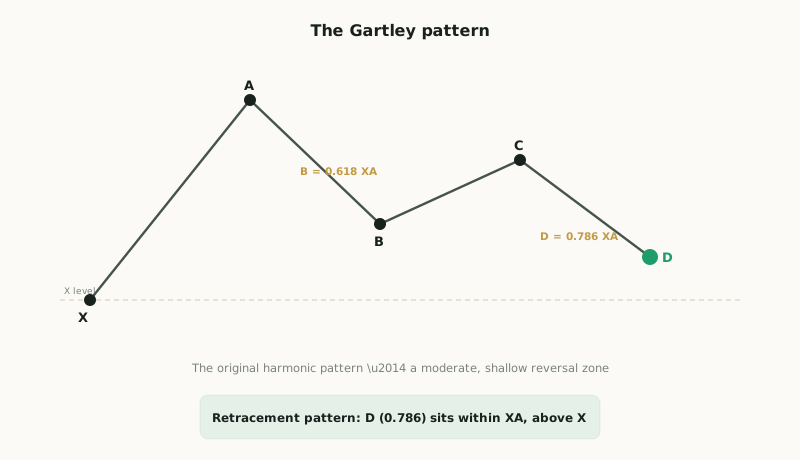
The defining ratios
The Gartley follows the standard XABCD structure, with its identity fixed by a specific set of Fibonacci ratios. The defining one is the D point at 0.786 of XA — the reversal zone completes at a 0.786 retracement of the initial XA leg. Because 0.786 is less than 1, D falls within the XA range (above X in a bullish pattern), which makes the Gartley a retracement pattern: the reversal zone sits inside the original move rather than beyond it. This is the key structural fact about the Gartley and the feature that distinguishes it from the extension patterns.
The other ratios complete the definition. The B point retraces 0.618 of XA — a deep, "golden ratio" pullback that is itself characteristic of the Gartley (and a key difference from the Bat, whose B is shallower). The C point retraces somewhere between 0.382 and 0.886 of the AB leg, and the CD leg typically extends 1.27 to 1.618 of BC, with the pattern often also satisfying an AB=CD relationship (the two legs roughly equal). When all these ratios align within tolerance, the structure qualifies as a Gartley. The combination — a 0.618 B and a 0.786 D — gives the Gartley its character: a balanced, moderate retracement pattern whose reversal zone (0.786) is relatively shallow, sitting comfortably within the XA range. Memorising the two headline ratios (B = 0.618, D = 0.786) is enough to recognise and distinguish the Gartley from its cousins.
Identifying a Gartley
Identifying a Gartley means finding an XABCD structure in price whose legs conform to these ratios. The process: locate a clear XA move, then a B that retraces close to 0.618 of it, a C that retraces 0.382-0.886 of AB (without exceeding A), and a projected D at 0.786 of XA where the CD leg completes. Modern charting tools and harmonic-pattern indicators can assist by automatically scanning for and measuring these ratios, though understanding the structure yourself is essential to judging quality.
Crucially — and consistent with the overview's caveats — the ratios will rarely be exact, so practitioners allow reasonable tolerances around the ideal values. This introduces the subjectivity the harmonic overview flags: judging whether a structure is "close enough" to a Gartley involves discretion, and there is a real risk of forcing the pattern onto price that does not genuinely fit (the pattern-seeking bias). A disciplined approach is to require the ratios to be reasonably close to ideal, to favour clean, clear structures over forced ones, and to treat marginal or distorted "patterns" with scepticism. The cleaner the XABCD structure and the closer its ratios to the ideal Gartley values, the more confidence the pattern warrants; messy, approximate structures that require generous tolerances to qualify are best passed over. Good identification — finding genuine, well-formed Gartleys rather than forcing the pattern — is the foundation of trading it well, and it is where discipline and honesty about what the chart actually shows matter most.
Trading the Gartley
Trading a Gartley follows the harmonic method set out in the overview, applied to this pattern's PRZ at 0.786. When a valid Gartley completes at D, the trader looks to enter in the pattern's direction — buying at D in a bullish Gartley (where the pattern points to an upward reversal) or selling at D in a bearish one — anticipating the reversal the pattern predicts. Best practice is to seek confirmation that price is actually reversing at the PRZ (such as a reversal candlestick pattern from the candlesticks guide), rather than entering blindly on the pattern's completion, since not every completed pattern reverses.
Risk and targets are defined precisely. The stop-loss goes just beyond the D point (beyond X, since D at 0.786 is within XA but a break past X would invalidate the pattern) — so if price continues through the reversal zone instead of turning, the loss is contained and the failed pattern is survivable. Targets are typically set at Fibonacci retracements of the move (commonly retracements of the AD or CD leg), giving defined profit objectives. The Gartley's relatively shallow 0.786 reversal zone means the stop (beyond X) is a bit further from entry than in the deeper Bat, so the reward-to-risk, while still definable, is generally less extreme than the deeper patterns offer. As always, the trade should respect the broader context (trading a bullish Gartley in an uptrend, or at a significant support level, adds confluence) and strict risk management — the Gartley, like every harmonic pattern, is a probabilistic tool that fails regularly, and the tight, defined stop beyond X is what keeps those failures manageable. Traded with confirmation, context and discipline, the Gartley offers a structured, rules-based reversal setup; treated as an infallible signal, it will disappoint like any single pattern.
Bullish and bearish Gartleys, and using context
The Gartley, like all harmonic patterns, comes in bullish and bearish forms that mirror each other. A bullish Gartley points to an upward reversal at D: the structure forms with X as a low, and D completes as a higher low (the 0.786 retracement) where the trader looks to buy, anticipating a move up. A bearish Gartley is the inverse: X is a high, and D completes as a lower high where the trader looks to sell, anticipating a move down. The ratios are identical in both cases; only the direction is flipped. Recognising both forms doubles the opportunities and lets the Gartley be applied in either market direction — the same XABCD geometry, read for an up-reversal or a down-reversal depending on its orientation.
The Gartley is also closely related to the simpler AB=CD pattern that underlies much of harmonic trading. The Gartley essentially contains an AB=CD structure within it (the AB and CD legs in proportion), with the additional XA leg and the 0.618/0.786 ratios layered on top to define the fuller pattern. Understanding this kinship helps: the Gartley is, in a sense, an AB=CD completion that also satisfies the broader XABCD Fibonacci relationships, which is why the two legs are often roughly equal. This nested structure is part of what gives the Gartley its balanced, harmonious character.
Above all, the Gartley works best when used with context and confluence rather than in isolation. A bullish Gartley completing at a level that is also a significant support level, or a 0.786 D that coincides with another Fibonacci level from a larger move, or a pattern forming in the direction of the higher-timeframe trend — each adds confluence that strengthens the setup. The harmonic overview's caveats apply fully: the Gartley is subjective to identify, its ratios rarely align perfectly, and it fails regularly, so it is at its most useful when its reversal zone aligns with independent evidence (support/resistance, trend, other Fibonacci levels) and when entry awaits confirmation. A Gartley standing alone, against the trend, with no confluence, is a weak setup however neat its ratios; a Gartley whose PRZ sits at major support, in line with the larger trend, confirmed by a reversal signal, is a strong one. Using the Gartley as one piece of a confluent picture — not as a standalone signal — is the disciplined way to trade it, consistent with the approach to every tool on this site.
The Gartley is the original harmonic pattern (H.M. Gartley, 1935), an XABCD retracement pattern defined by B at 0.618 of XA and D (the reversal zone) at 0.786 of XA — D sits within the XA range. It comes in bullish (buy at D) and bearish (sell at D) forms, and contains an AB=CD structure at its core. Identify clean patterns with near-ideal ratios (don't force it), trade the reversal at D with confirmation, stop just beyond X, target Fibonacci retracements. It's strongest with confluence — PRZ at support/resistance, in the trend's direction, aligned with other Fib levels. Like all harmonic patterns it's subjective and fails regularly, so use confirmation, context and strict risk management.