The Bat pattern is a refinement of the Gartley, developed by Scott Carney as part of his formalisation of harmonic trading. Like the Gartley it is a retracement pattern — D falls within the XA range — but it differs in two telling ways: a shallower B point and a deeper reversal zone at 0.886 of XA. That deep, precise PRZ, sitting close to the point where the pattern would fail, is the Bat's signature, and it allows an unusually tight stop — a feature that makes the Bat a favourite among harmonic traders for its favourable risk definition. This guide explains the Bat's ratios, how it differs from the Gartley, and how its deep reversal zone shapes the way it is traded.
It is the close cousin of the Gartley within the family from harmonic patterns explained, and a step toward the extension patterns like the Butterfly.
Key takeaways
Q: What is the Bat pattern?
A: The Bat is a harmonic retracement pattern, developed by Scott Carney, with an XABCD structure in which the B point retraces 0.382 to 0.50 of XA and the D point (the reversal zone) completes at 0.886 of XA — a deeper reversal zone than the Gartley's, sitting close to the X point.
Q: How does the Bat differ from the Gartley?
A: The main differences are the B and D points. The Bat has a shallower B (0.382-0.50 of XA versus the Gartley's 0.618) and a deeper D (0.886 versus 0.786 of XA). The Bat's deeper 0.886 reversal zone sits closer to X, which allows a tighter stop placed just beyond X.
Q: Why does the Bat allow a tight stop?
A: Because the Bat's D point completes at 0.886 of XA — very close to the X level — the stop-loss placed just beyond X is only a short distance from the entry at D. This proximity gives the Bat a tight, well-defined risk and often a favourable reward-to-risk ratio.
Bat pattern profile
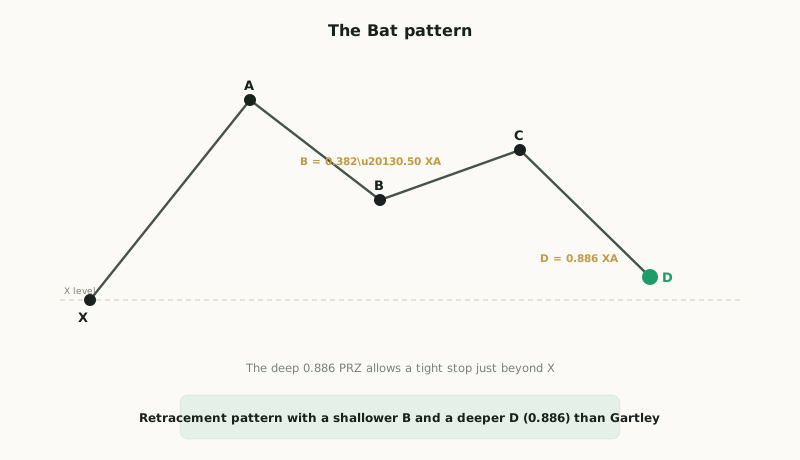
The defining ratios
The Bat shares the XABCD structure but has its own characteristic ratios. Its defining feature is the D point at 0.886 of XA — a deeper reversal zone than the Gartley's 0.786, completing closer to the X point. Like the Gartley, the Bat is a retracement pattern (0.886 is still less than 1, so D remains within the XA range, above X in a bullish pattern), but its D sits much nearer to X. This deep 0.886 reversal zone is the single most important fact about the Bat and the source of its distinctive character.
The other key ratio is the B point at 0.382 to 0.50 of XA — a shallower retracement than the Gartley's 0.618. This shallower B is the other main distinguishing feature: where the Gartley pulls back deeply to B (0.618), the Bat's B is more modest (0.382-0.50). The C point retraces 0.382 to 0.886 of AB (as in the Gartley), and the CD leg is typically a deeper extension of BC (often around 1.618 to 2.618) to reach the deep 0.886 D. The combination — a shallow B (0.382-0.50) and a deep D (0.886) — defines the Bat and sets it apart from the Gartley's deeper B (0.618) and shallower D (0.786). These two headline differences (shallower B, deeper D) are the essence of the Bat, and recognising them is how you tell a Bat from a Gartley on the chart.
How it differs from the Gartley, and why it matters
The Bat and Gartley are close cousins — both XABCD retracement patterns — so it is worth being clear on the differences and, more importantly, why they matter. The differences are the B and D points: the Bat's B is shallower (0.382-0.50 vs 0.618) and its D is deeper (0.886 vs 0.786). Visually, the Bat's reversal zone sits closer to X than the Gartley's, which is the practically significant consequence.
Why does this matter? Because the depth of D determines where the stop-loss sits and therefore the trade's risk. The stop in a harmonic pattern goes just beyond X (a break past X invalidates the pattern). In the Bat, the entry at D (0.886) is very close to X, so the stop just beyond X is only a short distance from the entry — giving the Bat a notably tight, well-defined stop. This is the Bat's great practical appeal: the deep 0.886 reversal zone, sitting near the invalidation point, allows a tight stop, which in turn can produce a favourable reward-to-risk ratio (a small risk to the stop against a larger potential reward to the targets). The Gartley's shallower 0.786 D sits further from X, giving a somewhat wider stop and less extreme reward-to-risk by comparison. So the Bat's deeper reversal zone is not just a different number but a meaningful advantage in risk definition — a tighter, more precise trade — which is why many harmonic traders favour the Bat. Understanding that the depth of D drives the stop distance, and thus the reward-to-risk, is the key to appreciating why the Bat's specific ratios matter and what makes it distinct from its Gartley parent.
The Bat's deep 0.886 D is the whole point. Because the reversal zone sits so close to X — right next to the invalidation level — the stop just beyond X is tight, giving a small, precise risk against larger targets. The Gartley's shallower 0.786 D sits further from X, so its stop is wider. Depth of D drives stop distance, which drives reward-to-risk.
Trading the Bat
Trading the Bat follows the same harmonic method as the Gartley, with the difference being its deep PRZ and the tight stop that allows. When a valid Bat completes at the 0.886 D point, the trader enters in the pattern's direction — buying at D in a bullish Bat, selling at D in a bearish one — ideally with reversal confirmation at the PRZ rather than blind entry. The stop-loss goes just beyond X, which (given the deep 0.886 D) is close to the entry, yielding the Bat's characteristic tight risk. Targets are set at Fibonacci retracements of the move, and because the stop is tight, the resulting reward-to-risk can be attractive when targets are reached.
The Bat's appeal — its precise, deep reversal zone and tight stop — should not obscure the universal harmonic caveats from the overview, which apply fully here. Identifying a valid Bat is subjective, the 0.886 and other ratios rarely align perfectly (requiring tolerances and judgement), and the pattern fails regularly like any technical setup. The tight stop is an advantage only if the pattern is genuine and well-formed; forcing a marginal "Bat" onto price that does not really fit, then relying on a tight stop, is a recipe for repeated small losses. So the discipline is the same: require clean structures with ratios close to ideal, seek confirmation at the PRZ, respect the broader context (a bullish Bat at support in an uptrend carries more weight), and apply strict risk management, with the tight stop beyond X keeping inevitable failures contained. Used this way, the Bat is one of the more attractive harmonic patterns for its favourable risk definition; but it remains, like all of them, a probabilistic tool to be traded with confirmation and discipline, not a guaranteed signal. Its deep reversal zone is an edge in risk terms, not a promise of accuracy.
Using the Bat in context
Like every harmonic pattern, the Bat comes in bullish and bearish forms — a bullish Bat completing at a deep 0.886 low where the trader buys, a bearish Bat at a 0.886 high where the trader sells — with identical ratios, only the direction flipped. The Bat's deep reversal zone gives both forms a characteristic feel: the entry sits close to the X level, so a bullish Bat buys near the prior low (just above it), and a bearish Bat sells near the prior high (just below it), with the tight stop just beyond X.
This proximity of the PRZ to X creates a natural confluence opportunity that is part of the Bat's appeal. Because the 0.886 D sits so close to the X point — which is itself a prior swing high or low — the Bat's reversal zone often coincides with a significant prior level: the X point is frequently a meaningful support or resistance, and a Bat completing just shy of it places its entry right at that important level. A bullish Bat whose D forms just above a prior support low, for instance, combines the harmonic pattern with a classic support level, adding genuine confluence. This tendency for the Bat's PRZ to align with the structurally important X level is a real strength, layering the pattern onto independent support/resistance evidence.
The disciplines from the overview apply in full. The Bat is subjective to identify, its ratios (especially the precise 0.886) rarely align perfectly, and it fails regularly like any pattern — so the tight stop is an advantage only when the pattern is genuine and well-formed. The strongest Bat setups combine a clean structure with near-ideal ratios, a PRZ that aligns with a significant support/resistance level (often around X), agreement with the higher-timeframe trend, and reversal confirmation at D before entry. A Bat with all of these is a high-quality, tightly-defined reversal trade with attractive reward-to-risk; a forced or context-free Bat, relying on the tight stop to bail out a marginal pattern, is not. As with the whole harmonic family, the Bat is best used as one confluent piece of a disciplined process, not as a standalone signal — its precise risk definition rewards selective, well-contextualised application.
The Bat (Scott Carney) is a harmonic retracement pattern with a shallow B (0.382-0.50 of XA) and a deep D reversal zone at 0.886 of XA — deeper than the Gartley's 0.786 and close to X. That proximity to X lets the stop sit tight just beyond X, giving precise risk and often favourable reward-to-risk. It comes in bullish and bearish forms, and its PRZ near X often aligns with a significant prior support/resistance level — useful confluence. Trade the reversal at D with confirmation, stop just beyond X, Fibonacci targets. Like all harmonic patterns it's subjective and fails regularly, so the tight stop helps only on genuine patterns — demand clean structures, confluence, confirmation and discipline.