Harmonic patterns rest on a striking claim: that price moves in precise, repeating geometric shapes governed by Fibonacci ratios, and that those shapes mark where reversals are likely to occur. By measuring the proportions of a price structure against specific Fibonacci ratios, harmonic traders aim to identify a Potential Reversal Zone — a precise area where price is expected to turn — and to trade the reversal with tightly defined risk. It is one of the most exacting, rule-based, and also most debated, theories in trading. This guide introduces harmonic patterns: the common XABCD structure, how the Fibonacci ratios define them, the family of named patterns (Gartley, Bat, Butterfly, Crab), how they are traded, and the honest caveats that any serious treatment must include.
Harmonic patterns are built entirely on Fibonacci ratios, and this overview leads into the individual patterns: the Gartley, Bat, Butterfly and Crab.
Key takeaways
Q: What are harmonic patterns?
A: Harmonic patterns are geometric price patterns defined by specific Fibonacci ratios. They typically consist of five points (X, A, B, C, D) and four legs, and they aim to identify a Potential Reversal Zone at point D, where price is expected to turn. The Gartley, Bat, Butterfly and Crab are the best-known.
Q: How do harmonic patterns work?
A: Each harmonic pattern requires its legs to conform to particular Fibonacci ratios. When the ratios align, the pattern completes at point D, the Potential Reversal Zone (PRZ), where traders look to enter in anticipation of a reversal, placing a stop beyond D and targeting Fibonacci retracements of the move.
Q: Are harmonic patterns reliable?
A: Harmonic patterns are precise and rule-based, which appeals to many traders, but they are also debated. Identifying valid patterns can be subjective, the exact ratios rarely align perfectly, and like all technical methods they are probabilistic, not certain. They are best used with confirmation and strict risk management, not as a standalone system.
The core idea
The foundational idea of harmonic patterns is that markets exhibit repeating geometric structures whose proportions conform to Fibonacci ratios. This builds directly on the Fibonacci concepts covered elsewhere on the site — the retracement and extension ratios (0.618, 0.786, 1.272, 1.618 and others) derived from the Fibonacci sequence — extending them from single retracements into complete, multi-leg patterns. Where a simple Fibonacci retracement measures one pullback, a harmonic pattern measures an entire sequence of moves and requires each to conform to particular ratios, creating a precise geometric structure.
The claim is that when these specific ratio relationships align, they identify points where price is likely to reverse — that the geometry has predictive value. This is a bold and contested claim, and it is worth stating plainly from the outset that harmonic trading is debated: proponents report it as a precise, effective method, while sceptics question whether the patterns have genuine predictive power beyond the general tendency of price to react at Fibonacci levels. This guide presents harmonic patterns as their practitioners understand them — the structures, ratios and methods — while maintaining the honest, no-hype stance of the rest of the site: harmonic patterns are an interesting, exacting approach used by some traders, not a proven path to certain profits, and they should be approached with the same critical thinking and risk management as any method.
The XABCD structure
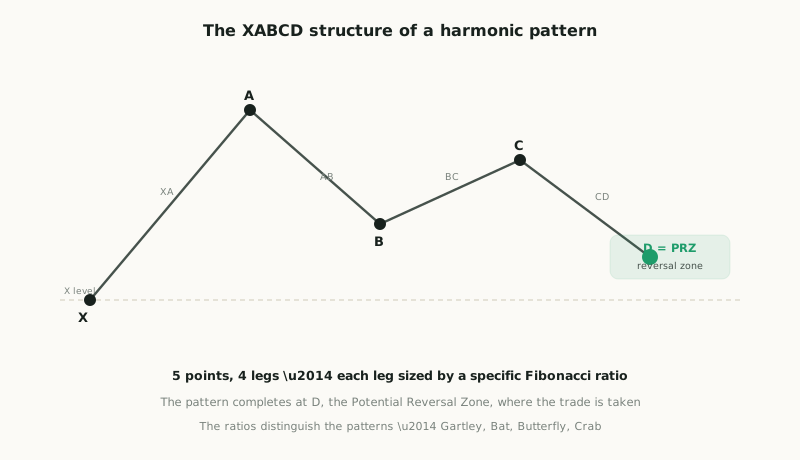
Most harmonic patterns share a common XABCD structure: five points labelled X, A, B, C and D, connected by four legs (XA, AB, BC and CD). The pattern begins at X, moves to A (the XA leg), retraces to B, moves to C, and completes at D — forming a distinctive zig-zag shape. Point D is the crucial one: it is where the pattern completes and where the Potential Reversal Zone (PRZ) lies — the area where price is expected to reverse and where the trade is taken.
What makes a structure a specific harmonic pattern, rather than just any zig-zag, is that each leg must conform to particular Fibonacci ratios. The B point must be a certain Fibonacci retracement of the XA leg; the D point a certain Fibonacci ratio of XA; the legs in particular proportions to one another. Different patterns are defined by different sets of these ratios — this is the key to the whole system. A Gartley, a Bat, a Butterfly and a Crab all share the XABCD shape but are distinguished by their specific required ratios, particularly where the B and D points fall relative to XA. The most important distinction, which the individual pattern guides explore, is whether D falls within the XA range (a retracement pattern, like the Gartley and Bat) or beyond X (an extension pattern, like the Butterfly and Crab). Understanding the shared XABCD structure, and that the ratios are what define and distinguish the patterns, is the foundation for understanding the whole family.
The harmonic family
Harmonic trading has a history and a family of patterns. The original was described by H.M. Gartley in his 1935 work, where he set out the pattern that now bears his name (sometimes called the "Gartley 222" after the page on which it appeared). Later traders, notably Scott Carney, formalised harmonic trading as a method, applied precise Fibonacci ratios to the patterns, and developed and named several of them — including the Bat and the Crab — while the Butterfly is associated with Bryce Gilmore. Together these built harmonic patterns into the structured approach practised today.
The four best-known patterns, each covered in its own guide, are: the Gartley, the original, a retracement pattern with a moderate, shallow reversal zone (D at 0.786 of XA); the Bat, a retracement pattern with a deeper reversal zone (D at 0.886 of XA) allowing a tight stop; the Butterfly, an extension pattern where D extends beyond X (D at 1.27 to 1.618 of XA); and the Crab, the most extreme extension (D at 1.618 of XA), reaching far beyond X for a deep, distant reversal zone. The table below summarises their defining ratios. Other harmonic patterns exist too (the Cypher, Shark, and the simpler AB=CD among them), but these four are the classics that anchor the approach. Each shares the XABCD structure and the Fibonacci basis, differing in the specific ratios — especially the depth of the B point and the position of the D point — which give each its character and its particular reversal zone.
The four classic patterns compared
| Pattern | B point (of XA) | D point (of XA) | Type |
|---|---|---|---|
| Gartley | 0.618 | 0.786 | Retracement |
| Bat | 0.382–0.50 | 0.886 | Retracement |
| Butterfly | 0.786 | 1.27–1.618 | Extension |
| Crab | 0.382–0.618 | 1.618 | Extension |
How they are traded
Trading a harmonic pattern follows a defined process. First, identify the pattern: scan price for an XABCD structure whose legs conform to the required Fibonacci ratios for one of the patterns — this is the analytical work, checking whether the proportions match within acceptable tolerance. When a valid pattern is identified and price approaches the completion point, the Potential Reversal Zone (PRZ) at D becomes the focus: this is where the trader anticipates a reversal and looks to enter, buying at D in a bullish pattern or selling at D in a bearish one, ideally with some confirmation that price is indeed reversing there (a candlestick reversal signal, for instance) rather than entering blindly on the pattern alone.
Risk is defined with the precision the method's exactness allows. The stop-loss is placed just beyond the D point (beyond X for the deeper patterns), so that if price continues through the PRZ rather than reversing, the loss is contained — and because the PRZ is a precise level, the stop can be tight. Targets are typically set at Fibonacci retracements of the completed pattern (commonly retracements of the CD or AD leg), giving defined profit objectives. This precision — exact entry at the PRZ, tight stop just beyond it, defined Fibonacci targets — is a large part of harmonic trading's appeal: it offers clearly defined risk and reward, and the deeper patterns (Bat, Crab) in particular allow tight stops relative to their targets, giving favourable reward-to-risk. The method's structure thus dovetails with the risk-management and reward-to-risk principles covered elsewhere, providing a rules-based framework for entry, stop and target.
Harmonic patterns all share one XABCD skeleton; the Fibonacci ratios are what flesh it into a specific pattern. The single most useful distinction: does D land within XA (a retracement — Gartley, Bat) or beyond X (an extension — Butterfly, Crab)? That, plus the depth of D, defines each pattern's character and its reversal zone.
The honest caveats
Harmonic patterns deserve the same critical scrutiny this site applies to every method, and several caveats are important. First, identification can be subjective: deciding where the X, A, B, C points are, and whether the ratios "match" closely enough, involves judgement, and different traders may see different patterns (or none) in the same price action. The exact ratios rarely align perfectly, so practitioners allow tolerances, which introduces discretion and the risk of forcing patterns onto price that are not really there — a form of the pattern-seeking bias the cognitive-biases guide warns about. The precision of the theory can create an illusion of precision in practice that the messy reality does not support.
Second, harmonic patterns are debated, and their predictive power is not established beyond dispute. Sceptics argue that any apparent edge may reflect the general tendency of price to react at Fibonacci levels (and at prior highs/lows), rather than a special property of the specific geometric patterns; the elaborate ratio requirements may add complexity without adding genuine predictive value. A fair-minded view holds that harmonic patterns may help some traders by imposing structure and discipline, and by focusing attention on confluent Fibonacci levels where reactions are plausible, without necessarily possessing the precise predictive power their most enthusiastic proponents claim. Third, and consequently, harmonic patterns are not a standalone system or a path to certain profits: like all technical methods, they are probabilistic at best, patterns fail regularly, and they must be combined with confirmation, broader context, and — above all — strict risk management (the stop beyond D is what makes a failed pattern survivable). Approached this way — as a precise, structured, but fallible tool, used with confirmation and disciplined risk control, and with clear-eyed awareness of the subjectivity and the debate — harmonic patterns can be a legitimate part of a trader's toolkit. Approached as a magic geometric key to the markets, they will disappoint, as every such claimed key does. The individual pattern guides that follow explain each pattern's specific ratios and character in this same spirit: precise in method, honest about limits.
Harmonic patterns are Fibonacci-based geometric price patterns, usually with an XABCD structure (five points, four legs) completing at point D, the Potential Reversal Zone where a reversal is anticipated. Specific Fibonacci ratios define and distinguish each pattern — the Gartley and Bat are retracements (D within XA), the Butterfly and Crab extensions (D beyond X). They're traded by entering at the PRZ with confirmation, a tight stop just beyond D, and Fibonacci targets — offering precise, defined risk/reward. But identification is subjective, ratios rarely align perfectly, and their predictive power is debated, so use them with confirmation, context and strict risk management, never as a standalone or magic system.