
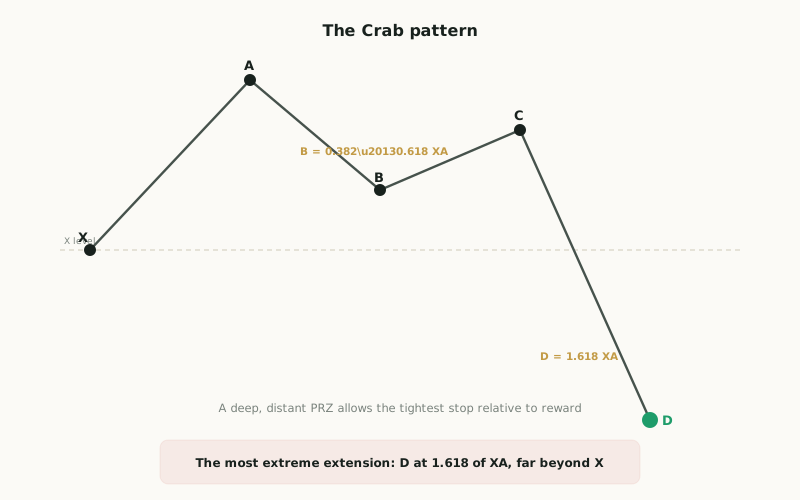
The Crab pattern is the most extreme of the classic harmonic patterns. Developed by Scott Carney, who regarded it as one of the most precise, it pushes the extension logic of the Butterfly to its limit: the reversal zone D stretches all the way to 1.618 of XA — the golden ratio extension — reaching far beyond the starting point X. That deep, distant PRZ is the Crab's signature, and it has a striking practical consequence: because D is so far out and so precisely defined, the stop placed just beyond it is tight relative to the large move the pattern captures, giving the Crab arguably the most favourable reward-to-risk of any harmonic pattern. This guide explains the Crab's extreme ratios, what makes it so precise, and how its distant reversal zone shapes the trade.
It is the most extreme extension pattern in the family from harmonic patterns explained, taking the Butterfly's extension logic to its limit.
Key takeaways
Q: What is the Crab pattern?
A: The Crab is a harmonic extension pattern developed by Scott Carney, considered the most extreme of the classic patterns. Its D point (the reversal zone) extends to 1.618 of XA — far beyond the starting point X — with the B point retracing 0.382-0.618 of XA.
Q: Why is the Crab considered the most precise harmonic pattern?
A: Because its D point extends so far (1.618 of XA), the reversal zone is a deep, distant and tightly defined level. The stop placed just beyond D is close to the entry relative to the large move the pattern captures, allowing the tightest stop and potentially the most favourable reward-to-risk of the patterns.
Q: How does the Crab differ from the Butterfly?
A: Both are extension patterns where D extends beyond X, but the Crab is more extreme: its D reaches 1.618 of XA, versus the Butterfly's 1.27-1.618. The Crab's reversal zone is therefore deeper and more distant, catching a reversal at a more extreme overshoot of the prior move.
Crab pattern profile
The most extreme extension
The Crab takes the extension principle to its extreme. Like the Butterfly, it is an extension pattern — D extends beyond X — but the Crab's D reaches all the way to 1.618 of XA, the golden ratio extension, considerably further than the Butterfly's 1.27-1.618. This makes the Crab's reversal zone deeper and more distant than any other classic harmonic pattern: in a bullish Crab, D forms a low far below X; in a bearish one, a high far above X. The pattern catches a reversal at a very extreme overshoot of the prior move — price has pushed dramatically past its prior turning point, and the Crab anticipates a reversal from that far extreme.
This extreme extension is the Crab's defining trait and the source of both its power and its character. Among the four classic patterns, the Crab sits at the far end of the spectrum: the Gartley and Bat are retracements (D within XA), the Butterfly a moderate extension (D to 1.27-1.618), and the Crab the most extreme extension (D to 1.618 and the most distant). The progression from retracement to extreme extension — Gartley, Bat, Butterfly, Crab — traces increasingly deep and distant reversal zones, and the Crab anchors the extreme end. Trading a Crab means betting that a dramatic overshoot marks a turning point: that price, having stretched far beyond X to the 1.618 extension, is exhausted and poised to reverse. It is the most aggressive of the reversal-at-an-extreme trades, catching the turn at the most stretched point — a powerful proposition when right, and one that, like all such trades, requires the discipline to be wrong gracefully when price extends even further.
Why it allows the tightest stop
The Crab's most celebrated feature is that it allows the tightest stop relative to reward of the harmonic patterns — the reason Carney regarded it as among the most precise. The logic follows from its extreme D. The entry is at D (1.618 of XA, far from X), and the stop goes just beyond D — a short distance past the extreme reversal zone. Because D is a deep, distant, precisely defined level, the stop just beyond it is close to the entry in absolute terms. Meanwhile, the potential reward — the reversal move back from this far extreme — is large, since price has stretched a long way and a reversal can retrace a substantial distance.
The result is a small risk (tight stop just beyond the precise, distant D) against a large potential reward (the reversal from the extreme), producing a potentially very favourable reward-to-risk ratio — the most favourable, in principle, of the classic patterns. This is the Crab's great appeal: its extreme, precise reversal zone permits a tight, well-defined stop while the deep overshoot offers substantial reward potential, exactly the kind of asymmetric risk-reward the reward-to-risk and risk-management guides prize. It is why the Crab, despite (or because of) its extremity, is favoured by many harmonic traders for its risk definition. That said, the favourable reward-to-risk is realised only when the pattern works — when price genuinely reverses from the extreme. The flip side of trading reversals at the most stretched point is that markets in a powerful move can blow well past even the 1.618 extension, so the tight stop, while excellent risk definition, is also frequently hit when the extreme keeps extending. The Crab offers superb reward-to-risk on its winners, but it is trading reversals at the most extreme point, where being wrong is entirely possible — the tight stop is what makes those wrongs cheap.
The Crab's extreme 1.618 D is its edge: the reversal zone is so deep and distant that the stop just beyond it is tiny relative to the large reversal move on offer — the most favourable reward-to-risk of the classic patterns. But that edge is realised only on winners. Trading reversals at the most stretched point means the stop is hit often when the extreme keeps extending; the tight stop is what keeps those losses cheap.
Trading the Crab
Trading the Crab applies the harmonic method to its extreme reversal zone. When a valid Crab completes at D (1.618 of XA, far beyond X), the trader enters in the pattern's direction — buying the deep low at D in a bullish Crab, selling the far high in a bearish one — anticipating a reversal from the extreme overshoot. Given that this means trading against a market that has just made a dramatic new extreme, confirmation of the reversal at the PRZ is especially important: waiting for a reversal signal rather than blindly catching the extreme guards against entering while price is still powerfully extending. The stop-loss goes just beyond D, giving the tight, precise risk that is the Crab's hallmark, and targets are set at Fibonacci retracements of the large move, supporting the favourable reward-to-risk.
The Crab's appeal — extreme precision, tight stop, favourable reward-to-risk — must be balanced against the universal harmonic caveats and the specific demands of trading the most extreme reversals. Identification is subjective and the ratios rarely align perfectly (as with all the patterns), and the Crab in particular involves trading against a powerful, extended move, which is inherently demanding — price that has stretched to 1.618 of XA has strong momentum, and it can extend further before reversing, or simply continue. The tight stop is therefore both the Crab's strength (cheap to be wrong) and a reflection of its difficulty (it gets hit when extremes extend). So the same disciplines apply, with extra emphasis: demand clean, well-formed patterns with ratios close to ideal; insist on reversal confirmation before entering against the extreme; respect the broader context (a Crab reversal aligning with a major support/resistance level or a higher-timeframe turning point carries far more weight than one fighting a strong trend); and apply strict risk management, with the tight stop beyond D keeping the frequent failures inexpensive. Used this way — selectively, with confirmation, in good context, and with disciplined risk control — the Crab can offer the most attractive risk-reward of the harmonic patterns. But it remains a probabilistic tool used to trade the most extreme reversals, where being wrong is common; its favourable reward-to-risk on winners is the compensation for a setup that, by its nature, fails often. Like every pattern on this site, it is a structured tool, not a guarantee.
The deep Crab and choosing among the patterns
The Crab also has a recognised variant worth knowing: the deep Crab. It keeps the Crab's extreme 1.618 D point but uses a deeper B retracement — typically around 0.886 of XA, rather than the standard Crab's shallower 0.382-0.618. The deep Crab thus combines a deep B (like the Bat's deep D) with the Crab's extreme extension D, producing a slightly different internal structure while preserving the defining 1.618 reversal zone. For most purposes it is traded just like the standard Crab — the extreme 1.618 D and the tight-stop, high-reward logic are the same — but recognising the deep-B variant helps when a structure shows a deep B yet still projects to the 1.618 extension.
Stepping back, the four classic patterns form a coherent spectrum of reversal depth that helps in choosing among them. The Gartley (D 0.786) and Bat (D 0.886) are retracement patterns catching reversals within the prior move — the Bat deeper, allowing a tighter stop. The Butterfly (D 1.27-1.618) and Crab (D 1.618) are extension patterns catching reversals beyond the prior extreme — the Crab the most extreme, offering the tightest stop relative to reward but trading the most stretched reversals. Which to favour depends partly on what the market presents (you trade the pattern that actually forms) and partly on temperament: retracement patterns (Gartley, Bat) offer reversals in less extreme locations, while extension patterns (Butterfly, Crab) chase the more dramatic, higher-reward-but-harder turns at extremes.
In the end, the Crab rewards the same disciplined approach as the whole family, applied to its extreme character. It is subjective to identify, fails regularly, and trades the most stretched reversals — so it demands clean structure, reversal confirmation at the PRZ, strong confluence (the 1.618 D aligning with an independent major level greatly strengthens it), agreement with the broader context, and the firm, tight stop just beyond D that makes its frequent failures cheap. Its superb reward-to-risk on winners is the compensation for a difficult setup, not evidence that it is reliable. Used selectively and with discipline, the Crab is the most precise and potentially rewarding of the harmonic patterns; used recklessly to call tops and bottoms, it is a fast way to be repeatedly stopped out as extremes extend. As with every tool on this site, the Crab is a structured aid to decision-making, valuable in skilled and disciplined hands, and dangerous when mistaken for a certainty.
The Crab (Scott Carney) is the most extreme harmonic extension pattern: D reaches 1.618 of XA, far beyond X, with a 0.382-0.618 B (the "deep Crab" variant uses a ~0.886 B). Its deep, distant, precise reversal zone lets the stop sit tight just beyond D relative to the large reversal on offer — the most favourable reward-to-risk of the classic patterns, and why it's considered the most precise. But it trades the most stretched reversals, so the stop is hit often when extremes extend; the tight stop just keeps losses cheap. Across the family, depth of D rises from Gartley (0.786) to Bat (0.886) to Butterfly/Crab (extensions). Trade it selectively with confirmation, confluence, context and strict risk management — a probabilistic tool, not a guarantee.