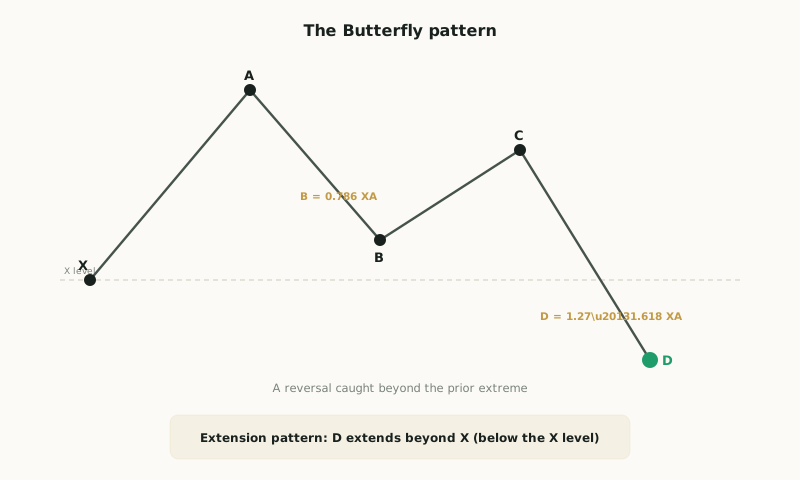
The Butterfly pattern is the first of the harmonic extension patterns — where the reversal zone D pushes beyond the starting point X, rather than completing within the original move as the Gartley and Bat do. This is a fundamental shift in character: instead of catching a reversal inside a retracement, the Butterfly catches a reversal at a fresh extreme, where price has overshot the prior move and is poised to turn back. Associated with Bryce Gilmore and formalised within Scott Carney's harmonic framework, the Butterfly opens the extension family that the Crab completes. This guide explains the Butterfly's ratios, what makes it an extension pattern, and how it catches reversals beyond the prior extreme.
It is the gateway to the extension patterns within the family from harmonic patterns explained, contrasting with the retracement Bat and leading to the extreme Crab.
Key takeaways
Q: What is the Butterfly pattern?
A: The Butterfly is a harmonic extension pattern with an XABCD structure in which the B point retraces 0.786 of XA and the D point (the reversal zone) extends to 1.27-1.618 of XA — meaning D pushes beyond the starting point X, catching a reversal at a new extreme.
Q: How is the Butterfly different from the Gartley and Bat?
A: The Gartley and Bat are retracement patterns where D stays within the XA range. The Butterfly is an extension pattern: its D point extends beyond X (to 1.27-1.618 of XA), so the reversal zone sits past the prior extreme rather than inside the original move.
Q: What are the Butterfly pattern's ratios?
A: In a Butterfly, the B point retraces 0.786 of XA, C retraces 0.382-0.886 of AB, and D extends to between 1.27 and 1.618 of XA (beyond X). The CD leg is typically a 1.618-2.24 extension of BC. The 0.786 B and the beyond-X D define the pattern.
Butterfly pattern profile
An extension pattern
The defining characteristic of the Butterfly — and what separates it from the Gartley and Bat — is that it is an extension pattern: the D point extends beyond X. Where the retracement patterns (Gartley, Bat) complete with D inside the XA range (D at 0.786 or 0.886, both less than 1), the Butterfly's D extends to 1.27 to 1.618 of XA — a value greater than 1, meaning D pushes past the starting point X. In a bullish Butterfly, this means D forms a new low below X; in a bearish one, a new high above X. The reversal zone sits beyond the prior extreme, not within the original move.
This changes the pattern's character and the kind of trade it represents. A retracement pattern catches a reversal within a pullback — price retraces part of a move and turns. An extension pattern like the Butterfly catches a reversal at a fresh extreme — price has pushed beyond its prior turning point (X), overshooting it, and the pattern anticipates a reversal from that new extreme. This is a meaningfully different trade: you are buying a new low (or selling a new high), betting that the overshoot beyond X marks exhaustion and a turning point rather than a continuation. Such trades can be powerful (catching a reversal right at an extreme, near the start of a new move) but also have a different risk profile from retracement patterns, since you are trading against price that has just made a new extreme. Understanding the Butterfly as an extension pattern — D beyond X, a reversal at a new high or low — is the essential conceptual shift from the retracement patterns, and it is what the 1.27-1.618 D ratio encodes.
The defining ratios
The Butterfly's specific ratios complete its definition. The headline is the D point at 1.27 to 1.618 of XA — the extension beyond X that makes it an extension pattern, with the reversal zone typically in the 1.27-1.618 range past the origin. The other defining ratio is the B point at 0.786 of XA — a fairly deep retracement that is characteristic of the Butterfly (deeper than the Bat's 0.382-0.50, and different from the Gartley's 0.618). This 0.786 B is a useful identifier: a deep B near 0.786 combined with a D that extends beyond X points to a Butterfly.
The remaining ratios follow the family pattern: the C point retraces 0.382 to 0.886 of AB, and the CD leg is typically a substantial extension of BC (often around 1.618 to 2.24) to reach the extended D beyond X. When the structure shows a 0.786 B and projects a D extending to 1.27-1.618 of XA, it qualifies as a Butterfly. The two headline features — the 0.786 B and the beyond-X D (1.27-1.618) — distinguish the Butterfly from its relatives: it shares neither the Gartley's 0.618-B/0.786-D nor the Bat's 0.382-0.50-B/0.886-D, and crucially its D extends past X where theirs stay within XA. Recognising the deep 0.786 B and the extension D is how you identify a Butterfly and tell it apart from the retracement patterns and from the more extreme Crab.
The Butterfly flips the harmonic logic: instead of catching a reversal inside a pullback (like the Gartley and Bat), it catches one beyond the prior extreme, where price has overshot X. You're buying a new low or selling a new high, betting the overshoot marks exhaustion. That's a different trade with a different risk profile from the retracement patterns.
Trading the Butterfly
Trading the Butterfly follows the harmonic method, adapted to its extension character. When a valid Butterfly completes at D (1.27-1.618 of XA, beyond X), the trader enters in the pattern's direction — buying the new low at D in a bullish Butterfly, selling the new high at D in a bearish one — anticipating a reversal from the extreme. Because this means trading against price that has just made a new extreme, confirmation of the reversal at the PRZ is especially valuable here: entering on a reversal signal (a reversal candlestick, say) rather than blindly catching a falling (or rising) market guards against entering while the overshoot is still extending.
The stop-loss goes beyond D — since D is already past X, the stop sits past the new extreme that D forms, so that if price continues extending rather than reversing, the loss is contained. Targets are set at Fibonacci retracements of the move (often of the CD or AD leg). The Butterfly's extension nature gives it a particular profile: catching a reversal at a fresh extreme can mean entering near the very start of a new move (good reward potential), but trading against a market making new extremes carries the risk that the extreme extends further before (or instead of) reversing — hence the importance of confirmation and a disciplined stop beyond D. All the universal harmonic caveats from the overview apply: identification is subjective, the ratios rarely align perfectly, and the pattern fails regularly. The Butterfly is a probabilistic tool, and trading reversals at extremes is inherently demanding — so it warrants confirmation, broader context (a bullish Butterfly forming at a major support level beyond which price has overshot carries more weight), and strict risk management. Traded with these disciplines, the Butterfly offers a structured way to catch reversals at extremes; treated as a guaranteed top or bottom signal, it carries real danger, since markets can and do extend well beyond where any pattern says they "should" turn.
Trading the Butterfly in context
The Butterfly, like its relatives, has bullish and bearish forms. A bullish Butterfly completes with D forming a new low below X, where the trader buys, anticipating an upward reversal from the overshoot; a bearish Butterfly completes with D forming a new high above X, where the trader sells. Because the Butterfly is an extension pattern, both forms share the distinctive feature that the entry is at a fresh extreme — buying a new low or selling a new high — which gives the Butterfly trade its characteristic "catching the turn at the extreme" feel, quite different from buying a pullback within a move.
This extension character makes confluence especially valuable for the Butterfly, because trading reversals at new extremes is inherently riskier than trading retracements. The strongest Butterfly setups occur where the D point — the new extreme beyond X — coincides with an independent significant level: a major higher-timeframe support or resistance, a key round number, or a Fibonacci extension from a larger move. When the overshoot beyond X reaches a level that is independently significant (a place price might be expected to turn anyway), the Butterfly's reversal thesis gains real support. Conversely, a Butterfly whose D extends into open space, against a strong trend, with no independent level to halt the move, is a weak and dangerous setup — it is fighting a market making new extremes with nothing to back the reversal.
The overview's caveats carry extra weight here precisely because the Butterfly trades against new extremes. Identification is subjective; the ratios rarely align perfectly; and crucially, a market making new extremes can keep making them — price that has overshot X to 1.27-1.618 can extend further (even into Crab territory) before reversing, or simply continue. This is why confirmation at the PRZ is so important for the Butterfly: waiting for an actual reversal signal, rather than blindly buying the new low or selling the new high, guards against catching a knife that keeps falling. The disciplined approach is to trade Butterflies selectively, at confluent extremes, with confirmation, in a context that supports a reversal (ideally not against a powerful trend), and with a firm stop beyond D — accepting that some will fail as the extreme extends. Treated this way, the Butterfly is a structured way to catch high-value reversals near the start of new moves; treated as a guaranteed top or bottom, it is a fast route to losses, since the market owes no allegiance to where a pattern says it should turn.
The Butterfly is the first harmonic extension pattern: D extends to 1.27-1.618 of XA, beyond X (a new low if bullish, new high if bearish), with a deep 0.786 B. It catches a reversal at a fresh extreme rather than within a pullback. It comes in bullish and bearish forms, and is strongest when D coincides with an independent significant level (major support/resistance, a larger Fib extension). Trade the reversal at D with confirmation — essential, since markets making new extremes can keep extending — stop beyond D, Fibonacci targets. Subjective and fails regularly like all harmonic patterns; trade it selectively, at confluent extremes, with confirmation, context and strict risk management.