CAD/JPY is the yen cross with an oil twist. While the other yen crosses answer mainly to risk sentiment, CAD/JPY answers to two masters: crude oil prices, through the oil-linked Canadian dollar, and global risk sentiment, through the safe-haven yen. This distinctive double exposure — oil on one side, the risk mood on the other — sets it apart from its yen-cross siblings and gives it a character worth understanding. This guide profiles CAD/JPY: the oil driver, the risk driver, how they interact, the carry angle, and what to know. (Educational only — a behavioural profile, not a forecast or advice.)
It combines the oil-linked Loonie from USD/CAD (and the commodity link from commodities and currencies) with the safe-haven yen of the other yen crosses like EUR/JPY.
Key takeaways
Q: What drives CAD/JPY?
A: CAD/JPY is driven by two main forces: oil prices (the Canadian dollar is oil-linked, so higher oil tends to lift CAD and the pair) and global risk sentiment (the safe-haven yen strengthens in risk-off, pushing the pair down). The BoC versus BoJ rate gap and the carry dynamic also play a role.
Q: Why is CAD/JPY linked to oil?
A: Because the Canadian dollar is a commodity currency tied to oil — Canada is a major oil exporter, so higher oil prices tend to strengthen the CAD. Since CAD is the base currency in CAD/JPY, a stronger CAD pushes the pair up, giving CAD/JPY a positive link to oil prices.
Q: How does risk sentiment affect CAD/JPY?
A: Through the yen side. The yen is a safe haven that strengthens in risk-off conditions, pushing CAD/JPY down, and weakens in risk-on, lifting it. Risk-off episodes often hit oil prices too, so both the oil and risk channels can weigh on CAD/JPY at once.
Two drivers: oil and risk
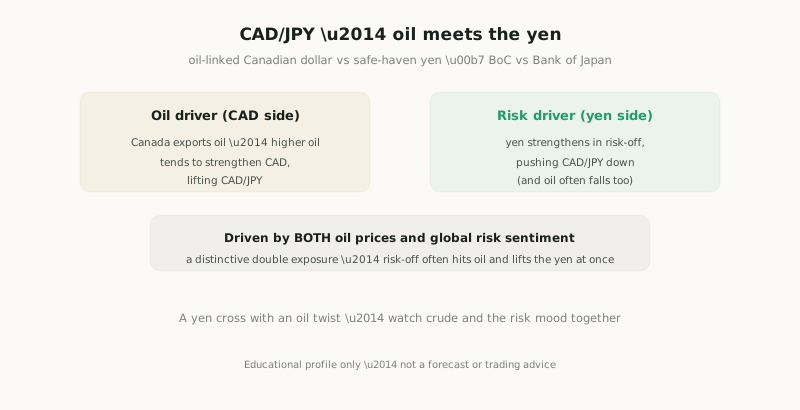
CAD/JPY's defining feature is that it's pulled by two main forces, one from each side of the pair. From the Canadian dollar side comes the oil link: Canada is a major oil exporter, so the Canadian dollar is a commodity currency tied to oil prices (as the USD/CAD guide explains) — higher oil tends to strengthen the CAD, and since CAD is the base currency in CAD/JPY, a stronger CAD pushes the pair up. So CAD/JPY has a positive link to oil: rising oil tends to lift it, falling oil tends to weigh on it. (Note this is the opposite direction to USD/CAD's oil link, because the positions are flipped — here CAD is the base, not the quote.) From the yen side comes the risk-sentiment link: the yen is a safe haven that strengthens in risk-off and weakens in risk-on, and since the yen is the quote currency, a stronger yen pushes the pair down — so risk-off weighs on CAD/JPY (stronger yen) and risk-on lifts it (weaker yen), exactly as for the other yen crosses.
CAD/JPY answers to both oil and the risk mood — and the two often align. In a risk-off episode, the safe-haven yen strengthens and oil prices frequently fall (oil is itself a risk-sensitive, growth-linked asset), so both channels push CAD/JPY down at once — a weaker CAD (low oil) and a stronger yen (risk-off) compounding. In risk-on with firm oil, both lift it. This double exposure is CAD/JPY's signature: to read it, watch crude oil and the global risk mood together, and recognise that risk-off can hit it from both directions simultaneously.
The interaction of the two drivers is what makes CAD/JPY distinctive. Often they align (risk-off tends to coincide with falling oil, since both reflect a darkening growth/risk outlook — so both weigh on the pair together; risk-on with strong oil lifts it on both counts), which can produce strong, well-supported moves. Sometimes they can partly conflict (e.g., an oil-specific supply shock lifting oil even amid a cautious risk mood), giving a more mixed outcome. Either way, reading CAD/JPY means weighing both the oil picture and the risk picture, rather than just one — a richer analysis than a pure risk-sentiment cross requires, and the reason CAD/JPY rewards traders who watch the oil market alongside the broader mood.
Carry, character and what to know
Beyond oil and risk, CAD/JPY shares the yen crosses' other features. There's a carry angle: the Canadian dollar has historically yielded more than the yen, so CAD/JPY is also a carry trade (holding the higher-yielding CAD against the low-yielding funding yen), with the usual dynamic — supportive in calm conditions, unwinding in risk-off (reinforcing the downside in panics, alongside the safe-haven and oil effects). The BoC-versus-BoJ rate gap drives the carry's attractiveness and the pair's rate-differential picture, and BoJ policy/intervention risk applies to the yen as in all yen crosses. It's also worth noting the Canadian dollar is itself somewhat risk-sensitive (as a commodity currency), so CAD/JPY's risk sensitivity comes from both sides to a degree — though the safe-haven yen is the stronger risk channel.
In character, CAD/JPY is a yen cross with a distinctive oil-and-risk double exposure — a liquid pair (though typically less heavily traded than EUR/JPY or GBP/JPY) whose moves reflect crude oil and the global risk mood together. For a trader, the key things to know are: watch oil (it's a primary driver via the CAD side — higher oil tends to lift CAD/JPY, the opposite direction to USD/CAD's oil link); watch risk sentiment (the yen side makes it a risk-sensitive yen cross, falling in risk-off); recognise the double exposure (risk-off often hits both oil and the yen together, weighing on the pair from both sides — a source of sharp downside moves to manage with sound sizing and stops); and note the carry and rate-gap angle. The honest, educational summary: CAD/JPY is a yen cross with an oil twist — driven by both oil prices (via the oil-linked Canadian dollar, positively) and global risk sentiment (via the safe-haven yen), a distinctive double exposure where risk-off can weigh from both directions — plus the usual carry and rate-gap dynamics. Read it by watching crude oil and the risk mood together: a yen cross that, uniquely, also trades the oil market.
Watching and trading CAD/JPY
In practice, following CAD/JPY means watching two screens at once: the oil market and the global risk mood. On timing, the pair draws activity from the North American session (the Canadian dollar's home hours, when Canadian data, US developments and oil-market action land) and the Asian/Tokyo session (the yen's home hours) — so it sees meaningful liquidity across both, with the New York hours often important given the CAD and oil link (per the trading-sessions guide). It's typically less heavily traded than the headline EUR/JPY or GBP/JPY, so liquidity is good but not the deepest among yen crosses.
On what to watch, CAD/JPY's double exposure sets a distinctive two-part watchlist. Crude oil is a primary input — oil-market moves and oil-related news feed the CAD side, and rising oil tends to lift CAD/JPY (the opposite direction to oil's effect on USD/CAD, since CAD is the base here). Global risk sentiment is the other primary input — the safe-haven yen makes the pair fall in risk-off and rise in risk-on. Then the central banks (BoC and BoJ, and the rate gap driving the carry) and BoJ intervention risk. The key analytical habit is to weigh oil and the risk mood together, since CAD/JPY answers to both.
A few practical notes. The double exposure is the thing to internalise: because risk-off episodes often hit oil and lift the yen simultaneously, CAD/JPY can be pushed down from both directions at once, producing sharp downside moves — a real risk to manage with sound position sizing and stops. Conversely, risk-on with firm oil can support it strongly from both sides. Occasionally the drivers conflict (an oil-specific shock lifting oil amid a cautious mood), giving a muddier result that requires weighing which force dominates. As a carry trade (higher-yield CAD vs low-yield yen), it shares the yen crosses' carry dynamic — supportive in calm, unwinding in fear. The honest framing: CAD/JPY rewards a trader who watches the oil market and the risk mood together and respects that risk-off can weigh from both sides; it's a yen cross that, uniquely, also trades crude. None of this is advice on how to trade it — it's how the oil-meets-yen character shapes what its followers watch and the risks they weigh.
When oil and risk diverge
Although oil and the risk mood usually align for CAD/JPY (both weighing on it in risk-off, both lifting it in risk-on), it's worth understanding the cases where they diverge, since these are where the pair gets tricky. On which oil: crude prices (commonly referenced via a benchmark like WTI) and oil-market events — production decisions by major exporters, supply disruptions, inventory data — drive the CAD side, so an oil-specific development can move CAD/JPY even with no change in the broad risk mood. That's the source of potential divergence.
The classic conflict case is an oil supply shock: a disruption to oil supply can send crude sharply higher even while the broader market is cautious or risk-averse. Here CAD/JPY's two drivers pull in opposite directions — rising oil supports the CAD side (lifting the pair), while a cautious risk mood supports the yen (weighing on it) — and the net move depends on which force dominates, often producing a muddier, less directional outcome than when the two align. Conversely, a demand-driven oil slump during a growth scare hits both drivers the same way (low oil and risk-off together), reinforcing the downside. The practical takeaway is that reading CAD/JPY requires identifying why oil is moving: a demand-driven oil move (tied to the growth/risk outlook) usually aligns with the risk channel, while a supply-driven oil move can conflict with it. This extra layer — distinguishing oil's drivers and weighing them against the risk mood — is what makes CAD/JPY a richer analytical exercise than a pure risk-sentiment yen cross, and the reason it rewards a trader who genuinely watches the oil market rather than treating crude as a single number. As always, the divergence cases especially warrant caution and sound risk management, since the pair's behaviour is less predictable when its two drivers disagree.
CAD/JPY is the yen cross with an oil twist — a double exposure to two drivers. From the CAD side: oil (Canada exports oil, so higher oil strengthens CAD; since CAD is the base here, that lifts CAD/JPY — a positive oil link, opposite to USD/CAD's). From the yen side: risk sentiment (the safe-haven yen strengthens in risk-off, pushing the pair down). The two often align — risk-off tends to hit oil and lift the yen, so both weigh on CAD/JPY at once (sharp downside). It's also a carry trade (higher-yield CAD vs low-yield yen), with the BoC–BoJ rate gap and BoJ intervention risk relevant. To read it, watch crude oil and the global risk mood together. Respect its sharp risk-off moves with sound sizing and stops. Educational profile only — not a forecast or advice.