The Canadian dollar — "the Loonie" — is forex's great oil play, but with a twist that catches beginners out. Because Canada is a major oil exporter, higher oil prices tend to strengthen the Canadian dollar — and since CAD is the quote currency in USD/CAD, a stronger Canadian dollar pushes the pair down. So oil and USD/CAD tend to move inversely, a relationship that puzzles those who expect "oil up, oil currency up, pair up." Understanding that inversion is the key to the pair. This guide profiles USD/CAD: the oil relationship and its twist, the close US–Canada linkage, the BoC–Fed rate gap, and what beginners should know. (Educational only — a behavioural profile, not a forecast or advice.)
It's one of the major-pair guides under the major currency pairs, a key example in commodities and currencies, and sits alongside the other commodity currency, AUD/USD.
Key takeaways
Q: What drives the USD/CAD exchange rate?
A: USD/CAD is driven mainly by oil prices (Canada is a major oil exporter), the close economic linkage between Canada and the United States, the interest-rate gap between the Bank of Canada and the US Federal Reserve, and broad US dollar strength.
Q: How does oil affect USD/CAD?
A: Because Canada is a major oil exporter, higher oil prices tend to strengthen the Canadian dollar. Since CAD is the quote currency in USD/CAD, a stronger CAD pushes the pair DOWN — so there's an inverse relationship: rising oil generally means a falling USD/CAD, which catches many beginners out.
Q: Why is the Canadian dollar called the Loonie?
A: The Canadian dollar is nicknamed the 'Loonie' after the loon, a bird depicted on the Canadian one-dollar coin. It's a major currency, closely tied to oil prices and to the US economy given Canada's deep trade relationship with the United States.
The oil relationship — and its twist
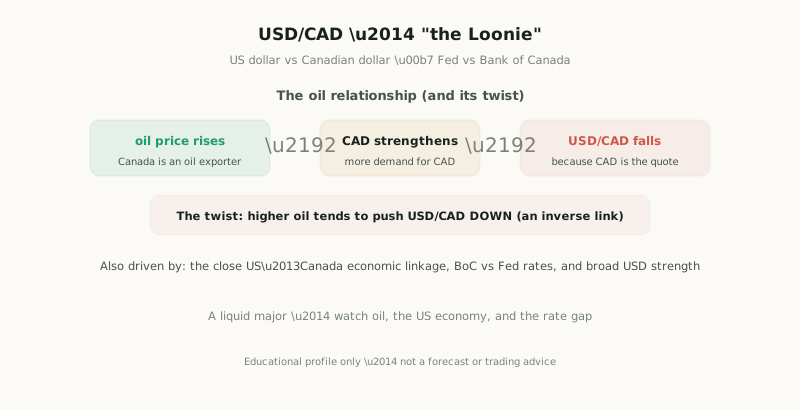
The defining driver of USD/CAD is oil. Canada is a major oil exporter, so oil is central to its economy and export earnings, making the Canadian dollar a commodity currency tied closely to oil prices (the commodities-and-currencies guide covers the general link). When oil prices rise, Canada's export earnings rise and demand for the Canadian dollar tends to increase, strengthening CAD; when oil falls, CAD tends to weaken. So far, this is the standard commodity-currency logic. The twist that catches beginners out is the direction, and it comes down to how the pair is quoted.
USD/CAD is quoted with the US dollar first (base) and the Canadian dollar second (quote). So when CAD strengthens — as it tends to when oil rises — the pair goes down (it takes fewer Canadian dollars to buy one US dollar). The result: higher oil generally pushes USD/CAD lower, and lower oil pushes it higher — an inverse relationship between oil and the pair. Beginners often expect "oil up → oil currency up → pair up," but because CAD is the quote currency, it's the reverse. Keeping this inversion straight is essential to reading USD/CAD.
This inverse oil relationship is one of the most-watched dynamics in the pair: traders of USD/CAD keep a close eye on oil prices, knowing that a rally in oil tends to weigh on USD/CAD (via a stronger CAD) and a drop in oil tends to lift it (via a weaker CAD). The relationship isn't perfect or mechanical — other factors intervene, and it can decouple at times — but it's a strong, persistent tendency that defines the pair's character. Understanding it turns the otherwise confusing oil–Loonie link into a clear, usable read: to gauge a likely pressure on USD/CAD, look at what oil is doing, and remember the inversion.
The US linkage, rates and the broad dollar
Beyond oil, several other forces shape USD/CAD. The close US–Canada economic linkage is fundamental: the United States is by far Canada's largest trading partner, and the two economies are deeply intertwined, so US economic conditions strongly affect Canada, and both US and Canadian data move the pair. This linkage means the two economies often move somewhat together, which can dampen the pair's volatility relative to pairs of less-connected economies, while also making US data (not just Canadian) important for USD/CAD. The interest-rate gap between the Bank of Canada (BoC) and the US Federal Reserve matters as for all pairs — relative monetary policy and the rate differential drive capital flows and the pair; a more hawkish BoC relative to the Fed tends to support CAD (pressuring USD/CAD lower), and vice versa.
Finally, broad US dollar strength is a major factor, as USD/CAD is, after all, a dollar pair: when the dollar is broadly strong (against most currencies, as reflected in the dollar index), USD/CAD tends to rise regardless of oil, and when the dollar is broadly weak, it tends to fall — so the pair reflects both the CAD side (oil, Canadian economy, BoC) and the USD side (US economy, Fed, broad dollar). In practice, USD/CAD is pushed and pulled by this interplay: oil and Canadian factors on one side, US factors and the broad dollar on the other. In character, it's a liquid major; its volatility is influenced by oil's swings and by US/Canadian data, and the close US–Canada linkage can make it somewhat range-prone at times, though oil shocks or policy divergences can drive strong moves. For a beginner, the key things to know are: watch oil (and remember the inversion — higher oil tends to push USD/CAD down); watch both US and Canadian factors (the pair has a strong US side given the linkage and the broad dollar, plus the Canadian/oil side); and note the BoC–Fed rate gap. The honest, educational summary: USD/CAD — the Loonie — is a liquid major driven by oil prices (with the crucial inverse twist: higher oil tends to lower USD/CAD because CAD is the quote currency), the deep US–Canada economic linkage, the BoC–Fed rate gap, and broad US dollar strength. Master the oil inversion and the dual US/Canada nature of the pair, and USD/CAD becomes one of the more readable majors.
Watching and trading the Loonie
In practice, following USD/CAD means watching both an oil screen and the broad US picture. On timing, USD/CAD is naturally most active during the North American session and the London–New York overlap, given that both the US and Canada are in the Americas and their data lands in those hours. Canadian and US releases during the New York session frequently drive the pair, and the overlap with London tends to be its busiest, most liquid window (per the trading-sessions guide).
On what to watch, the Loonie's profile gives a distinctive watchlist. Oil prices are first — traders keep an eye on crude oil, remembering the inversion (higher oil tends to weigh on USD/CAD via a stronger CAD), so an oil rally and a falling USD/CAD often go together, and vice versa. The US economy and broad dollar are equally important given the pair's strong US side: US data and Fed policy move the dollar leg, and because the US and Canadian economies are so linked, big US releases (even ones nominally about the US, like Non-Farm Payrolls) can move both sides of the pair at once — a notable feature of USD/CAD, where a single US release can affect both the USD and, via the linkage, the CAD. The Bank of Canada (rate decisions, statements) and key Canadian data (employment, inflation, GDP) drive the CAD side and the BoC–Fed rate gap.
A few practical notes. The dual oil-and-dollar nature means USD/CAD can be pushed by two somewhat independent forces — the oil/Canada side and the US/dollar side — which sometimes reinforce and sometimes offset each other, so reading the pair means weighing both (a strong-dollar, high-oil environment, for instance, pulls the pair in opposite directions). The close US–Canada linkage can make the pair relatively range-prone at times (the linked economies moving together dampening big divergences), though oil shocks or genuine BoC–Fed policy divergences can drive strong trends. As always, the pair's volatility — especially around oil-market and data events — should be respected with sound position sizing and stops, and a trader holding USD/CAD should be aware that it carries oil-price risk in a way most pairs don't. None of this is advice on how to trade the pair; it simply shows how the Loonie's oil-and-US character shapes what its followers watch and the risks they keep in mind.
A note on the oil link's nuances
A few nuances sharpen the oil relationship. First, on which oil: crude oil prices (commonly referenced via benchmarks like WTI, the North American grade) are what traders watch, and oil-market events — production decisions by major exporters, supply disruptions, and scheduled oil inventory data — can move oil and, through it, the Canadian dollar and USD/CAD. So an oil-market shock can ripple into the pair even with no Canadian or US economic news at all, which is part of what makes USD/CAD distinctive among the majors. Second, the oil link is a tendency, not a mechanical rule: while higher oil generally pressures USD/CAD lower (via a stronger CAD), the relationship varies in strength over time and can be overridden by other forces — a powerful broad-dollar move, a divergence in BoC versus Fed policy, or shifting risk sentiment can dominate oil's influence on any given day. The inverse oil correlation is strong and persistent enough to be a defining feature, but a trader shouldn't treat it as a guaranteed lockstep relationship.
Third, because the pair has both an oil/Canada side and a US/dollar side, the two can align or conflict: rising oil and a weakening dollar both push USD/CAD down (a strong combined move), whereas rising oil but a strengthening dollar pull in opposite directions (a muddier, often range-bound outcome). Reading USD/CAD well means holding both forces in view rather than fixating on oil alone. This dual nature, with the oil link as its signature, is what gives the Loonie its particular character among the dollar majors.
USD/CAD ("the Loonie") is a major driven above all by oil — with a twist. Canada exports oil, so higher oil strengthens CAD; but because CAD is the quote currency, a stronger CAD pushes the pair down, so oil and USD/CAD move inversely (higher oil → lower USD/CAD). Beginners often get this backwards. Other drivers: the close US–Canada economic linkage (so both US and Canadian data matter, and the linked economies can dampen volatility), the BoC–Fed interest-rate gap, and broad US dollar strength (it's a dollar pair too). Character: a liquid major, oil-sensitive, with a strong US side. For beginners: watch oil (remember the inversion), watch both US and Canadian factors, and note the rate gap. Educational profile only — not a forecast or advice.