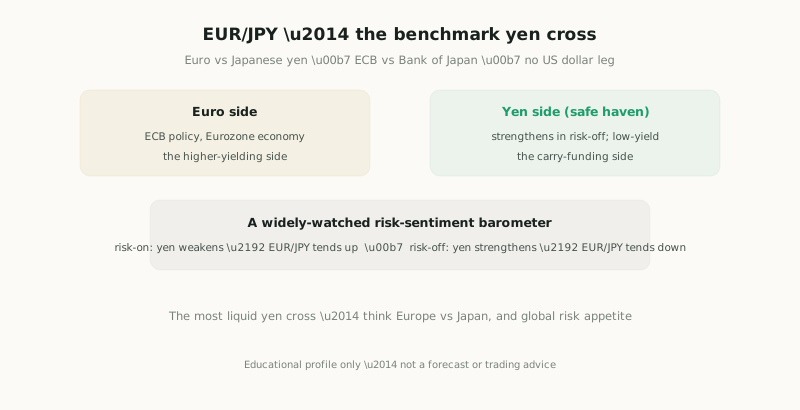
EUR/JPY is the benchmark yen cross — the most liquid of them, and a widely-watched gauge of global risk appetite. As the leading yen cross, it's the natural place to start understanding this whole family of pairs, because the yen's special role — as a safe haven and a carry-funding currency — colours every yen cross that follows. Understanding EUR/JPY means understanding both the euro-versus-yen relationship and the yen dynamics that make all yen crosses instruments of risk sentiment and carry. This guide profiles EUR/JPY: the yen's role, why the pair is a risk barometer, the carry angle, the ECB and BoJ, and what to know. (Educational only — a behavioural profile, not a forecast or advice.)
It's a Pairs & Sessions guide building on USD/JPY (for the yen itself), and it brings together risk sentiment and the carry trade — the two dynamics that define the yen crosses.
Key takeaways
Q: What drives the EUR/JPY exchange rate?
A: EUR/JPY is driven by the euro side (ECB policy and the Eurozone economy), the yen side (the Bank of Japan and, crucially, the yen's safe-haven status), global risk sentiment (the yen strengthens in risk-off, weakening EUR/JPY), and the carry-trade appeal of holding the higher-yielding euro against the low-yielding yen.
Q: Why is EUR/JPY a risk-sentiment barometer?
A: Because the Japanese yen is a safe-haven currency that strengthens when markets are fearful (risk-off) and weakens when they're optimistic (risk-on). So EUR/JPY tends to fall in risk-off conditions (a stronger yen) and rise in risk-on conditions (a weaker yen), making it a widely-watched gauge of global risk appetite.
Q: Is EUR/JPY a cross or a major?
A: EUR/JPY is a cross — a pair without the US dollar. It's the most liquid and widely-traded of the yen crosses, often treated as the benchmark cross, reflecting the relative strength of the euro versus the yen and the broader global risk mood.
The pair at a glance
EUR/JPY profile
The yen's special role
To understand EUR/JPY — and every yen cross — you must understand the special role of the Japanese yen, which has two defining features. First, the yen is a major safe-haven currency: in times of fear and uncertainty (risk-off), capital flows into the yen (linked to Japan's status as a major creditor nation and the repatriation of capital in stress), strengthening it; in calm, optimistic conditions (risk-on), the yen tends to weaken as that safe-haven demand recedes. Second, the yen has long been a very low-yielding currency (Japan has maintained ultra-low interest rates for many years), which makes it the classic carry-trade funding currency — traders borrow cheap yen to buy higher-yielding currencies, earning the interest differential (the carry-trade guide explains this).
These two features shape how all yen crosses behave, EUR/JPY included. Because the yen is the quote currency in a yen cross (XXX/JPY), a stronger yen pushes the cross down and a weaker yen pushes it up. Combined with the safe-haven dynamic, this means: in risk-off conditions the yen strengthens, so yen crosses fall; in risk-on conditions the yen weakens, so yen crosses rise. This is why yen crosses are so closely tied to global risk sentiment — the yen side responds directly to the risk mood. And the carry dynamic reinforces it: because yen crosses are popular carry trades (holding a higher-yielder against the funding yen), carry flows support them in calm, risk-on conditions but unwind violently in risk-off (traders rush to buy back yen to repay the borrowed funds), amplifying the falls. So the yen's twin features — safe haven and carry-funding currency — together make every yen cross an instrument of risk sentiment and carry: rising in calm/risk-on, falling (often sharply) in fear/risk-off. EUR/JPY is the benchmark example, and grasping this yen dynamic is the key that unlocks all the yen crosses.
EUR/JPY's drivers and character
With the yen role understood, EUR/JPY's drivers come into focus. On the yen side: global risk sentiment (the dominant influence via the safe-haven yen), the carry dynamic, and Bank of Japan policy (historically ultra-loose, with a notable history of intervention on the yen at extremes — an intervention risk to be aware of, as the currency-intervention guide discusses). On the euro side: ECB policy and the rate gap versus the BoJ, plus the Eurozone economy — the euro is the higher-yielding side of this cross, and its relative strength against the yen matters. So EUR/JPY reflects both the euro-versus-yen relative picture and, heavily, the global risk mood through the yen.
In character, EUR/JPY is the most liquid yen cross and is widely watched as a risk-sentiment barometer — many traders monitor it (alongside other yen crosses) as a read on global risk appetite, since its tendency to rise in risk-on and fall in risk-off makes it a useful gauge of the market's mood. It has decent volatility (more than the placid EUR/GBP, less than the wild GBP/JPY), and as a cross it lacks a direct US dollar leg, making it a cleaner play on Europe-versus-Japan and global risk than a dollar pair. For a trader, the key things to know are: respect the risk-sentiment sensitivity (EUR/JPY can fall sharply in risk-off as the yen strengthens and carry unwinds — it carries the gap and volatility risk of risk-sensitive assets); watch global risk sentiment (equities, the market mood) as a primary driver, alongside ECB and BoJ developments; be aware of the carry dynamic (favourable in calm conditions, dangerous in panics); and note BoJ intervention risk on the yen at extremes. The honest, educational summary: EUR/JPY — the benchmark yen cross — pairs the euro against the safe-haven, low-yield yen, making it a liquid, widely-watched risk-sentiment barometer driven by global risk appetite and the carry dynamic (via the yen) plus the ECB-versus-BoJ picture (via the euro). Understanding the yen's role here is the foundation for understanding all the yen crosses that follow.
Watching and trading EUR/JPY
In practice, following EUR/JPY means keeping one eye on Europe and Japan and the other, more importantly, on the global risk mood. On timing, as a euro-and-yen cross it sees activity across both the Asian/Tokyo session (the yen's home hours, when Japanese developments and Asian risk sentiment register) and the European/London session (the euro's home hours, when Eurozone data and ECB news land) — giving it good liquidity through a long span of the trading day, with the European session typically its most active (per the trading-sessions guide).
On what to watch, EUR/JPY's profile sets a clear priority order. Global risk sentiment comes first — because the yen side responds so strongly to the risk mood, watching equities, volatility and the broad market tone often tells you more about EUR/JPY's likely direction than any single data point; a shift from risk-on to risk-off can move it regardless of euro or yen specifics. Then the central banks and economies: ECB policy and Eurozone data (the euro side), and Bank of Japan policy (the yen side), with the rate gap between them shaping the carry. And BoJ intervention risk on the yen at extremes is worth keeping in mind, as the yen can move sharply on official action. Because EUR/JPY is widely treated as a risk barometer, many traders also watch it the other way round — reading its direction as a signal of the prevailing risk appetite that affects their other positions.
A few practical notes, in keeping with the site's risk-first stance. The pair's risk-off sensitivity means it can fall sharply when fear strikes (a strengthening yen plus carry unwinds), so it carries real downside-gap and volatility risk to manage with sound position sizing and stops — a calm-looking uptrend in risk-on can reverse hard when the mood turns. Its lack of a dollar leg makes it useful for taking a position not directly driven by the broad dollar (a Europe-versus-Japan and risk-mood play), though it remains related to EUR/USD and USD/JPY and should be counted in overall exposure. And the carry works for you in calm conditions but against you in panics, so the pair rewards an awareness of the risk environment, not just the euro-yen fundamentals. None of this is advice on how to trade EUR/JPY; it's how the benchmark yen cross's risk-and-carry character shapes what its followers watch and the risks they weigh.
EUR/JPY in the yen-crosses family
It helps to place EUR/JPY within the broader family of yen crosses, since they share a common DNA but differ in flavour. All yen crosses — EUR/JPY, GBP/JPY, AUD/JPY, NZD/JPY, CAD/JPY and others — have the safe-haven, low-yield yen on the quote side, so all are risk-sentiment and carry instruments: they tend to rise in calm/risk-on and fall (often sharply) in fear/risk-off, with carry supporting them in calm and unwinding in panic. That shared yen dynamic is the thread connecting the whole family, and understanding it for EUR/JPY means understanding it for all of them.
Within the family, EUR/JPY occupies a particular spot: it's the most liquid and is often the benchmark, with moderate volatility — livelier than the placid EUR/GBP, but far calmer than the wild GBP/JPY, and less of a pure risk barometer than AUD/JPY (whose risk-on currency against the safe-haven yen makes both sides reinforce the risk signal). The euro side is a relatively major, stable economy rather than a commodity or high-yield currency, which gives EUR/JPY a steadier character than the commodity-and-risk-driven AUD/JPY or NZD/JPY, or the oil-driven CAD/JPY. This makes EUR/JPY a sensible reference point for the family — the liquid, moderate benchmark against which the others' particular characters (GBP/JPY's volatility, AUD/JPY's risk-barometer purity, NZD/JPY's high carry, CAD/JPY's oil twist) can be understood. Grasp EUR/JPY and the shared yen dynamic, and the rest of the yen crosses fall into place as variations on the theme.
EUR/JPY is the most liquid yen cross and a widely-watched risk-sentiment barometer. The key is the yen's role: it's a safe haven (strengthens in risk-off, weakens in risk-on) and a low-yield carry-funding currency. Since the yen is the quote currency, a stronger yen pushes the cross down — so yen crosses fall in risk-off (stronger yen + carry unwinds, often sharply) and rise in risk-on (weaker yen, favourable carry). EUR/JPY's drivers: global risk sentiment and carry (yen side), plus ECB policy and the Eurozone economy (the higher-yielding euro side), with BoJ policy/intervention risk. Character: liquid, a useful gauge of global risk appetite, no dollar leg. For traders: respect its risk-off sensitivity, watch the risk mood and the ECB/BoJ, mind the carry dynamic. This yen logic underlies all the yen crosses. Educational profile only — not a forecast or advice.