
GBP/JPY — nicknamed "the Dragon" — is famous for one thing above all: volatility. Big, fast swings and wide daily ranges make it a favourite of thrill-seeking active traders and a trap for the unprepared. Its wild character comes from combining a volatile pound with a risk-sensitive yen cross — two sources of movement stacked together. Understanding GBP/JPY means understanding why it moves so much, and why that volatility demands serious respect and strict risk management. This guide profiles the Dragon: what drives it, why it's so volatile, and why it's a pair for the experienced. (Educational only — a behavioural profile, not a forecast or advice.)
It's a yen cross like EUR/JPY (which explains the shared yen dynamics), combines the pound from GBP/USD with the yen, and is a prime case for volatility-based position sizing.
Key takeaways
Q: Why is GBP/JPY so volatile?
A: Because it combines two sources of movement: the British pound, itself a relatively volatile currency, and the yen-cross dynamic, where the safe-haven yen makes the pair swing with global risk sentiment. The combination produces large, fast price swings and wide daily ranges, earning GBP/JPY its 'Dragon' nickname.
Q: What drives GBP/JPY?
A: GBP/JPY is driven by the pound side (Bank of England policy, the UK economy and UK politics) and the yen side (the safe-haven yen, global risk sentiment and the carry dynamic). Both the pound's own volatility and the yen's risk sensitivity contribute to the pair's large moves.
Q: Is GBP/JPY good for beginners?
A: Generally no. GBP/JPY's high volatility means large, fast moves that can produce big gains but also big, rapid losses, so it's considered a pair for experienced traders who can handle the swings with strict risk management — not a sensible starting point for beginners.
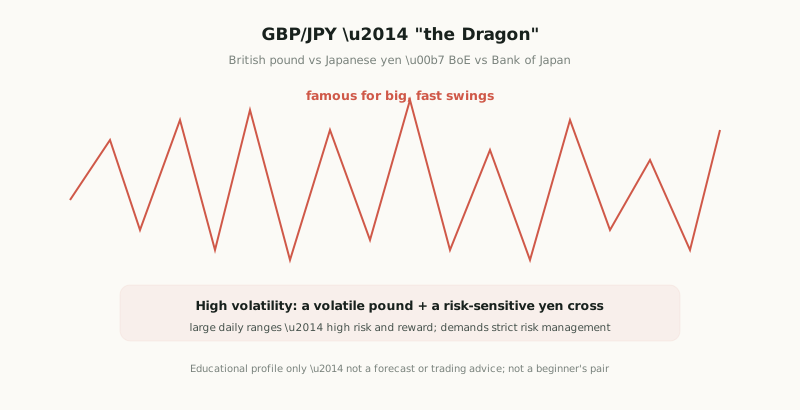
Why the Dragon is so volatile
GBP/JPY's defining feature is its high volatility — it's one of the most volatile of the widely-traded pairs, known for large, fast price swings and wide daily ranges. This isn't random; it comes from combining two sources of movement. First, the pound is itself a relatively volatile currency — GBP can move sharply on UK economic data, Bank of England policy, and UK political developments, so any pound pair tends to be livelier than average. Second, GBP/JPY is a yen cross, and as such it carries the full risk-sentiment sensitivity that the yen brings (covered in the EUR/JPY guide): the safe-haven yen makes the pair swing with global risk appetite, falling in risk-off (stronger yen, carry unwinds) and rising in risk-on (weaker yen). When you stack a volatile pound on top of a risk-sensitive yen cross, you get a pair that can move on both UK-specific catalysts and shifts in global risk sentiment — two independent engines of volatility, which together produce the Dragon's characteristic large, rapid moves.
The result is a pair capable of moving a great distance in a short time — wide intraday ranges, fast swings, and the capacity for dramatic moves when UK events and risk-sentiment shifts coincide. This volatility is GBP/JPY's signature and the source of both its appeal and its danger. For traders who thrive on movement, the Dragon offers plenty of opportunity — large ranges mean large potential moves to capture. But the same volatility that creates opportunity creates risk: the pair can move against a position just as far and fast as it can move in favour, and the wide swings can quickly hit stops, trigger slippage, and produce large losses for the unprepared. Understanding why GBP/JPY is so volatile — the stacking of a volatile pound and a risk-sensitive yen cross — is the key to approaching it with appropriate respect rather than being caught out by moves that would be unusual in a calmer pair.
Drivers and the volatility warning
GBP/JPY's drivers follow from its two sides. On the pound side: Bank of England policy and the rate gap versus the BoJ, the UK economy (data releases), and UK political developments — all of which can move the pound sharply. On the yen side: the safe-haven yen and global risk sentiment (the dominant risk-mood driver), the carry dynamic (GBP/JPY is a carry trade, holding the higher-yielding pound against the funding yen — favourable in calm conditions, unwinding in panics), and Bank of Japan policy/intervention risk. So the pair responds to UK-specific news, Japanese/yen factors, and — heavily — the global risk mood, with its volatility amplified by the combination.
GBP/JPY's volatility makes it a pair for experienced traders, not beginners. The large, fast swings that offer big rewards can produce equally big, rapid losses — and the wide ranges mean stops are hit faster, slippage is worse, and an oversized position can do serious damage in moments. It demands strict risk management above all: conservative position sizing (ideally volatility-based, since the Dragon's wide ranges require wider stops and therefore smaller positions to keep risk controlled), sensible stops, and full awareness that this pair moves more than most. Trading the Dragon without respecting its volatility is a fast way to a large loss. It's not a sensible starting point for a beginner.
The honest, educational summary, with the site's risk-first philosophy front and centre: GBP/JPY — the Dragon — is one of forex's most volatile widely-traded pairs, its big, fast swings arising from combining a volatile pound (BoE, UK economy and politics) with a risk-sensitive yen cross (the safe-haven yen, global risk sentiment, carry). That volatility is its defining feature — the source of both opportunity and serious danger. The pair responds to UK-specific catalysts and global risk shifts alike, and can move dramatically when they coincide. For any trader, the essential point is that GBP/JPY demands strict risk management and respect for its volatility: volatility-based position sizing (wider stops, smaller positions), disciplined stops, and the recognition that this is a pair for experienced traders, not beginners. Approached with that respect — understanding why it moves so much and sizing accordingly — the Dragon's volatility can be navigated; approached carelessly, it bites. As always, this is a profile of the pair's character, not a recommendation to trade it: GBP/JPY's wild reputation is earned, and it should be treated with the caution that reputation warrants.
Approaching the Dragon safely
If you do follow GBP/JPY, the practical emphasis is squarely on managing its volatility. On timing, the pair is most active during the overlap of the Tokyo and London sessions and through the European session — when both the yen's and the pound's home markets are awake and UK data lands — which is when its largest moves tend to occur (per the trading-sessions guide). Its volatility means even "quiet" periods can produce sizeable swings, so there's rarely a truly calm time to treat it casually.
On what to watch, the Dragon's two engines define the watchlist: on the pound side, Bank of England policy, UK economic data and UK political developments (any of which can jolt GBP); on the yen side, global risk sentiment (the dominant risk-mood driver), the carry dynamic, and BoJ policy/intervention risk. Because both a pound catalyst and a risk-sentiment shift can move it — and especially when they coincide — a trader needs to be aware of UK events and the global mood simultaneously. The pair can accelerate fast when, say, a hawkish BoE surprise lands during a risk-off lurch.
The risk-management emphasis is everything with GBP/JPY, and bears spelling out. Its wide ranges mean that sensible stops must be placed further away (to avoid being caught by normal Dragon-sized noise), which in turn means positions must be sized smaller to keep the money risked within prudent limits — this is exactly where volatility-based position sizing (from its own guide) earns its keep: let the stop reflect the pair's volatility, then size down so the risk per trade stays controlled. An oversized position in GBP/JPY can deliver an outsized loss in minutes, which is why it's a pair for experienced traders who respect its character, not a beginner's instrument. Its appeal to active traders is real — the large ranges offer big moves to capture — but that appeal is inseparable from the danger, and only disciplined risk management makes trading it sane. The honest framing: approach the Dragon, if at all, with conservative sizing, volatility-appropriate stops, and full awareness that it moves more than almost anything else — respect the volatility, and it can be navigated; ignore it, and it bites. This is a profile of the pair's character, not a recommendation to trade it.
Living with wide ranges
A practical reality of trading GBP/JPY is simply living with its wide ranges, which differ enough from calmer pairs to demand a different mindset. The Dragon routinely covers far more ground in a day than a placid pair like EUR/GBP, which has two consequences a trader must internalise. First, fixed pip stops are especially unsuitable here: a stop distance that would be sensible on a calm pair is mere noise to GBP/JPY, likely to be hit by ordinary swings before the trade has a chance — which is exactly why volatility-based stops (wider, reflecting the pair's true range) and correspondingly smaller positions are the right approach (the volatility-based-sizing guide). Trying to trade the Dragon with tight, calm-pair stops is a recipe for being repeatedly stopped out by normal movement.
Second, the wide ranges demand patience and emotional steadiness. A position in GBP/JPY can swing through large unrealised profits and losses in the course of a normal session, which tests a trader's composure — the temptation to panic-exit on a sharp adverse swing, or to over-celebrate a fast gain, is stronger here than in calmer pairs (the trading-psychology material on emotional control applies with extra force). The trader who survives the Dragon is the one who sizes small enough that its swings don't trigger emotional decisions, sets volatility-appropriate stops and then lets them do their job, and accepts the wide ranges as the pair's nature rather than fighting them. In short, living with GBP/JPY means adapting to its scale: bigger stops, smaller size, steadier nerves. Those who adapt can navigate it; those who treat it like a calm pair are quickly overwhelmed. As ever, this describes the pair's demands, not a recommendation to take them on.
GBP/JPY ("the Dragon") is one of the most volatile widely-traded pairs. Its big, fast swings come from stacking two sources of movement: a volatile pound (BoE policy, UK economy and politics) and a risk-sensitive yen cross (the safe-haven yen makes it swing with global risk sentiment — falling in risk-off, rising in risk-on — plus the carry dynamic). It responds to UK-specific catalysts and global risk shifts, and can move dramatically when they coincide. That volatility is the source of both opportunity and serious danger: wide ranges mean faster stop-outs, worse slippage, and big rapid losses for the unprepared. It demands strict risk management — volatility-based sizing (wider stops, smaller positions), disciplined stops — and is a pair for experienced traders, not beginners. Educational profile only — not a forecast or advice.