A fixed 20-pip stop-loss sounds tidy — until you apply it to a wildly volatile pair (where 20 pips is mere noise and you get stopped out instantly) and then to a quiet one (where 20 pips is needlessly far). Worse, the same pip stop represents different real risk from trade to trade, so your carefully chosen risk percentage quietly varies. Volatility-based position sizing fixes this by letting the stop distance and position size adapt to volatility, so that your risk per trade stays constant regardless of how wild or calm the market is. It is a more sophisticated, more consistent approach to sizing than fixed pip stops, and it is the standard among professional and systematic traders. This guide explains the problem with fixed stops, how volatility-based sizing works (typically using ATR), and why it keeps risk consistent.
It refines position sizing and stop placement, and is most often implemented with the ATR indicator.
Key takeaways
Q: What is volatility-based position sizing?
A: Volatility-based position sizing uses a measure of market volatility (commonly the ATR indicator) to set the stop distance and position size, so that your risk per trade stays consistent regardless of how volatile the instrument or period is. The stop and size adapt to conditions while the dollar risk stays fixed.
Q: Why are fixed pip stops a problem?
A: A fixed pip stop is too tight for a volatile pair (it gets hit by normal noise) and unnecessarily wide for a calm one. It also means the same pip distance represents different real risk across instruments and conditions, so your risk per trade varies unintentionally rather than staying controlled.
Q: How does ATR help with position sizing?
A: ATR (Average True Range) measures recent volatility. You place the stop a multiple of ATR away — wider when volatile, tighter when calm — so it respects each market's noise, then size the position so the dollar risk to that stop equals your fixed risk percentage. This keeps risk consistent while the stop adapts.
The problem with fixed stops
The intuitive approach to stops — using a fixed pip distance (always a 20-pip stop, say) — has two related problems that undermine consistent risk management. First, a fixed pip stop ignores the market's volatility, and so it is wrong for most conditions: on a highly volatile pair (or in a volatile period), a tight fixed stop sits well within the market's normal range of fluctuation, so it gets hit by ordinary noise — stopping you out of trades that would have worked, simply because the stop didn't account for how much the market routinely moves. On a calm pair (or in a quiet period), the same fixed stop is unnecessarily wide, risking more distance than the conditions warrant. A one-size-fits-all pip stop fits almost nothing well, because different markets and conditions have very different normal ranges of movement.
Second, and more fundamentally for risk management, a fixed pip stop means your real risk varies from trade to trade in ways you may not intend. If you always use a 20-pip stop but size positions the same way, the actual dollar risk and the relationship between your stop and the market's volatility differ across trades — a 20-pip stop on a volatile pair is a very different (and weaker) risk proposition than a 20-pip stop on a calm one. Your nominal "fixed" approach produces inconsistent real risk: sometimes your stop is too tight for conditions (high chance of a noise stop-out), sometimes too loose. This inconsistency is the opposite of what good risk management seeks. The core issue is that volatility varies — across instruments, and over time for the same instrument — and a stop (and position size) that ignores volatility cannot deliver consistent, appropriate risk. To size and stop consistently, you must account for how much the market actually moves, which is exactly what volatility-based sizing does.
How volatility-based sizing works
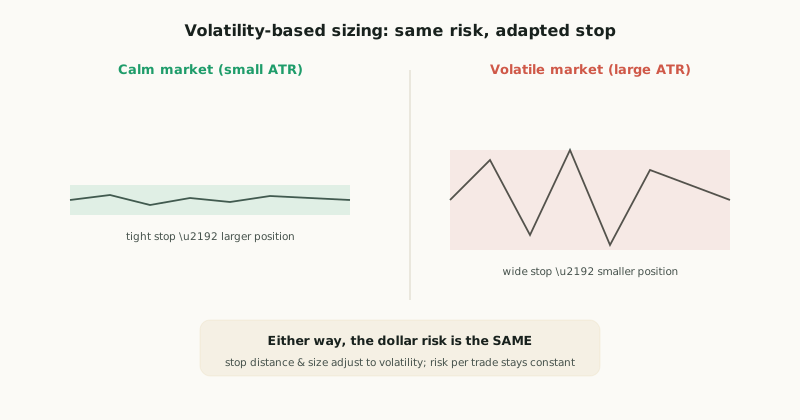
Volatility-based position sizing solves these problems by using a measure of volatility to set the stop, then sizing the position to keep risk constant. The most common volatility measure for this purpose is the ATR (Average True Range), which quantifies the average size of a market's recent price movements — a direct gauge of current volatility (covered in the ATR indicator guide). The method works in two steps. First, set the stop distance as a multiple of ATR (for example, a stop placed two ATRs away from entry). Because ATR reflects current volatility, this makes the stop adapt to conditions automatically: when volatility is high (large ATR), the stop is placed wider (giving the trade room to breathe amid the larger fluctuations, avoiding noise stop-outs); when volatility is low (small ATR), the stop is placed tighter (since the market isn't moving much, a wide stop isn't needed). The stop is thus always appropriate to the market's actual movement.
Second, size the position so that the dollar risk to that volatility-based stop equals your fixed risk percentage. This is the crucial step that keeps risk constant. Having set the stop distance from volatility, you then calculate the position size (using the standard position-sizing logic: risk amount ÷ stop distance) so that, whatever the stop distance, hitting the stop costs exactly your chosen risk (say 1% of the account). The result is the elegant property illustrated in the diagram: in a volatile market, the stop is wide, so the position is smaller (to keep the dollar risk fixed despite the wide stop); in a calm market, the stop is tight, so the position is larger (the tight stop allows a bigger position for the same dollar risk). The stop distance and position size both adjust to volatility — in opposite directions — so that the risk per trade stays exactly the same regardless of conditions. The table below contrasts the two approaches.
Fixed versus volatility-based sizing
| Aspect | Fixed pip stop | Volatility-based (ATR) |
|---|---|---|
| Stop distance | Always the same | Adapts (wider when volatile) |
| Respects market noise | No — often too tight or too wide | Yes — fits the conditions |
| Position size | Often fixed too | Adjusts to keep risk constant |
| Real risk per trade | Varies unintentionally | Consistent across trades |
Why it keeps risk consistent
The central benefit of volatility-based sizing is consistent risk across instruments and conditions — the holy grail of disciplined position sizing. Because the method fixes the dollar risk per trade while letting the stop and size flex with volatility, every trade carries the same risk regardless of whether you're trading a wild pair or a quiet one, in a turbulent period or a calm one. This consistency is exactly what risk management seeks: your 1% (or whatever you choose) really is 1% on every trade, not a figure that secretly varies with conditions. It makes your risk predictable and your expectancy meaningful (since each trade risks the same, results are comparable and your edge plays out cleanly across many trades).
The approach delivers further advantages. It produces stops that respect each market's noise, dramatically reducing the frustrating noise stop-outs that fixed-pip stops cause on volatile instruments — your stop is far enough away to survive normal fluctuation while still defining your risk. It adapts automatically as volatility changes over time: when a market becomes more volatile, your stops widen and positions shrink without you having to rethink it, keeping risk constant through changing regimes (and when volatility falls, the reverse). And it lets you trade different instruments consistently, since the volatility adjustment puts them all on the same risk footing — you can size a calm pair and a wild one to identical risk, comparing and combining them coherently. The honest framing: volatility-based sizing is a more sophisticated and more consistent approach than fixed pip stops, and it is widely used by professionals and systematic traders precisely because it solves the inconsistency problem — keeping risk constant while letting stops and sizes adapt to the ever-changing volatility of markets. It does require a volatility measure (ATR is standard) and a little more calculation than a fixed stop, but the payoff — genuinely consistent, appropriately-sized risk on every trade — is exactly what robust risk management aims for. For any trader serious about controlling risk precisely, sizing by volatility rather than by a fixed pip count is a significant step up, turning "I risk 1% per trade" from a rough approximation into a precise reality.
A worked example
A concrete example makes the consistency tangible. Suppose your rule is to risk 1% of a £10,000 account — £100 — per trade, and you set stops at two ATRs. You're looking at two opportunities. The first is a calm pair whose ATR is small, so two ATRs is a relatively tight stop — say 25 pips away. To risk exactly £100 over 25 pips, you take a position sized so that each pip is worth £4, giving a reasonably large position. The second is a volatile pair whose ATR is large, so two ATRs is a wide stop — say 100 pips away. To risk the same £100 over 100 pips, each pip can only be worth £1, giving a much smaller position.
Notice the outcome: the calm pair gets a tight stop and a large position; the volatile pair gets a wide stop and a small position; yet both risk exactly £100. The volatility-driven differences in stop distance and position size precisely offset, holding the dollar risk constant. Equally important, each stop is appropriate to its market — the volatile pair's 100-pip stop gives the trade room to breathe amid its large swings (avoiding a noise stop-out), while the calm pair's 25-pip stop isn't wastefully wide. Had you instead used a fixed 25-pip stop on both, the volatile pair would likely be stopped out by routine noise, and your "1% risk" would have been an illusion of consistency.
In practice, the choice of ATR multiple (one ATR, two, three) is yours to calibrate: a larger multiple gives more breathing room (fewer noise stop-outs, but wider stops and smaller positions), a smaller multiple the reverse. Many traders settle on a multiple suited to their strategy and timeframe and apply it consistently. The mechanics are simple once set up — read the ATR, multiply for the stop distance, then size for fixed risk — and most charting platforms make ATR readily available. The small extra effort buys the genuine, precise risk consistency that fixed pip stops can never deliver.
Volatility-based position sizing uses a volatility measure (commonly ATR) to set stops and size, keeping risk per trade constant across instruments and conditions. Fixed pip stops fail because they ignore volatility — too tight on wild pairs (noise stop-outs), too wide on calm ones — making real risk vary unintentionally. The method: set the stop a multiple of ATR away (wider when volatile, tighter when calm, so it respects market noise), then size the position so the dollar risk to that stop equals your fixed risk %. Result: volatile market = wide stop + smaller size; calm market = tight stop + larger size; same risk either way (e.g. £100 risk whether the stop is 25 or 100 pips). Choose an ATR multiple suited to your strategy. It gives consistent risk, fewer noise stop-outs, and automatic adaptation as volatility shifts — which is why professionals favour it over fixed pip stops.