If you want one pair that captures the market's mood, it's AUD/JPY. By pitting a risk-on currency (the Australian dollar) against a safe-haven currency (the Japanese yen), it turns global risk sentiment into price more purely than almost any other pair — a true barometer of fear and greed. When risk appetite is high, both sides push it up; when fear strikes, both push it down. Add a classic carry-trade dynamic, and AUD/JPY becomes the textbook risk pair. This guide profiles it: why it's such a pure risk barometer, how the two sides reinforce each other, the carry angle, and what to know. (Educational only — a behavioural profile, not a forecast or advice.)
It's the purest expression of risk-on/risk-off, a classic carry trade, and combines the Aussie from AUD/USD with the safe-haven yen.
Key takeaways
Q: Why is AUD/JPY a risk-on/risk-off barometer?
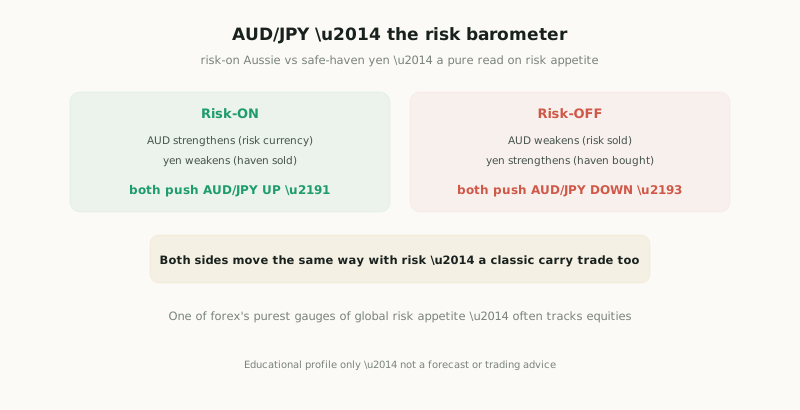
A: Because it pairs a risk-on currency (the Australian dollar) against a safe-haven currency (the Japanese yen). In risk-on conditions, the AUD strengthens and the yen weakens — both pushing AUD/JPY up. In risk-off, the AUD weakens and the yen strengthens — both pushing it down. Both sides move the same way with risk, amplifying the signal.
Q: What drives AUD/JPY?
A: Global risk sentiment is the dominant driver, since both currencies respond to it (in opposite ways that reinforce each other). Also important are the Australian dollar's commodity and China links, the carry-trade appeal of holding the higher-yielding AUD against the low-yielding yen, and the RBA versus BoJ rate gap.
Q: Why is AUD/JPY a popular carry trade?
A: Because it involves holding a historically higher-yielding currency (AUD) funded by a very low-yielding one (JPY), earning the interest differential. This carry appeal supports AUD/JPY in calm, risk-on conditions but causes it to fall sharply in risk-off, when carry trades unwind — reinforcing its risk sensitivity.
The purest risk barometer
AUD/JPY's claim to fame is being one of forex's purest risk-on/risk-off barometers, and the reason is elegant: it pairs a risk-on currency against a safe-haven currency, so both sides respond to risk sentiment in the same direction, amplifying the signal. Recall that the Australian dollar is a risk-on currency (it strengthens in risk-on, weakens in risk-off — from the AUD/USD guide), while the Japanese yen is a safe haven (it strengthens in risk-off, weakens in risk-on — from the EUR/JPY guide). Put them together in AUD/JPY (with the yen as the quote currency), and watch what happens with the risk mood, as the table shows.
AUD/JPY and the risk mood
| Condition | Risk-on (optimism) | Risk-off (fear) |
|---|---|---|
| AUD (risk currency) | Strengthens | Weakens |
| JPY (safe haven) | Weakens | Strengthens |
| Effect on AUD/JPY | Both push it UP | Both push it DOWN |
This is the key insight: in risk-on conditions, the AUD strengthens and the yen weakens — both effects push AUD/JPY up; in risk-off, the AUD weakens and the yen strengthens — both push it down. Because the two sides move the same way with risk sentiment (reinforcing rather than offsetting), AUD/JPY responds to the risk mood more purely and powerfully than a pair where only one side is risk-sensitive. It rises strongly in optimistic, risk-on markets and falls sharply in fearful, risk-off ones — tracking global risk appetite so cleanly that traders widely watch it as a barometer of risk sentiment, often correlated with global equities (which also rise in risk-on and fall in risk-off). If you want a single, clean read on whether the market is in a "risk-on" or "risk-off" mood, AUD/JPY is one of the best gauges in forex — its direction tells you the prevailing mood at a glance. This makes it valuable not just as a pair to trade but as an indicator of the broader risk environment, watched even by those trading other instruments.
The carry angle, drivers and what to know
Reinforcing AUD/JPY's risk sensitivity is the carry trade. The pair is a classic carry trade: it involves holding the historically higher-yielding Australian dollar funded by the very low-yielding yen, earning the interest-rate differential (the carry-trade guide explains this). This carry appeal means AUD/JPY attracts yield-seeking carry flows in calm, risk-on conditions (supporting it as traders hold the position for the yield), but those carry trades unwind violently in risk-off (traders rush to exit, selling AUD and buying back yen to repay funding), amplifying the pair's falls in a panic. So the carry dynamic and the risk-sentiment dynamic point the same way and reinforce each other: in risk-on, both the safe-haven dynamic and favourable carry support the pair; in risk-off, both safe-haven yen demand and carry unwinds slam it down. This double reinforcement is why AUD/JPY can fall so hard and fast in risk-off episodes — it's a defining feature of the pair.
AUD/JPY's drivers, then, are: global risk sentiment (the dominant driver, via both sides), the carry dynamic, the Aussie's commodity and China links (the AUD side — commodities and Chinese growth, which themselves correlate with the risk/growth cycle), the RBA-versus-BoJ rate gap (the carry's attractiveness), and BoJ policy/intervention risk on the yen. In character, it's a liquid yen cross and a premier risk barometer, capable of sharp moves in risk events (especially down, given the double reinforcement in risk-off). For a trader, the key things to know are: it's a risk gauge (its direction reflects global risk appetite — useful as an indicator, and meaning its moves are driven by the risk mood more than pair-specific factors); respect its risk-off sensitivity (it can fall sharply and fast in panics as the yen surges and carry unwinds — a real volatility/gap risk to manage with sound position sizing and stops); be aware of the carry dynamic (rewarding in calm, dangerous in fear); and watch global risk sentiment and equities as primary drivers. The honest, educational summary: AUD/JPY is one of forex's purest risk-on/risk-off barometers, pairing a risk-on currency (AUD) against a safe haven (JPY) so both sides reinforce the risk signal — rising in risk-on, falling sharply in risk-off — with a classic carry-trade dynamic that amplifies the effect. It's as much a read on the market's mood as a pair to trade, and its risk-off sensitivity demands respect.
Watching and trading AUD/JPY
In practice, following AUD/JPY is largely about reading the global risk mood, since that's what the pair tracks so purely. On timing, with both the Australian dollar and the yen rooted in the Asia-Pacific, AUD/JPY sees notable activity in the Asian/Tokyo and Sydney sessions — when Australian and Japanese developments and Asian risk sentiment set the tone — while remaining liquid through the European and US sessions, especially around risk-moving events anywhere in the world (per the trading-sessions guide). Because it responds to the global mood, AUD/JPY can move on risk catalysts from any region at any hour.
On what to watch, the priority is clear: global risk sentiment dominates — equities, volatility, and the broad market tone are the primary guide to AUD/JPY's direction, more so than any pair-specific data, because both sides respond to the mood. Beyond that: the Aussie's commodity and China links (which themselves move with the global growth/risk cycle), the carry and the RBA-versus-BoJ rate gap (the carry's attractiveness), and BoJ policy/intervention. Many traders also use AUD/JPY as an indicator — watching its direction as a clean read on whether the market is in a risk-on or risk-off mood, information they apply to other positions too.
A few practical notes. The pair's defining risk is its risk-off sensitivity: because both the safe-haven yen and carry unwinds compound on the downside, AUD/JPY can fall especially sharply and fast in panics — a real volatility/gap risk to respect with sound position sizing and stops, and a reason not to be lulled by a steady risk-on climb that can reverse violently. Its close correlation with NZD/JPY (and with equities) matters for exposure: holding AUD/JPY alongside NZD/JPY, or alongside other risk-on positions, concentrates risk in the single theme of global risk appetite (a correlation-risk and portfolio-heat consideration). And the carry rewards calm but punishes fear, so the pair suits an awareness of the risk environment above all. None of this is advice on how to trade AUD/JPY; it's how this purest of risk barometers' character shapes what its followers watch and the risks they weigh — with the global risk mood the single most important thing to read.
The equity-market link
One relationship worth highlighting is AUD/JPY's strong tendency to move with global equity markets. Because both AUD/JPY and stock markets are fundamentally risk-on assets — they rise when investors are optimistic and seeking risk, and fall when fear takes over — they're driven by the same underlying force (the global risk mood) and therefore tend to be positively correlated: when equities rally in risk-on optimism, AUD/JPY tends to rise; when equities sell off in risk-off fear, AUD/JPY tends to fall. This makes the pair a kind of currency-market echo of the stock market's risk appetite, and is a big part of why it's regarded as such a clean risk barometer.
This link has a couple of practical uses. As cross-confirmation: a trader gauging the risk environment can look at AUD/JPY and equities together — when they agree (both rising or both falling), the risk signal is clearer; a divergence between them can be a flag worth investigating. And as context: understanding that AUD/JPY largely follows the same risk currents as global stocks reminds a trader that the pair's moves are driven by the broad market mood more than by Australia-or-Japan-specific news, so watching equity markets and the general risk tone is watching AUD/JPY's main driver. It also reinforces the correlation-risk point: holding AUD/JPY alongside risk-on positions in other markets (equities, other risk currencies) stacks exposure to the same risk-appetite theme, which a trader should account for in total risk. The equity link, in short, underlines what AUD/JPY fundamentally is — a currency expression of global risk appetite, moving in sympathy with the world's stock markets.
AUD/JPY is one of forex's purest risk-on/risk-off barometers. It pairs a risk-on currency (AUD) against a safe haven (JPY), so both sides move the same way with risk sentiment: risk-on → AUD up + yen down → AUD/JPY rises; risk-off → AUD down + yen up → AUD/JPY falls (often sharply). Because the two sides reinforce rather than offset, it tracks the risk mood more purely than most pairs — widely watched as a risk gauge, correlated with equities. It's also a classic carry trade (higher-yield AUD funded by low-yield yen): carry supports it in calm/risk-on and unwinds violently in risk-off, amplifying falls. Drivers: global risk sentiment (dominant), carry, the Aussie's commodity/China links, the RBA–BoJ rate gap. Respect its sharp risk-off moves with sound sizing and stops. Educational profile only — not a forecast or advice.