NZD/JPY is AUD/JPY's higher-octane cousin — another risk barometer and carry trade, but built on the Kiwi's higher yields and smaller market. Like AUD/JPY, it pairs a risk-on currency (the New Zealand dollar) against the safe-haven yen, so it rises in risk-on and falls in risk-off, rewarding calm and punishing panic. But its higher yields make it an even more prized carry trade, and its smaller market makes it run a touch hotter. This guide profiles NZD/JPY: its risk-and-carry character, how it compares with AUD/JPY, its drivers, and what to know. (Educational only — a behavioural profile, not a forecast or advice.)
It's the close cousin of AUD/JPY (which explains the risk-barometer logic), a high-yielding carry trade, and combines the Kiwi from NZD/USD with the yen.
Key takeaways
Q: What drives NZD/JPY?
A: NZD/JPY is driven by global risk sentiment (both the risk-on Kiwi and safe-haven yen respond to it, reinforcing each other), the carry-trade appeal of the higher-yielding NZD funded by the low-yielding yen, the New Zealand dollar's dairy and commodity links, and the RBNZ versus BoJ rate gap.
Q: How is NZD/JPY different from AUD/JPY?
A: They're very similar — both are risk-on currencies against the safe-haven yen, both risk barometers and carry trades, and they're closely correlated. NZD/JPY tends to be a higher-yielding carry trade (the Kiwi's higher historical yields) and, from a smaller, less liquid market, can be a touch more volatile than AUD/JPY.
Q: Why is NZD/JPY a carry trade?
A: Because it involves holding the historically higher-yielding New Zealand dollar funded by the very low-yielding yen, earning the interest differential. This makes it a popular, high-yielding carry trade — supportive in calm conditions but prone to sharp falls when carry trades unwind in risk-off episodes.
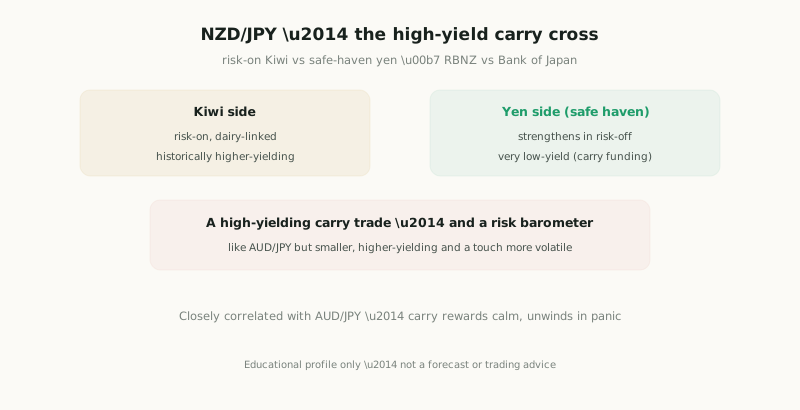
The pair at a glance
NZD/JPY profile
A risk barometer and high-yield carry
NZD/JPY shares AUD/JPY's essential character: it's a risk-on/risk-off barometer built on the same logic. The New Zealand dollar is a risk-on currency (it strengthens in risk-on, weakens in risk-off — from the NZD/USD guide), and the yen is a safe haven (strengthening in risk-off, weakening in risk-on). So, exactly as with AUD/JPY, both sides move the same way with risk sentiment: in risk-on, the Kiwi strengthens and the yen weakens, both pushing NZD/JPY up; in risk-off, the Kiwi weakens and the yen strengthens, both pushing it down. This makes NZD/JPY another clean risk gauge, rising in optimistic markets and falling in fearful ones, watched (alongside AUD/JPY) as a read on global risk appetite.
Where NZD/JPY stands out is the carry trade. Because the New Zealand dollar has historically offered higher yields than even the Australian dollar, NZD/JPY has often been an especially attractive, high-yielding carry trade — holding the higher-yielding Kiwi funded by the very low-yielding yen to capture a larger interest differential. This made it a favourite carry pair for yield-seekers. The carry dynamic, as always with yen crosses, cuts both ways: the high yield supports the pair in calm, risk-on conditions (traders hold it for the attractive carry), but the carry trade unwinds sharply in risk-off (a rush to exit and buy back yen), amplifying the pair's falls. Because NZD/JPY's carry has historically been among the most attractive of the yen crosses, this carry-and-risk dynamic is particularly pronounced — the pair can be well-supported in calm yield-seeking environments and fall especially hard when carry trades unwind in a panic. So NZD/JPY is best understood as a high-yielding carry cross that is also a risk barometer, with the carry and risk dynamics reinforcing each other as in AUD/JPY, but with the carry element especially prominent given the Kiwi's yields.
Versus AUD/JPY, drivers and what to know
Given how alike they are, the natural comparison is with AUD/JPY. The two are very similar and closely correlated: both pair a risk-on Antipodean currency against the safe-haven yen, both are risk barometers and carry trades, and they tend to move closely together (much as AUD/USD and NZD/USD do) — a correlation worth noting for correlation risk (trading both NZD/JPY and AUD/JPY in the same direction is largely doubling the same risk/carry bet, not diversifying). The differences are matters of degree: NZD/JPY tends to be the higher-yielding carry trade (the Kiwi's higher yields), and, because New Zealand is a smaller, less liquid economy than Australia, NZD/JPY can be a touch more volatile than AUD/JPY — running a little hotter, with the potential for sharper moves. In broad terms, though, what's true of AUD/JPY is true of NZD/JPY, with the carry a bit richer and the ride a bit bumpier.
NZD/JPY's drivers are accordingly: global risk sentiment (dominant, via both sides), the high-yield carry dynamic, the Kiwi's dairy and commodity links (the NZD side), the RBNZ-versus-BoJ rate gap (the carry's attractiveness), and BoJ policy/intervention risk. In character, it's a yen-cross risk barometer and prominent carry trade, a touch more volatile than AUD/JPY, and closely correlated with it. For a trader, the key things to know are: it's a risk gauge and carry trade (its direction reflects risk appetite, and the carry is central); respect its risk-off sensitivity (it can fall sharply and fast in panics as the yen surges and the high-yield carry unwinds — perhaps even more so than AUD/JPY — demanding sound position sizing and stops); be very aware of the AUD/JPY correlation (don't unknowingly double up); and note the higher volatility versus AUD/JPY given New Zealand's smaller market. The honest, educational summary: NZD/JPY is a high-yielding carry cross and risk-on/risk-off barometer — the Kiwi against the safe-haven yen — very like AUD/JPY (closely correlated, same risk logic) but with a richer carry and a touch more volatility. Understand it as AUD/JPY's higher-octane cousin: a clean risk gauge and prominent carry trade that rewards calm and punishes panic, to be traded with respect for its sharp risk-off moves.
Watching and trading NZD/JPY
In practice, following NZD/JPY looks much like following AUD/JPY — with AUD/JPY itself on the watchlist. On timing, with both the Kiwi and the yen in the Asia-Pacific, the pair is active in the Asian and Sydney/Wellington sessions (New Zealand is among the first markets open in the trading week), and remains liquid through the European and US sessions, moving on risk catalysts from anywhere (per the trading-sessions guide).
On what to watch, the list mirrors AUD/JPY's with a carry emphasis: global risk sentiment first (equities, the market mood — the dominant driver, since both sides respond to it); the high-yield carry and the RBNZ-versus-BoJ rate gap (especially central here given the Kiwi's richer yields); the Kiwi's dairy and commodity links; BoJ policy/intervention; and — distinctively — AUD/JPY itself, since the two move so closely that watching the Aussie cross is part of reading the Kiwi cross. As with AUD/JPY, NZD/JPY's direction also serves as a read on global risk appetite.
A few practical notes. The dominant practical fact is the AUD/JPY correlation: NZD/JPY and AUD/JPY move so closely together that they should be treated as near-duplicate, not independent, exposures — holding both in the same direction concentrates risk in a single risk/carry theme (a correlation-risk and portfolio-heat consideration), and AUD/JPY often acts as a lead the Kiwi cross follows. The higher carry and lower liquidity (New Zealand's smaller market) make NZD/JPY a touch more volatile and prone to sharper moves than AUD/JPY — and the rich carry means carry unwinds in risk-off can be especially brutal, so its downside moves warrant particular respect with sound position sizing and stops. As a high-yield carry trade, it rewards calm yield-seeking conditions and punishes panic. None of this is advice on how to trade NZD/JPY; it's how this high-octane carry cousin of AUD/JPY's character shapes what its followers watch and the risks they weigh — with the AUD/JPY relationship and the risk mood the things to keep most firmly in view.
The carry trade in focus
Because the carry is so central to NZD/JPY, it's worth looking at how it actually works for the pair. When a trader holds NZD/JPY long (buying the higher-yielding Kiwi, funded by the low-yielding yen), they earn the interest-rate differential — in practice received as a small positive swap credit for each night the position is held (the swap mechanism from the cost-of-trading guide). Over time, in calm conditions, these nightly credits accumulate into a meaningful return on top of any favourable price movement — the essence of the carry trade's appeal, and why a high-yielding pair like NZD/JPY has historically attracted yield-seekers willing to hold it for the carry. The richer the Kiwi's yield advantage over the yen, the more attractive this carry.
But the carry's reward comes with its characteristic danger, which the risk-management and carry-trade guides stress. The accumulated carry income can be wiped out in moments when the pair falls, because carry trades unwind in risk-off: when fear strikes, the crowd holding the carry rushes to exit simultaneously (selling NZD, buying back yen to repay funding), driving the pair down sharply — and a high-yield, popular carry pair like NZD/JPY can fall especially hard in such an unwind, as the very popularity that built up the position turns into a stampede for the exits. History offers periodic examples of high-yield carry crosses collapsing rapidly when risk sentiment turned. The lesson is that the carry is "picking up pennies" that can be undone by a single sharp drop, so it must be traded with the downside firmly in mind — sound position sizing and stops, and full awareness that the steady carry income is no protection against (and can lull a trader into underestimating) the risk of a violent risk-off unwind. NZD/JPY's carry is a genuine feature, but a double-edged one: rewarding patience in calm markets, punishing complacency in fearful ones.
NZD/JPY is a high-yielding carry cross and risk-on/risk-off barometer — AUD/JPY's higher-octane cousin. Like AUD/JPY, it pairs a risk-on currency (the Kiwi) against the safe-haven yen, so both sides reinforce the risk signal: risk-on → up, risk-off → down (often sharply). Its standout feature is the carry: the Kiwi's historically higher yields make it an especially attractive, high-yielding carry trade (higher-yield NZD funded by low-yield yen) — supportive in calm/risk-on, unwinding hard in risk-off. It's closely correlated with AUD/JPY (don't double up — correlation risk) but tends to be higher-yielding and, from a smaller market, a touch more volatile. Drivers: global risk sentiment, the high-yield carry, the Kiwi's dairy/commodity links, the RBNZ–BoJ rate gap. Respect its sharp risk-off moves with sound sizing and stops. Educational profile only — not a forecast or advice.