Currencies move for reasons — not randomly. Behind the flickering price of any pair sits a handful of identifiable forces, all ultimately acting through the same mechanism of supply and demand, that drive exchange rates up and down. Understanding what moves the forex market is the foundation everything else in trading builds on: you can't analyse, anticipate or manage what you don't understand the drivers of. This guide explains, simply, the main forces that move currency prices — and points to where each is covered in depth.
It's the big-picture overview behind the types of forex analysis and the economic calendar, and it complements what forex trading is.
Key takeaways
Q: What moves the forex market?
A: A handful of forces, all ultimately acting through supply and demand for a currency: interest rates and central-bank policy, economic data (growth, inflation, employment), risk sentiment (risk-on versus risk-off), trade and capital flows, and geopolitics and news. When demand for a currency rises relative to supply, it strengthens; when it falls, the currency weakens.
Q: Why are interest rates so important to forex?
A: Because money tends to flow toward higher returns. When a country's central bank raises interest rates (or is expected to), its currency typically becomes more attractive to hold, increasing demand and strengthening it; cuts tend to weaken it. Markets are forward-looking, so currencies often move on the expectation of rate changes — driven by central-bank guidance and economic data — rather than only on the changes themselves.
Q: Do all these factors act through supply and demand?
A: Yes. Every driver of currency prices — rates, data, sentiment, flows, geopolitics — ultimately works by changing the balance of supply and demand for that currency. More buyers than sellers pushes the price up; more sellers than buyers pushes it down. The various factors are simply the reasons traders, businesses, banks and governments decide to buy or sell, which is why they all funnel into that single mechanism.
The main drivers
A few forces account for most of what moves currencies. Each is a reason that market participants — banks, businesses, funds, governments and traders — decide to buy or sell a currency.
What moves currency prices
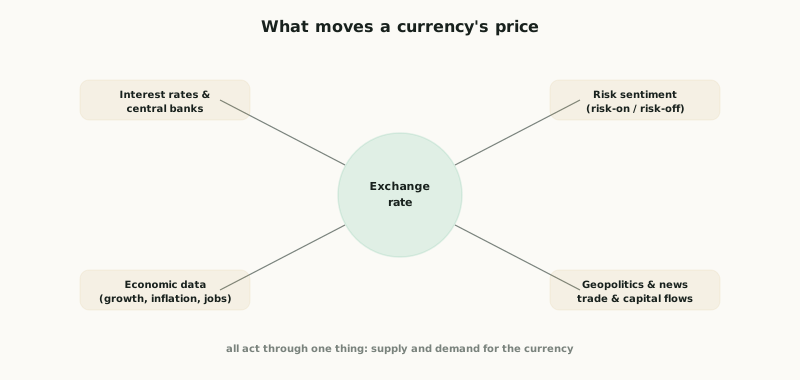
Interest rates and central banks are arguably the single biggest driver: money tends to flow toward higher returns, so when a central bank raises rates (or is expected to), its currency typically becomes more attractive to hold — demand rises and the currency strengthens; cuts tend to weaken it. Because markets are forward-looking, currencies often move on the expectation of rate changes, set by central-bank guidance and the data, rather than only on the changes themselves. Economic data — growth (GDP), inflation, employment and more — matters largely because it shapes those rate expectations and signals an economy's health; strong data tends to support a currency, weak data to undermine it (which is why traders watch the economic calendar). Risk sentiment — the market's overall appetite for risk — drives flows between "risk-on" currencies (favoured when optimism reigns) and "safe-haven" currencies (sought in fear), independent of any single country's data. Trade and capital flows generate real demand: a country's exports must be paid for in its currency, and foreign investment into its assets requires buying its currency, so persistent trade and investment patterns push exchange rates over time. And geopolitics and news — elections, conflicts, crises, surprise announcements — can move money fast, especially toward havens, as uncertainty changes where participants want to hold their capital.
It all comes down to supply and demand
The unifying idea — and the one that makes all of this coherent rather than a list to memorise — is that every one of these forces acts through a single mechanism: supply and demand for the currency. A currency's price is simply the balance between those wanting to buy it and those wanting to sell it: more buyers than sellers and the price rises (the currency strengthens); more sellers than buyers and it falls (the currency weakens). Interest rates, data, sentiment, flows and geopolitics are all just reasons that tip that balance — reasons participants decide to acquire or offload a currency. Seen this way, the drivers aren't five disconnected topics but five answers to one question: what is making people want to hold, or get rid of, this currency right now? This is also why the factors interact and sometimes conflict (strong data might support a currency while a risk-off shock simultaneously pulls money to havens), and why no single factor predicts price with certainty — the market is weighing all of them at once, along with expectations about the future. For a beginner, the goal isn't to forecast precisely (no one can do that reliably) but to understand the forces in play, so that price movements make sense rather than seeming random, and so you know what to watch. From here, the deeper mechanics live in the analysis articles and the fundamental-analysis section. The honest framing: currencies move for reasons, not randomly, driven by a handful of forces — interest rates and central banks (higher rates attract demand), economic data (growth, inflation, jobs, shaping expectations), risk sentiment (risk-on vs risk-off), trade and capital flows (real demand), and geopolitics and news (shocks and uncertainty). Crucially, all of them act through one mechanism: supply and demand for the currency — more buyers than sellers strengthens it, more sellers than buyers weakens it. The factors interact and conflict, so none predicts price with certainty; the beginner's goal is to understand the forces, not to forecast, so movements make sense and you know what to watch.
How it plays out in practice
Knowing the drivers is essential, but a beginner needs one more honest lesson to use that knowledge well: the market doesn't respond to news as simply as you'd expect. It's tempting to assume that good economic data must push a currency up, a rate hike must strengthen it, and bad news must sink it — and then to be baffled when prices do the opposite. The reason is that markets are forward-looking and constantly price in expectations. By the time a piece of news arrives, the market has usually already moved in anticipation of it, so what matters is not the news itself but how it compares to what was expected. A strong jobs number that's weaker than the market hoped for can send a currency down, even though the data was "good," because expectations had been set higher. This is the logic behind the old market saying "buy the rumour, sell the news": price runs up on the expectation of a positive event, then falls when the event actually arrives and traders take profits, the anticipation now spent.
Two further realities complete the picture. First, the drivers interact and conflict: at any moment, interest-rate expectations might support a currency while a risk-off shock simultaneously drags money toward havens, and the price reflects the net of all these forces, weighted by what the market currently cares about most — which is why no single factor reliably predicts price. Second, relative comparison is what matters in forex specifically: because you trade currencies in pairs, it's never about one currency in isolation but about one country's situation versus the other's. A currency can strengthen not because its own economy improved but because the other country's deteriorated. For a beginner, the practical takeaways are liberating rather than discouraging: don't expect data releases to produce predictable, mechanical moves; understand that expectations are already in the price and surprises (versus expectations) are what move markets; appreciate that conflicting forces and pair-relative comparisons make precise prediction impossible even for professionals; and therefore focus on understanding and risk management rather than forecasting. Knowing what moves currencies tells you what to watch and helps price action make sense — it does not, and cannot, give you a crystal ball, which is exactly why disciplined risk management matters regardless of how well you understand the drivers. The honest framing: the drivers don't move price mechanically — markets are forward-looking and price in expectations, so what matters is the surprise versus expectations ("buy the rumour, sell the news"), the drivers interact and conflict (price reflects the net), and forex is always relative (one currency versus the other). Beginners should understand the forces to know what to watch and make price action sensible — not to forecast, which no one does reliably — and rely on risk management throughout.
Where to go from here
This overview is deliberately a map, not the territory — enough to make price movements feel sensible rather than random, and to know which forces to watch. Each driver opens into far more depth elsewhere on the site. The interplay of growth, inflation, rates and policy is the domain of fundamental analysis; the practical calendar of data releases is covered in reading an economic calendar; and how these macro forces sit alongside chart-based and sentiment-based methods is laid out in the types of forex analysis. A sensible next step is simply to start noticing: when a pair moves sharply, ask which of these forces was likely behind it, and check it against the news and the calendar. That habit — connecting movements to drivers — builds the intuition that turns a beginner's bewilderment at "random" price action into a working understanding of a market that, while never fully predictable, is far from arbitrary.
What moves the forex market: a handful of forces, all acting through supply and demand for the currency. The main ones are interest rates & central banks (money flows to higher returns, so higher/expected-higher rates tend to strengthen a currency), economic data (growth, inflation, jobs — shaping rate expectations and signalling health), risk sentiment (risk-on vs risk-off / safe havens), trade & capital flows (real demand from exports and investment), and geopolitics & news (shocks and uncertainty moving money fast). They're not five separate topics but five reasons people buy or sell — more buyers than sellers strengthens a currency, more sellers weakens it. They interact and conflict, so none predicts price with certainty; the beginner's goal is to understand the forces so price moves make sense and you know what to watch.