Should you trade forex or stocks? It's one of the first questions a new trader asks, and the honest answer is that they're genuinely different markets — in their hours, their choice of instruments, their typical leverage and what moves their prices — but they share the one thing that actually decides success: in both, you need an edge and the discipline to manage risk. This guide compares forex and stocks for beginners: how they differ, what each offers, and how to think about which might suit you.
It builds on what forex trading is, connects to what moves the forex market, and relates to choosing your trading style.
Key takeaways
Q: What is the main difference between forex and stocks?
A: Forex is a decentralised, over-the-counter market for trading currencies in pairs, open 24 hours a day, five days a week, with a small number of heavily traded major pairs and typically high leverage. Stocks are shares in companies traded on centralised exchanges during set hours, with thousands of individual instruments to choose from and typically lower leverage. They're also driven by different things — macroeconomics for forex, company performance for stocks.
Q: Is forex easier than stocks for beginners?
A: Neither is inherently easier. Forex offers fewer instruments to learn, near-continuous trading hours and high liquidity in the majors, but the high leverage available can be dangerous for beginners. Stocks offer huge choice and let you invest in companies you understand, but require picking among thousands of names. Success in either depends on having an edge and managing risk — not on which market you choose.
Q: Can you trade both forex and stocks?
A: Yes, many traders do, and some brokers offer both. But for a beginner, focusing on one market while learning is usually wiser than splitting attention. The core skills — risk management, discipline, having a tested approach — transfer between markets, but the specific drivers, instruments and behaviour differ, so it's easier to build competence in one before adding another.
The key differences
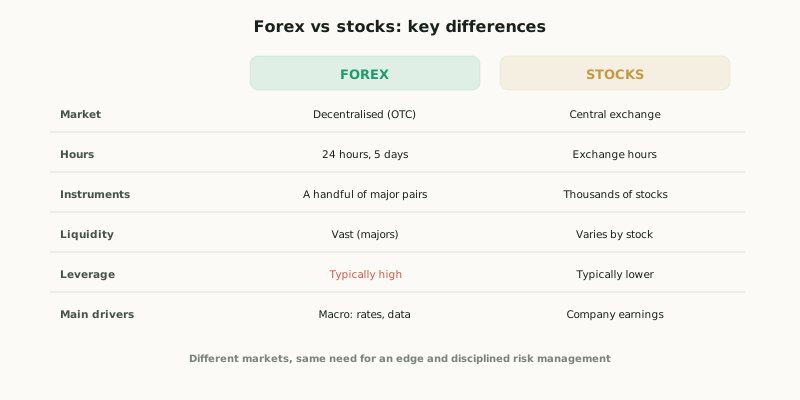
The two markets diverge across several structural dimensions, summarised below.
| Dimension | Forex | Stocks |
|---|---|---|
| Market structure | Decentralised (OTC) | Centralised exchange |
| Hours | 24/5 — around the clock | Set exchange hours |
| Instruments | A handful of major pairs | Thousands of stocks |
| Liquidity | Vast in the majors | Varies widely by stock |
| Leverage | Typically high | Typically lower |
| Main drivers | Macro: rates, data, sentiment | Company earnings & news |
Forex is a decentralised, over-the-counter market — there's no single exchange; currencies trade through a global network of banks and brokers — and it runs 24 hours a day, five days a week, following the sun around the world's financial centres. You trade currencies in pairs, and the bulk of activity concentrates in a small number of major pairs, which carry vast liquidity. Leverage available in forex is typically high (a double-edged feature — see pips, lots and leverage). Stocks, by contrast, are shares in individual companies traded on centralised exchanges during set hours, offering a choice of thousands of instruments with liquidity that varies from deeply traded blue-chips to thinly traded small-caps, and with typically lower leverage. Crucially, the two are driven by different forces: forex by macroeconomics — interest rates, economic data, central-bank policy and risk sentiment — while stocks respond above all to company-specific factors like earnings, guidance and sector news (alongside the broader market).
What each offers, and which might suit you
These differences translate into genuine trade-offs rather than a clear winner. Forex's appeal for beginners lies in its simplicity of choice (a handful of major pairs to learn rather than thousands of stocks), its near-continuous hours (convenient for those trading around a job or in a different time zone), and the deep liquidity and tight spreads of the majors. Its main hazard is the high leverage, which can amplify losses and ruin under-prepared beginners far faster than typical stock leverage — a reason for real caution. Stocks' appeal lies in the ability to invest in companies you understand, a tangible connection to real businesses, and the option to hold for the long term as well as trade; the cost is the burden of choice (researching among thousands of names) and the constraint of fixed exchange hours. Which suits you depends on your interests (do you enjoy macroeconomics or analysing companies?), your schedule (when can you actually trade?), and your temperament. But the most important point for a beginner is the one that cuts across the comparison: neither market is inherently easier or more profitable, and the choice of market is far less important than whether you bring a tested edge and sound risk management. The skills that determine success — discipline, a defined process, controlling risk — transfer between both, and they, not the venue, decide outcomes. A sensible beginner approach is to focus on one market while learning (splitting attention across both early on dilutes the steep learning each requires) and to add the other later if interest and competence warrant. The honest framing: forex and stocks are genuinely different — forex is decentralised, 24/5, a few major pairs, high leverage, macro-driven; stocks are exchange-traded, set hours, thousands of names, lower leverage, company-driven — each with real trade-offs but neither inherently easier. The choice matters less than bringing an edge and managing risk, which decide success in either; focus on one while learning, and remember the high leverage in forex demands particular caution.
Beyond the two: other markets, and getting started
Forex and stocks aren't the only options, and it helps a beginner to see where they sit among the alternatives. Commodities (gold, oil and the like) are driven by their own supply-and-demand dynamics and often by the same macro and risk-sentiment forces that move forex — indeed, several currencies are themselves "commodity currencies" tied to raw-material exports. Stock indices (baskets like a country's leading shares) let you trade a whole market's direction rather than single companies, sitting somewhere between individual stocks and macro trading. Cryptocurrencies trade around the clock like forex but are typically far more volatile, newer and less regulated — higher potential moves paired with higher risk. Many retail brokers now offer access to several of these markets through a single account (often via contracts for difference, or CFDs), so the choice isn't always either/or. The point of the comparison isn't to crown a winner but to help you choose a starting market that suits your interests and circumstances — and to recognise that the differences between markets are real but secondary.
That leads to the most encouraging insight for a beginner: the core skills transfer. Whichever market you start in, the things that actually determine success — risk management, discipline, having a tested approach, controlling your psychology, and patient capital preservation — are the same. A trader who learns to manage risk and follow a process in forex carries those abilities into stocks, indices or commodities; only the specific drivers, instruments and rhythms need relearning. This is why obsessing over "which market is best" is largely a distraction from the work that matters. Practically, getting started looks similar across markets: learn the fundamentals, choose a regulated broker, practise on a demo account, build a trading plan, and begin with small capital and small risk while you develop competence. Pick the market that genuinely engages you — because you'll learn faster studying something you find interesting — focus on it while building the transferable core skills, and treat the forex-versus-stocks question as settled the moment you've chosen somewhere sensible to begin and committed to learning to trade it well.
A word on leverage
Of all the differences, the one a beginner should weigh most heavily is leverage, because it has the biggest practical effect on how quickly you can get hurt. Forex typically offers far higher leverage than stock trading — meaning you control a large position with a small deposit — and while that magnifies gains, it magnifies losses just as powerfully, and it's the single most common reason inexperienced forex traders blow up faster than they expect. A modest adverse move on a heavily leveraged position can wipe out a large slice of an account, or trigger a margin call, in a way that the lower leverage typical of stock trading rarely does. This doesn't make forex "worse" — used responsibly, leverage is just a tool — but it does mean the discipline of using little leverage matters more in forex than almost anywhere else. A beginner moving from stocks to forex, in particular, should be conscious that the same position size feels far riskier here, and should deliberately trade small relative to capital. Whichever market you choose, treating leverage with respect (see the dangers of overleverage) is non-negotiable — but in forex it's the difference that bites soonest.
The bottom line on choosing between the two markets is worth restating plainly, because beginners often over-weight the decision: the differences between forex and stocks are real and worth understanding — they affect your hours, your choices, your costs and your risk — but they are secondary to the things that actually decide whether you succeed. A disciplined trader with a tested edge and tight risk control can do well in either market; an undisciplined one with no edge will lose in both, only faster in the more leveraged one. So weigh the structural differences, lean toward the market that genuinely interests you and fits your schedule, respect forex's leverage if that's where you start, and then put the comparison aside and get on with the real work: learning to trade well.
Forex vs stocks: forex is decentralised (OTC), open 24/5, concentrated in a few major pairs, with high leverage, driven by macro (rates, data, sentiment); stocks trade on central exchanges in set hours, offer thousands of instruments with lower leverage, driven by company earnings and news. Each has real trade-offs — forex offers fewer instruments and continuous hours but its high leverage is dangerous for beginners; stocks offer choice and businesses you can understand but demand picking among thousands. Neither is inherently easier or more profitable. The market matters far less than whether you have a tested edge and sound risk management — the skills that decide success transfer to both. Focus on one while learning, and treat forex's leverage with particular caution.