
Scalper, day trader, swing trader, position trader — these labels describe how long you hold trades, but the real question behind choosing your trading style isn't which sounds most exciting; it's which one genuinely fits your time, your temperament and your life. Pick a style that fights your natural disposition or your actual schedule, and it will work against you on every trade; pick one that fits, and execution feels far more natural. This guide explains the main trading styles and how to choose between them.
It's a key step in building a trading plan, it shapes which analysis you'll lean on, and it interacts with your trading mindset.
Key takeaways
Q: What are the main forex trading styles?
A: Four broad styles, defined mainly by how long you hold trades: scalping (seconds to minutes, many tiny trades), day trading (minutes to hours, all positions closed by the end of the day), swing trading (days to weeks, capturing larger moves), and position trading (weeks to months or longer, following major trends). Each demands a different amount of screen time, focus and tolerance for short-term noise.
Q: Which trading style is best for beginners?
A: There's no single 'best' style, but swing trading and position trading are often gentler for beginners because they require less screen time, involve fewer decisions, and are less affected by the noise and pressure of fast intraday moves. Scalping and day trading demand intense focus, fast decisions and significant time, which can overwhelm newcomers. The best style is the one that genuinely fits your schedule and temperament.
Q: How do I choose a trading style?
A: Match the style to your reality: how much time you can actually devote (scalping needs you glued to screens; position trading is hands-off), your temperament (can you handle fast-paced pressure, or do you prefer a slower pace?), and your personality. A style that fights your natural disposition or available time will be hard to sustain, while one that fits feels far more comfortable to execute consistently.
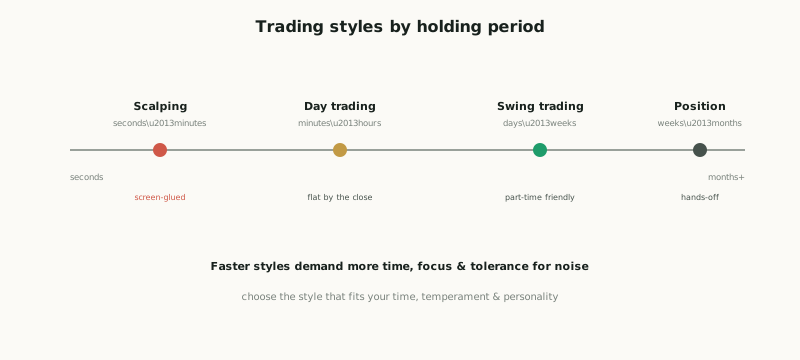
The four main styles
Trading styles are distinguished chiefly by holding period — how long a typical trade lasts — which in turn drives how much time, focus and noise-tolerance each demands.
The four trading styles
Scalping means taking many very short trades — holding for seconds to minutes — to capture tiny price moves, which demands intense focus, fast reflexes and being glued to the screen; costs (spread and slippage) matter enormously given the small targets. Day trading holds positions for minutes to hours and closes everything by the end of the day (no overnight risk), demanding significant time and concentration during trading hours. Swing trading holds for days to weeks, aiming to capture larger price swings; it requires far less screen time — often just periodic checks — making it friendly to part-time traders with jobs. Position trading holds for weeks to months (or longer), following major trends with a big-picture view; it's the most hands-off, leaning on higher-timeframe analysis and patience. As you move from scalping toward position trading, the time commitment and intensity fall, the influence of short-term noise diminishes, and the number of decisions drops — trade-offs that matter enormously when choosing.
How to choose the one that fits
The right style is the one that fits your reality, judged on three honest questions. First, time: how much can you actually devote to trading? Scalping and day trading require sustained, real-time attention during market hours — impossible alongside a demanding day job — whereas swing and position trading need only periodic checks, fitting around other commitments. Be honest here, because no style survives contact with a schedule that can't support it. Second, temperament: do you thrive under fast-paced pressure and rapid decisions, or do you make better choices at a slower, more considered pace? Someone who finds fast markets stressful will trade poorly as a scalper no matter how appealing the idea, while someone who can't bear holding through multi-day swings will struggle as a position trader. Third, personality: patience, decisiveness, tolerance for boredom or for adrenaline — all of these suit different styles. For beginners specifically, swing and position trading are often the gentler entry points: fewer decisions, less screen time, and less exposure to the noise and pressure that overwhelm newcomers in fast intraday trading (though there's no universal rule). The key principle is that a style which fights your natural disposition or available time is hard to execute consistently — and consistency is everything — whereas a well-fitting style feels comfortable enough to sustain through the inevitable hard patches. It's also fine to experiment (ideally on a demo account) to discover what suits you, and to evolve your style as your circumstances and experience change. The honest framing: trading styles are defined by holding period — scalping (seconds–minutes, screen-glued), day trading (minutes–hours, flat by close), swing trading (days–weeks, part-time friendly), position trading (weeks–months, hands-off) — with faster styles demanding more time, focus and noise-tolerance. Choose by matching the style to your time (what you can actually devote), temperament (fast pressure vs slower pace) and personality; beginners often find swing/position trading gentler. A style that fights your reality is hard to sustain; one that fits is far easier to execute consistently — experiment on demo to find yours.
Matching style to analysis, costs and life
Your chosen style doesn't just sit in isolation — it shapes several other practical choices, which is why matching matters beyond mere preference. It largely determines which timeframes and analysis you'll rely on: a scalper or day trader lives on short-term charts (one-minute to hourly) and intraday price action, while a swing trader works with daily charts and a position trader leans on weekly charts and the broader fundamental picture. Pick a style and you've largely picked your analytical world. Style also dictates how costs affect you: spread and slippage are a large fraction of a scalper's tiny targets (so execution quality and tight spreads are critical), whereas they're trivial relative to a position trader's large moves — but the position trader instead pays overnight swap charges for holding across days and weeks (see rollover and swap), which barely touch the day trader who's flat by the close. And style interacts with practicalities like your time zone: which sessions are active during your available hours can make some intraday approaches workable or impossible.
A concrete way to choose is to run your real circumstances through the styles. Someone with a full-time job and an hour in the evening simply cannot scalp or day-trade properly — the markets they could watch may be quiet, and the attention required isn't available — so swing or position trading, checked in the evening, is the honest fit. Someone who can dedicate full focus to the screen during active sessions, and who thrives on fast decisions, might suit day trading. Someone who finds rapid trading stressful but enjoys patient analysis is a natural swing or position trader regardless of their free time. Notice that the answer falls out of time plus temperament, not from which style sounds most appealing. It's also fine — and common — to blend styles (a "swing trader who occasionally day-trades a strong setup") or to evolve as your life changes: a style that fits while you're studying may not fit once you're working full-time, and adjusting is sensible, not inconsistent. The one constant is the principle: choose the style you can execute consistently given your real time, temperament and personality, test it on a demo before committing real money, and don't force yourself into a style that fights your life just because it looks exciting from the outside. Fit enables consistency, and consistency is what turns an edge into results.
The common beginner mistake
One mismatch is so common it's worth naming directly: beginners are frequently drawn to the fastest, most exciting styles — scalping and day trading — precisely because they look thrilling and promise quick action, when those are in fact the hardest styles to do well and often the worst fit for someone still learning. The fast pace that looks exhilarating from the outside translates, in practice, into relentless decisions, heavy exposure to costs and noise, intense screen time most beginners can't sustain, and an emotional pressure-cooker that punishes the very mistakes newcomers are still making. The "boring" styles — swing and position trading — are quietly far more forgiving: fewer decisions, more time to think, less noise, and a pace that lets a beginner actually apply what they're learning. The antidote is to choose your style from honest self-assessment (time, temperament, personality) rather than from the appeal of the action, and to be suspicious of any pull toward a style simply because it seems exciting. Excitement is not a trading edge; if anything, the desire for constant action is closer to the gambling instinct than the trading one. Choose for fit and sustainability, not for thrill — the calmer path is usually the wiser place to start.
A final reassurance: there is no prestige hierarchy among the styles. A patient position trader is not "less of a trader" than a frenetic scalper — if anything, the trader who has honestly matched their approach to their life and temperament, and can therefore execute it consistently, is doing the more sophisticated thing. The objective is never to trade in the most impressive-looking way; it's to trade in the way you can sustain profitably over the long run. Choose the style that lets you be consistent, and let go of any sense that a slower pace is a lesser one.
Trading styles are defined by holding period: scalping (seconds–minutes, many tiny trades, screen-glued), day trading (minutes–hours, flat by the close), swing trading (days–weeks, part-time friendly), and position trading (weeks–months, hands-off, trend-following). Faster styles demand more time, focus and tolerance for noise; slower ones need less screen time and fewer decisions. Choose by matching the style to your time (what you can actually devote), temperament (fast-paced pressure vs a slower pace) and personality — beginners often find swing or position trading gentler. A style that fights your reality is hard to sustain; one that fits is far easier to execute consistently — and consistency is what matters. Experiment on a demo to find yours, and let it evolve with you.