Should you study the charts, the economy, or the mood of the crowd? It's one of the first questions a new trader faces — and the answer, for most, is some of each. The three main approaches to analysing the forex market — technical, fundamental and sentiment analysis — are often presented as rival camps you must choose between, but they're better understood as three complementary lenses on the same market, each answering a different question. Understanding what each offers, and how they fit together, helps you find the approach (or blend) that suits you. This guide explains the three types of forex analysis, compares them, and shows why most traders combine them.
It's the conceptual map for the whole site: technical analysis and fundamental analysis each have their own deep clusters, while sentiment connects to themes like risk-on/risk-off.
Key takeaways
Q: What are the main types of forex analysis?
A: There are three main approaches. Technical analysis studies price itself — charts, patterns and indicators. Fundamental analysis studies the underlying economic and financial factors — interest rates, inflation, growth, central banks and news. Sentiment analysis gauges the mood and positioning of the market — how traders are positioned and whether the crowd is over-extended.
Q: Is technical or fundamental analysis better?
A: Neither is universally better — they're complementary, not rivals. They answer different questions: fundamentals help explain why a currency might move and its longer-term direction, while technicals help with the timing of entries and exits. Many traders combine them, and the best choice depends on your style and timeframe.
Q: Which type of analysis should a beginner learn first?
A: Beginners often start with technical analysis because it's visual and accessible — you can see patterns and levels directly on a chart. But it's important to understand that fundamentals drive the bigger picture too. A sensible approach is to learn one approach well first, while appreciating what the others offer, rather than dabbling shallowly in all three.
The three approaches
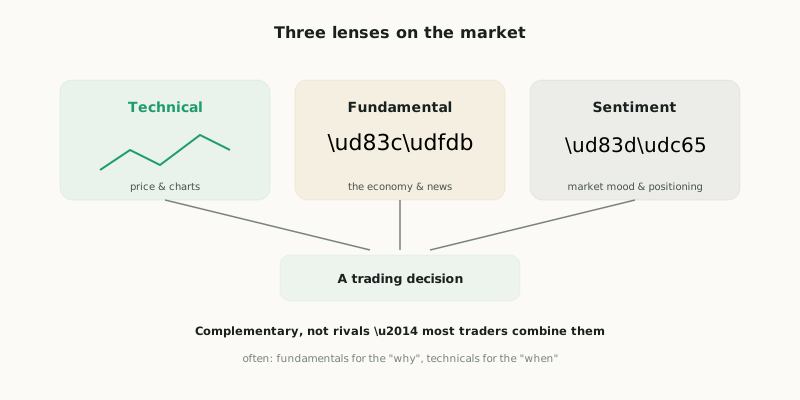
The three main approaches differ in what they study to understand and forecast the market.
Technical analysis studies price itself — the charts. It uses the history of price (and sometimes volume), reading charts, patterns, support and resistance, and indicators to forecast likely future moves. It rests on the idea that price action reflects all available information and tends to move in identifiable trends and patterns that can repeat. The technical analyst's focus is the chart: what price is doing and has done. Its tools are the subject of the site's large technical analysis cluster — charts, support and resistance, indicators, patterns and more.
Fundamental analysis studies the underlying economic and financial factors that drive a currency's value — interest rates, inflation, economic growth, central bank policy, employment, trade balances, political events and news. It aims to assess a currency's "true" value or likely direction based on the health and policy of its economy. The fundamental analyst's focus is the economy and news: why a currency might move. Its tools and topics fill the site's fundamental analysis cluster — interest rates, inflation, central banks, economic indicators and the rest.
Sentiment analysis gauges the mood and positioning of the market — how traders are collectively positioned, whether the crowd is bullish or bearish, the prevailing risk-on or risk-off mood, and crowd psychology. The idea is that market sentiment, especially when it reaches extremes (everyone positioned one way), can itself be informative — an over-extended crowd may signal a reversal. The sentiment analyst's focus is the market's mood and positioning. It's less often treated as a standalone discipline than technical and fundamental analysis, but it's a valuable third lens, drawing on tools like positioning data and sentiment surveys, and on understanding the fear-and-greed cycle that drives crowds.
The three lenses compared
| Approach | Studies | Answers |
|---|---|---|
| Technical | Price, charts, patterns, indicators | What is price doing? (when) |
| Fundamental | The economy, policy, news | Why might it move? (why) |
| Sentiment | Market mood & positioning | How is the crowd positioned? |
Complementary, not rivals
The classic "technical versus fundamental" debate frames these as opposing camps, but the more useful truth is that they're complementary, not mutually exclusive — and most successful traders combine them rather than picking one religiously. The reason is that they answer different questions, so they fit together naturally. A common and powerful combination is to use fundamentals for the "why" and direction — understanding which currencies have supportive or weak fundamentals, and the broader macro backdrop — and technicals for the "when" and timing — using charts to time precise entries and exits within that fundamental view. Fundamentals tell you the tide; technicals help you time the waves. Sentiment adds further context — a sense of how the crowd is positioned, which can flag when a move is over-extended or a reversal likely. Used together, the three lenses give a fuller picture than any one alone: the fundamental backdrop, the technical timing, and the sentiment context.
Which to emphasise depends on your style and timeframe. Short-term traders (scalpers, day traders) lean heavily on technical analysis, since they're trading on timing and price action over minutes and hours, where fundamentals move too slowly to time entries. Longer-term and macro traders lean more on fundamental analysis, since over weeks and months the economic factors dominate a currency's direction. But even within these tendencies, most traders use a blend appropriate to their approach. For beginners, technical analysis is often the natural starting point — it's visual and accessible, with patterns and levels you can see directly on a chart — but it's important to understand that fundamentals matter too (a chart can be blindsided by a major economic event), and that ignoring them entirely is a mistake. A sensible path is to learn one approach well first (often technical, given its accessibility) while appreciating what the others offer, rather than dabbling shallowly in all three at once. Depth in one lens, with awareness of the others, beats shallow familiarity with all.
The honest framing: the three types of analysis — technical (price and charts, the "when"), fundamental (the economy and news, the "why"), and sentiment (market mood and positioning) — are complementary lenses, not rival camps. Understand what each offers, recognise that most traders combine them (commonly fundamentals for direction, technicals for timing, sentiment for context), and choose an emphasis that fits your style and timeframe while appreciating the others. There's no single "right" approach — the right one is the one that suits you, applied with depth and discipline. As a beginner, start by learning one approach well, and build your understanding of the others over time. The whole of this site is organised around these lenses, so wherever you start, there's a path deeper in.
Going deeper into each approach
It's worth knowing a little more about what each approach involves in practice, and the debates around them, so you can judge where to invest your learning. Technical analysis, in practice, means working with charts: identifying the trend and market structure, marking support and resistance, recognising chart and candlestick patterns, and using indicators (moving averages, oscillators and the like) for additional signals. Its appeal is that it's directly observable and applies to any pair or timeframe; its critics point to the efficient market argument — the idea that prices already reflect all information, so past prices can't reliably predict future ones. In reality, markets are arguably not perfectly efficient, and many traders find genuine value in technical analysis, but it's best understood as reading probabilities and behaviour, not crystal-ball prediction — a theme the site's technical-analysis material returns to often.
Fundamental analysis, in practice, means following the economic and policy drivers: central bank decisions and interest-rate expectations, inflation and growth data, employment figures, and major news, then assessing what they imply for a currency's direction. Its strength is explaining the why behind big, lasting moves; its difficulty is timing — a currency can stay mispriced (relative to its fundamentals) for a long time, and reacting to news in real time is hard, which is partly why short-term traders lean on technicals instead. Sentiment analysis, in practice, means watching positioning and mood — whether the crowd is heavily one-sided, the prevailing risk appetite — often as a contrarian or contextual signal (an extremely one-sided crowd can precede a reversal). As for how to develop: rather than trying to master all three at once, it's usually wiser to build depth in one (most beginners start with technical, given its accessibility) while gradually learning enough of the others to understand the context they provide. Over time, many traders settle into a personal blend — perhaps primarily technical with an awareness of the fundamental backdrop and sentiment — that fits their style and timeframe. The aim is not to win the "technical versus fundamental" debate, which misunderstands the question, but to assemble a coherent, disciplined way of reading the market that works for you, drawing on whichever lenses serve your trading. Depth, coherence and discipline matter far more than which camp you nominally belong to.
Three main types of forex analysis: technical (studies price — charts, patterns, indicators — answering "what is price doing / when"), fundamental (studies the economy, policy and news — answering "why might it move"), and sentiment (gauges the market's mood and positioning — "how is the crowd positioned"). They're complementary lenses, not rival camps: most traders combine them, commonly using fundamentals for the "why"/direction, technicals for the "when"/timing, and sentiment for context. Which to emphasise depends on style and timeframe — short-term traders lean technical, longer-term/macro lean fundamental, most use a blend. Beginners often start with technical (visual, accessible) but should appreciate that fundamentals matter too. Learn one approach well first, while understanding the others — depth beats shallow dabbling.