Strip a market down to its essence and it's an auction: buyers and sellers haggling, price probing higher and lower to discover where business gets done. Auction market theory takes that simple truth and turns it into a powerful lens for understanding why price moves at all — not as random wandering or abstract patterns, but as a continuous process of seeking fair value. It's the conceptual foundation beneath Market Profile and much volume- and order-flow analysis, and it offers an intuitive way to read whether a market is ranging, trending, or rejecting a level. This guide explains auction market theory: the core idea, the concepts of value and acceptance, balance and imbalance, and what the framework does (and doesn't) offer.
It's the theory beneath Market Profile and order-flow analysis, closely related to supply and demand, and it deepens the idea of support and resistance.
Key takeaways
Q: What is auction market theory?
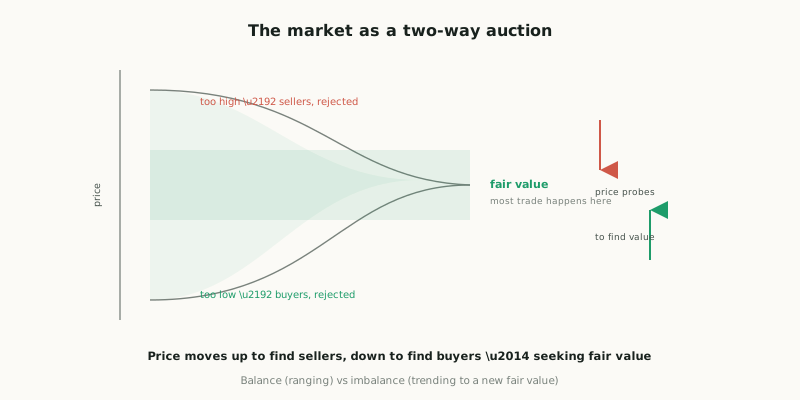
A: Auction market theory is the idea that a market is a continuous two-way auction between buyers and sellers, constantly negotiating price to find fair value. Price moves up to find sellers (until buying dries up) and down to find buyers, spending most of its time around the price where the most business gets done — the fair value, or value area.
Q: What is fair value in auction market theory?
A: Fair value is the price (or zone) where buyers and sellers most readily agree to transact, so the most volume or time accumulates there — the 'value area'. Price tends to oscillate around fair value during balance, and only moves decisively away when new information shifts what participants consider fair, seeking a new value level.
Q: What is the difference between balance and imbalance?
A: Balance is when a market is ranging — trading back and forth around an agreed fair value, a complete two-way auction. Imbalance is when it's trending — price moving directionally because buyers or sellers dominate, often as new information shifts perceived value, so the market seeks a new fair-value level before balancing again.
The core idea
Auction market theory holds that a market is a continuous two-way auction — buyers and sellers endlessly negotiating price to discover fair value. The mechanism is intuitive: price moves up to find sellers (it rises until it gets "too high," buying dries up, and sellers take over — the high is rejected), and price moves down to find buyers (it falls until "too low," buyers step in, and the low is rejected). Between these extremes lies fair value — the price where buyers and sellers most readily agree, where the most business gets done. The market's fundamental job is to facilitate trade: to find and revisit the price at which the most volume transacts. So price spends most of its time around fair value, probing the extremes only to confirm that they're, indeed, too high or too low.
This simple framing is surprisingly powerful, because it reframes everything a chart shows as the output of an auction. A market isn't moving randomly or because of mysterious forces — it's moving because, at each moment, buyers and sellers are negotiating, and price is being pushed to wherever it must go to find the other side of the trade. When you see price reject a high, auction theory says: it went up to find sellers, found plenty, and got pushed back. When you see it settle into a range, auction theory says: buyers and sellers have agreed on fair value and are transacting comfortably around it. This lens gives a reason for price behaviour, grounded in the actual process of trade — which is why it underpins more concrete tools like Market Profile (a visual map of where the auction did its business) and order-flow analysis (a close-up of the auction in real time).
Value, acceptance, balance and imbalance
Auction market theory comes with a handful of interlocking concepts that make it usable. Value and the value area: the range of prices where the most trade occurs — where the market considers price "fair" and business flows freely. Most of the auction's activity clusters here, forming a (roughly bell-shaped) distribution with value in the middle and less activity at the extremes. Acceptance versus rejection: a price level is accepted when significant trade occurs there (the market is happy to do business at that price — it becomes part of value), and rejected when price moves away from it quickly with little trade (the auction "failed" there — the level was too high or too low to attract two-sided business). Reading acceptance and rejection tells you which prices the market endorses and which it refuses — a richer idea than a simple support/resistance line, because it's about how much business happened, not just whether price touched a level.
Balance and imbalance describe the market's two fundamental states. In balance, the market is ranging — trading back and forth around an agreed fair value, with a complete, two-sided auction (buyers and sellers in rough equilibrium). In imbalance, the market is trending — price moving directionally because one side dominates, typically when new information shifts what participants consider fair, so the auction must travel to discover a new fair-value level. Markets alternate between these states: balance (range) until something shifts perception, then imbalance (trend) to find new value, then balance again at the new level. This balance–imbalance cycle is one of auction theory's most useful contributions, because it explains, in a unified way, both ranging and trending markets — and helps a trader recognise which state the market is in (am I in a balanced range, where price reverts to value, or an imbalanced trend, where price is seeking new value?), which is central to choosing an appropriate approach. The distribution of all this trade — lots at fair value, little at the rejected extremes — forms the profile shape that Market Profile makes visible.
What the framework offers
It's important to be clear about what auction market theory is: a conceptual framework — a way of thinking about price — rather than a mechanical trading system with buy and sell signals. Its value lies in understanding: it gives an intuitive, coherent explanation for why price moves (to find buyers and sellers, seeking fair value), for the difference between ranges and trends (balance versus imbalance), and for how to read levels (acceptance versus rejection). This understanding is genuinely useful — it helps a trader read market context and behaviour with more insight than treating the chart as a set of arbitrary patterns, and it provides the foundation for the more concrete tools (Market Profile, volume and order-flow analysis) that put the theory into practice.
But honesty requires noting its limits. Auction market theory is a lens, not a formula — it describes the auction process beautifully, but it doesn't, by itself, tell you exactly when to buy or sell; turning the understanding into actual trades requires additional tools (to identify value areas, acceptance, the state of balance) and skill in interpretation. And like any framework, applying it well is interpretive, and it's not a guaranteed edge — understanding that the market is an auction seeking fair value is valuable context, not a money-printing rule. The honest framing: auction market theory is a sound, widely respected conceptual framework — the market as a continuous two-way auction seeking fair value, with price moving up to find sellers and down to find buyers, levels accepted or rejected, and the market alternating between balance (ranging) and imbalance (trending to find new value). It's more a way of thinking about price than a mechanical system, and it underpins Market Profile and order-flow analysis. Used as a lens for reading market context and behaviour — and combined with concrete tools and disciplined risk management — it's a valuable and intuitive addition to a trader's understanding. Just don't mistake the framework for a trading signal: it explains the why of price; the what to do still requires tools, skill and risk management.
Reading the market through the auction lens
The practical value of auction market theory shows up when you use it to read what the market is doing in real time — not as a signal generator, but as an interpretive lens that sharpens your understanding of context. The first and most useful question it prompts is: is the market in balance or imbalance? If price is oscillating back and forth within a range, revisiting the same area repeatedly, the auction is balanced — buyers and sellers agree on fair value, and price is rotating around it. In that state, the auction lens suggests price is likely to revert toward value: moves to the range extremes are the auction probing for sellers (at the top) or buyers (at the bottom), often to be rejected back toward the middle. If instead price is moving directionally, leaving levels behind without looking back, the auction is in imbalance — it's trending, travelling to discover a new fair value because something has shifted perception. In that state, the lens suggests respecting the direction of travel rather than fading it, until the market finds a new area to balance.
This balance-versus-imbalance read directly informs how you might approach a market: a balanced, rotational market suits mean-reverting, range-style thinking (fade the extremes back toward value), while an imbalanced, trending market suits trend-following thinking (go with the move toward new value). The auction lens also reframes levels usefully: rather than asking only "did price touch this line?", it asks "is the market accepting this price (doing real business here) or rejecting it (moving away quickly with little trade)?" — a richer read of whether a level matters. And it gives meaning to where price is relative to value: is it trading within an established value area (likely to rotate), or has it broken away from value (possibly beginning an imbalance to find a new one)? Used this way — as a constant background question of "what is the auction doing: balancing or seeking new value, accepting or rejecting this price?" — auction market theory deepens your situational awareness and helps you match your approach to the market's current state. It won't tell you the exact entry, but it tells you what kind of market you're in, which is often half the battle — and it pairs naturally with the concrete tools (Market Profile, volume, order flow) that put numbers on the auction it describes.
Auction market theory holds that a market is a continuous two-way auction seeking fair value: price moves up to find sellers (until too high — rejected) and down to find buyers (until too low — rejected), spending most time around fair value, where the most business is done (the value area). Key concepts: value (where most trade occurs), acceptance vs rejection (whether real business happens at a price), and balance vs imbalance — balance is ranging (trading around agreed value), imbalance is trending (price seeking a new fair value as perception shifts). This explains both ranges and trends in one framework, and underpins Market Profile and order-flow analysis. It's a conceptual lens for understanding why price moves — not a mechanical signal system; turning it into trades needs tools, skill and risk management.