Beneath every candle is a torrent of actual orders — bids, offers, and executed trades hitting the market tick by tick. Most analysis works with the result of all that activity (the chart); order flow trading reads the raw stream directly, the closest a trader can get to watching supply and demand collide in real time. It's the most granular, "microstructure" level of market reading, used heavily by professional and institutional traders — and, for spot forex traders, it comes with a fundamental structural limitation worth understanding before going any further. This guide explains order flow trading: what it is, its core tools, and the honest caveats, especially for forex.
It's the real-time, close-up view of the auction, deeply connected to liquidity, and a more granular cousin of volume-based reading like VSA.
Key takeaways
Q: What is order flow trading?
A: Order flow trading analyses the actual flow of buy and sell orders hitting the market in real time — the underlying mechanics of how price forms — to gauge buying and selling pressure and the intent of large players. It uses tools like the order book (DOM), the tape (time and sales), footprint charts and delta, offering the most granular, microstructure-level view of supply and demand.
Q: What tools does order flow trading use?
A: The main tools are the order book or Depth of Market (the live ladder of resting bid and ask orders), the tape or time and sales (executed trades), footprint/cluster charts (volume traded at the bid vs ask within each bar), and delta (the net difference between aggressive buying and selling). Together they reveal where liquidity sits and where aggressive pressure is coming from.
Q: Can you trade order flow in forex?
A: It's limited. Order flow needs a central order book and true volume, but spot forex is decentralised — there's no central exchange, no consolidated order book or volume, and each broker shows only its own slice. So genuine order-flow trading is far harder in spot forex; traders who want it often use centralised FX futures as a proxy instead. It's also advanced and tool-heavy.
What order flow trading is
Order flow trading analyses the actual flow of buy and sell orders hitting the market in real time — the underlying mechanics of how price is formed — to gauge buying and selling pressure and the intent of large players. The premise is direct and, in a sense, the most honest possible: price moves because of orders. Every tick up or down happens because buy or sell orders interacted. So rather than inferring supply and demand from the resulting chart (as technical analysis does) or from volume patterns (as VSA does), order flow trading watches the orders and executions themselves — the rawest, most fundamental view of the supply-and-demand that drives all price movement. It's the market viewed at its most granular: the level of individual orders and trades, where price is literally being made.
This connects naturally to auction market theory: if the market is a continuous two-way auction, order flow is the auction observed up close, in real time — you're watching the bids and offers being placed and the trades being struck, moment by moment. Where Market Profile shows the auction's footprint after the fact (as a distribution) and auction theory explains it conceptually, order flow shows it happening. This is why it's prized by those who can use it: it offers the least-filtered read of who is buying, who is selling, how aggressively, and where the large players are active — information that the chart only summarises.
The core tools
Order flow trading relies on specialised tools that expose the raw order data. The table lists the main ones.
Core order-flow tools
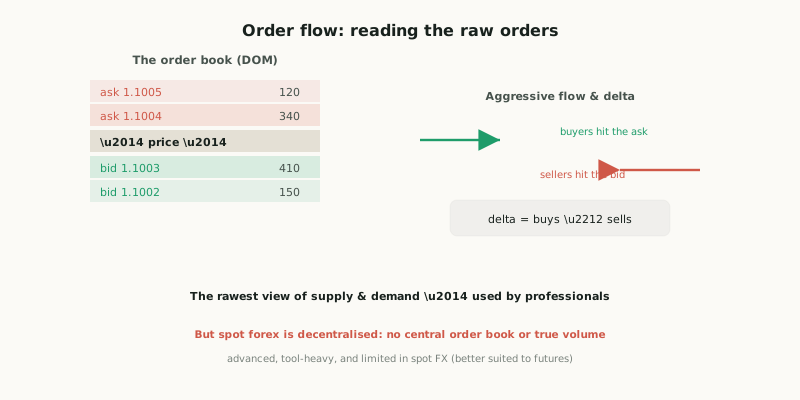
The order book (or Depth of Market, DOM) is the live "ladder" of resting limit orders — the bids (buy orders) below and offers (sell orders) above the current price, showing where liquidity sits at each level. The tape (or time and sales) is the running record of actual executed trades (price, size, time) — reading the tape means watching real transactions print as they happen. Footprint (or cluster) charts show, within each bar/candle, how much volume traded at the bid versus the ask at each price — revealing whether aggressive buyers (lifting the offer) or aggressive sellers (hitting the bid) were dominant. Delta is the net difference between aggressive buying and selling volume — a direct measure of net aggressive pressure, often tracked cumulatively. Reading these tools, order-flow traders look for telling phenomena: absorption (large resting orders soaking up aggressive flow without price moving — a sign of a big player defending a level), imbalances (lopsided aggressive buying or selling), large orders entering, and even manipulative behaviour like iceberg orders (large orders hidden as small ones) or spoofing (fake orders meant to mislead). The goal is to read, in real time, the intent behind the flow — where the genuine buying and selling pressure is, and where the big players are positioning.
Honest assessment and the forex limitation
Order flow is a legitimate, professional approach — the rawest view of supply and demand, powerful in skilled hands, and widely used by institutional traders and futures day-traders/scalpers. But it comes with serious caveats. It's advanced: it requires significant skill to interpret the fast-moving data, fast and capable software, and real-time market-depth feeds — it's emphatically not a beginner approach. The data and tools can be costly, and the edge is heavily contested: at the microsecond level, high-frequency trading firms and algorithms dominate, and the order book itself can be noisy and deliberately misleading (spoofing, icebergs), complicating the read. So even where it's available, order flow is hard, competitive, and far from a guaranteed edge.
And there's a crucial structural limitation for forex that any honest treatment must foreground. Order flow trading fundamentally needs a central order book and true, consolidated volume — which exist in centralised markets like futures and stocks (a single exchange where all orders meet). Spot forex is decentralised: there is no central exchange, no single consolidated order book, and no true consolidated volume — each broker or ECN sees only its own slice of the market, and "volume" is the imperfect tick-volume proxy discussed in the VSA and volume guides. This means genuine order-flow trading is far harder and more limited in spot forex than in centralised markets — the complete, authoritative order book that order flow depends on simply doesn't exist for spot FX. Traders who want true order-flow analysis in the currency space therefore often turn to FX futures (which are centralised, on exchanges like the CME, with a real order book and volume) as a proxy for the spot market, reading the futures' order flow to inform their spot trading. The honest framing: order flow trading reads the actual orders and executions (the DOM, the tape, footprint charts, delta) for the rawest, real-time view of supply, demand and big-player intent — a legitimate, powerful, but advanced professional approach requiring skill, fast tools and costly data, with a heavily contested edge. Crucially for this audience, spot forex is decentralised, with no central order book or true volume, so genuine order-flow trading is limited in spot FX (it's far better suited to centralised futures; forex traders sometimes use FX futures as a proxy). It's not a beginner approach or a guaranteed edge — powerful in the right hands and markets, but structurally constrained in spot forex, and always to be used within disciplined risk management.
Who it's for, and how to approach it
Given its power but also its difficulty and forex limitation, it's worth being clear about who actually benefits from order flow — because for most retail forex traders, the honest answer is that it's neither necessary nor practical. Order flow genuinely earns its keep for short-term traders in centralised markets: futures day-traders and scalpers who trade instruments with a real, consolidated order book and true volume (index futures, commodity futures, and FX futures), where the DOM, tape and footprint reflect the whole market. It's also the domain of institutional and professional traders with the tools, data and expertise to exploit microstructure. For these participants, reading the raw flow can be a genuine edge. For a typical retail spot forex trader operating on higher timeframes with a technical or fundamental approach, order flow is usually overkill and structurally impractical — the decentralised market doesn't provide the data the method needs, and the higher-timeframe trader isn't making microsecond decisions where order flow shines.
For the forex trader who genuinely wants order-flow insight, the practical route is the FX futures proxy: currency futures trade on centralised exchanges (such as the CME) with a real order book and true volume, so a trader can read the futures' order flow and use it to inform their spot trading on the same currency — accepting that the futures market, while highly correlated, isn't identical to spot. This is how serious order-flow-minded forex traders typically work around the decentralisation problem. As for how to approach learning it: recognise that it's an advanced specialty requiring substantial screen time, proper software and data, and a steep learning curve — it's not a beginner's tool, and it shouldn't be attempted before the fundamentals (risk management, a tested approach, reading charts) are solid. The honest bottom line: order flow is a powerful, legitimate professional approach, but it's advanced, tool- and data-intensive, contested, and — critically — structurally limited in decentralised spot forex (best suited to centralised futures, with FX futures usable as a proxy). Most retail forex traders neither need it nor can practically access it in spot FX, and are better served mastering the core disciplines this site emphasises. Those genuinely drawn to it should pursue it via centralised markets or FX futures, with realistic expectations about its difficulty — and, as ever, within strict risk management. It's a specialist's tool, not a shortcut.
Order flow trading reads the actual orders and executions in real time — the rawest view of supply and demand, since price moves because of orders. Tools: the order book / DOM (resting bids and offers — where liquidity sits), the tape (time & sales — executed trades), footprint charts (volume at bid vs ask per bar), and delta (net aggressive buying minus selling). Traders read it for absorption, imbalances, large/iceberg orders and spoofing — the intent behind the flow. It's the close-up, real-time view of the auction, used by professionals — but advanced, skill- and tool-heavy, with a contested edge. Crucial forex limitation: spot forex is decentralised — no central order book, no true volume (only tick volume) — so genuine order-flow trading is limited in spot FX and better suited to centralised FX futures (sometimes used as a proxy). Not a beginner approach or a guaranteed edge — use within risk management.