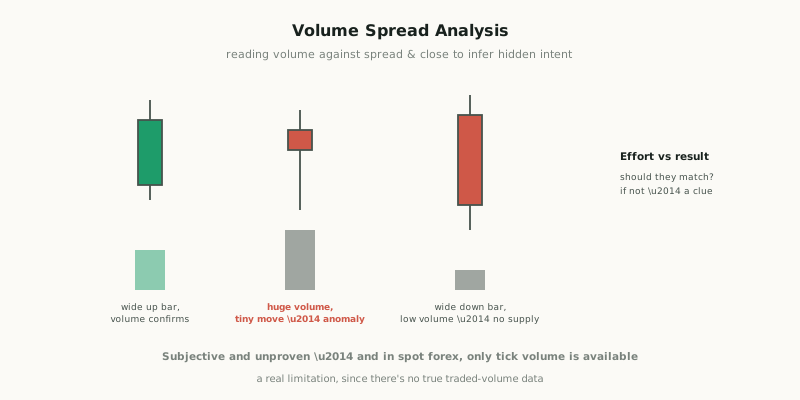
Volume Spread Analysis asks a simple question of every price bar: does the effort match the result? Normally, big volume should drive a big move. So when huge volume produces a tiny move — or a large move comes on almost no volume — something hidden is happening, and VSA tries to read it. Building on Wyckoff's principles, VSA interprets the interplay of volume, the spread (range) of a bar, and the close to infer the footprints of large "smart money" operators. It's an intriguing, logically-grounded approach — but one that comes with real subjectivity and, for forex traders, a crucial caveat about volume data. This guide explains VSA: its core idea, the key signals, its Wyckoff roots, and the honest limitations.
It's a direct descendant of the Wyckoff method (sharing concepts like the spring and upthrust), and it depends on the volume considerations discussed in volume in forex.
Key takeaways
Q: What is Volume Spread Analysis (VSA)?
A: VSA is a method of reading the relationship between volume, the spread (range) of a price bar, and the close, to infer the activity of large 'smart money' operators. Developed by Tom Williams from Wyckoff's principles, it looks for agreement or anomalies between volume (effort) and price movement (result) as clues to hidden buying or selling.
Q: What is 'effort versus result' in VSA?
A: It's the core VSA principle: high volume (effort) should normally produce a large price move (result). When they don't match — for example, huge volume but little movement, or a big move on low volume — it signals an anomaly, suggesting hidden activity such as large operators absorbing or distributing, which can precede a turn.
Q: Does VSA work in forex?
A: It faces a serious limitation. VSA depends on volume, but spot forex is decentralised with no true consolidated volume — charts show only tick volume (the number of price changes), an imperfect proxy. So VSA in forex rests on this proxy rather than real traded volume, which undermines the method compared with centralised markets like futures or stocks that have true volume data.
The core idea and its roots
Volume Spread Analysis (VSA) is a method of reading the relationship between three things on each price bar: the volume, the spread (the range, or high-to-low size of the bar), and the close (where price finished within that range). It was developed by Tom Williams — a former professional syndicate trader — building directly on the principles of Richard Wyckoff, who pioneered the study of volume and price together a century ago. The shared lineage matters: like Wyckoff, VSA assumes that markets are substantially moved by large, professional operators ("smart money," akin to Wyckoff's "Composite Operator"), and that their activity leaves footprints in the volume that a careful reader can detect.
The central idea is that volume reveals the activity and intent behind price moves, especially of these large players. By analysing how volume relates to the spread and close, VSA aims to infer whether smart money is accumulating (buying), distributing (selling), or absent — and thus to anticipate moves before they're obvious on price alone. The key is the relationship: does the volume support the price action (confirming a genuine move), or is there a divergence or anomaly that reveals hidden intent? A genuine, smart-money-backed move should show volume confirming price; a move where volume and price disagree hints that something other than the obvious is going on — perhaps large operators quietly doing the opposite of what the price action seems to suggest. Reading these confirmations and anomalies is the whole craft of VSA.
The key signals
VSA's most fundamental principle, from which its signals flow, is "effort versus result." High volume represents effort; a large price move represents result. Normally they should match — big effort, big result. When they don't match, there's an anomaly worth investigating. The table summarises the classic signals.
Classic VSA signals
| Signal | What it looks like | What it may suggest |
|---|---|---|
| Effort vs result anomaly | High volume, little movement | Hidden activity (e.g. absorption/distribution) |
| No demand | Up bar on low volume | Weak buying — bearish |
| No supply | Down bar on low volume | Weak selling — bullish |
| Stopping / climactic volume | Huge volume halting a trend | Smart money absorbing — possible turn |
To expand: an effort-versus-result anomaly — for instance, a wide-spread up bar on enormous volume that closes weakly, or a bar with huge volume but a narrow spread — suggests that the obvious move is being opposed (e.g. heavy selling into the buying, or absorption), a potential warning. "No demand" bars (up bars on low volume) suggest buyers lack genuine commitment — bearish, since a real advance should attract volume. "No supply" bars (down bars on low volume) suggest sellers lack commitment — bullish. Stopping or climactic volume (a huge volume spike that halts a trend) suggests smart money is absorbing the trend's momentum, potentially marking a turning point. VSA also shares Wyckoff's springs and upthrusts — false breakouts on revealing volume that expose the operators' true intent. The unifying logic in all of these is reading the relationship between volume and price for confirmation (volume supporting the move) or divergence (anomalies revealing hidden activity).
Honest assessment and the forex caveat
VSA has a coherent logic and a devoted following: the idea that volume reveals participation and intent, and that anomalies between effort and result expose hidden smart-money activity, is reasonable and grounded in the respected Wyckoff tradition. Many traders find it a useful lens for reading the "story" behind price. But intellectual honesty requires noting real limitations. VSA is highly subjective — interpreting bars, deciding what counts as an "anomaly," and inferring intent is an interpretive art, and different analysts read the same chart differently. Its evidence base is largely anecdotal — there's no robust, rigorous proof that VSA reliably predicts markets — and the "smart money" framing, while intuitive, can be overstated (not every volume anomaly is a cunning operator; markets are noisy). So VSA is best treated as a subjective interpretive lens, not a proven mechanical system.
For forex traders, there's a crucial additional caveat that cuts to the heart of the method. VSA depends on volume — but spot forex is decentralised, with no true, consolidated traded-volume data. Forex charts show only tick volume (the number of price changes/ticks in a period), which is a proxy for activity, not actual traded volume — and an imperfect one (it reflects how often price changed, not how much was traded, and each broker/feed sees only its own slice). Because VSA's entire premise rests on reading real volume, the reliance on tick volume undermines the method in spot forex compared with centralised markets like futures or stocks, which have genuine, exchange-reported volume. Tick volume does correlate somewhat with real activity (so VSA-style reading isn't meaningless in forex), but the forex trader must understand they're working with a flawed proxy, which is a significant limitation. The honest framing: VSA is a Wyckoff-derived approach reading volume, spread and close to infer "smart money" activity via the "effort versus result" principle and signals like no-demand, no-supply and climactic volume. It has a coherent logic and a following, but it's subjective, its evidence is largely anecdotal, and the smart-money framing can be overstated — treat it as an interpretive lens, not a proven system. And crucially in forex: there's no true volume (only tick volume), which substantially limits a volume-based method like VSA. Approach it critically, understand the forex volume problem, and — as always — use it (if at all) as one input within disciplined risk management, never as a guaranteed read of hidden intent.
Using VSA sensibly
For those drawn to VSA despite its limitations, the sensible approach is to treat it as one interpretive input within a broader, disciplined method — never as a standalone signal generator. The most natural pairing is with its parent, the Wyckoff method, and with market structure: VSA's volume reading is most meaningful at important locations — a possible accumulation or distribution zone, a key support/resistance level, a suspected spring or upthrust. Volume anomalies in context (a no-demand bar at resistance, climactic volume at a major low) carry more weight than the same bars in the middle of nowhere. So use VSA to add evidence to a read you've formed from structure and location, rather than hunting for volume signals in isolation. Treat its anomalies as clues that something may be happening — prompts to look closer — not as definitive signals to act on.
The forex tick-volume problem demands a specific adjustment. Since you don't have true volume, treat tick volume as a relative, comparative measure rather than an absolute one: what matters is whether a bar's tick volume is high or low relative to recent bars (unusually high activity, unusually quiet), not its precise figure. This relative reading still carries some information (tick volume does correlate with genuine activity), but hold your VSA conclusions loosely in forex, knowing the data is a flawed proxy. Above all, demand confirmation before acting — a VSA anomaly suggesting hidden selling means little until price action confirms weakness — and never let a volume interpretation override your risk management. The honest practical guidance: if you use VSA, use it as a supplementary lens — anchored to Wyckoff and structure, applied at key locations, read relatively (especially given forex tick volume), treated as clues rather than signals, confirmed by price, and always subordinate to position sizing and stops. Approached this way, VSA can add a useful dimension to reading the "story" behind price; approached as a precise, standalone smart-money decoder — especially on the flawed volume data forex provides — it will mislead. Skeptical, supplementary, and disciplined is the way to engage with it.
Volume Spread Analysis (VSA), developed by Tom Williams from Wyckoff's work, reads the relationship between volume, spread (bar range) and close to infer "smart money" activity. Core principle: effort vs result — high volume (effort) should produce a big move (result); when they don't match, an anomaly hints at hidden activity. Classic signals: effort/result anomalies (high volume, small move → absorption/distribution), no demand (up bar, low volume → bearish), no supply (down bar, low volume → bullish), and stopping/climactic volume (huge volume halting a trend → possible turn). It has coherent Wyckoff-rooted logic but is subjective, largely anecdotal in evidence, and the smart-money framing can be overstated. Crucial forex caveat: spot forex has no true volume — only tick volume (a flawed proxy) — which substantially limits VSA versus centralised futures/stocks. Treat it as an interpretive lens within risk management, not a proven system.