Volume — how much is traded in a given period — is one of the most powerful confirming tools in technical analysis: a breakout on heavy volume signals genuine conviction, while the same breakout on thin volume invites suspicion. But forex comes with a crucial catch that traders coming from stocks or futures must understand: as a decentralised market, forex has no true volume figure at all. What your platform labels "volume" is actually tick volume — a proxy, not the real thing. Understanding this caveat is essential to using volume honestly in forex, neither ignoring a useful tool nor over-trusting an approximation. This guide explains how volume confirms price moves, the forex-specific limitation, VWAP, and how to use volume soundly given the constraint.
It complements breakout trading (where volume confirmation matters most), support and resistance, and adds a factor to confluence.
Key takeaways
Q: Does forex have volume data?
A: Not true volume. Because forex is a decentralised, over-the-counter market with no central exchange, there is no single consolidated volume figure as there is for stocks or futures. Retail platforms instead show 'tick volume' — the number of price changes in a period — as a proxy for actual trading volume.
Q: What is tick volume in forex?
A: Tick volume counts the number of price changes (ticks) in a given period, used as a proxy for true trading volume in forex. It correlates reasonably with actual volume — more activity generally means more ticks — but it is an approximation, not a precise measure of how much was actually traded.
Q: How is volume used in trading?
A: Volume confirms price moves: a breakout or trend on rising volume signals conviction, while a move on low volume is suspect. Volume divergence (price rising as volume falls) can warn of weakness, and volume spikes often mark turning points. In forex, this analysis uses tick volume as a proxy.
How volume confirms moves
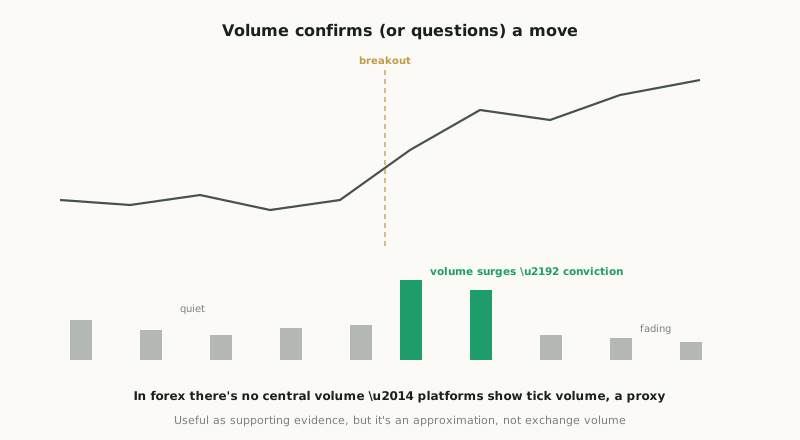
In markets that have it, volume is valued chiefly as a confirmation tool — it tells you how much conviction is behind a price move. The core principle: a price move on high volume reflects strong participation and conviction (many traders are involved, lending the move weight and making it more likely to be genuine and sustained), while a move on low volume is weaker and more suspect (few participants, so the move may lack the force to continue and is more prone to reversal). Volume, in other words, measures the "fuel" behind a move.
This yields several practical uses. Confirming breakouts is the classic application: a breakout from a level or range on rising volume is more convincing (the surge in participation suggests genuine commitment to the new direction), whereas a breakout on low volume is more likely to be a false break that fizzles — so volume helps distinguish real breakouts from fakeouts (directly relevant to the breakout-trading guide). Confirming trends works similarly: a healthy trend tends to show volume expanding in the trend's direction, while declining volume during a trend can warn that it is losing momentum. Volume divergence — price making new highs while volume falls — can signal weakening conviction and a possible reversal, much like the momentum divergences the oscillator guides describe. And volume spikes often mark significant moments: a climactic surge in volume can indicate exhaustion at a turning point (a buying or selling climax). In all these uses, volume serves as supporting evidence about the strength behind price action, helping confirm or question what price alone suggests. It is rarely a standalone signal but a valuable confirming factor — a natural contributor to confluence. The catch, in forex, is whether the "volume" you are looking at is real.
The crucial forex caveat
Here is the essential point that distinguishes volume in forex from volume in other markets: forex has no true, consolidated volume figure. The reason is structural. Stocks and futures trade on centralised exchanges, which record every transaction and publish a single, authoritative volume figure — the actual amount traded. Forex, by contrast, is a decentralised, over-the-counter market: there is no central exchange, and trading happens across a vast, fragmented network of banks, brokers and platforms worldwide. No single entity sees or records all forex transactions, so there is no consolidated, true volume figure to report. This is a fundamental consequence of forex's decentralised structure (the same structure covered in how the forex market works).
The "volume" indicator on a retail forex platform is almost always tick volume — the number of price changes (ticks) in each period — used as a proxy for real volume. It is not the actual amount traded, because no such figure exists for the whole decentralised market. Tick volume also reflects only your broker's feed, not the global market. Treat it as a useful approximation, never as the precise exchange volume you would get trading stocks or futures.
So what traders actually use in forex is tick volume: the count of price changes (ticks) in a given period, used as a proxy for trading volume. The logic is that more trading activity generally produces more price changes, so tick volume correlates with actual volume — periods of high activity show many ticks, quiet periods few. Studies generally find this correlation reasonable, so tick volume is a usable approximation. But it is exactly that — an approximation, with limitations: it counts price changes, not amount traded (a large trade and a small one may each produce one tick); it reflects only the data feed of your particular broker or platform, not the whole market (different brokers may show different tick volumes); and it is not the precise, authoritative figure that centralised-market volume provides. None of this makes tick volume useless — it is a reasonable proxy and the best available in forex — but it must be understood for what it is. A trader using volume analysis in forex is working with tick volume, an approximation of activity from one broker's feed, not the true consolidated volume of the market. Honesty about this is essential: volume analysis can be applied in forex via tick volume, and is genuinely useful as supporting evidence, but one should hold its conclusions a little more loosely than in centralised markets, aware that the underlying data is a proxy.
VWAP and using volume soundly
A volume-based tool worth knowing is VWAP — the Volume-Weighted Average Price — the average price over a period weighted by volume, giving more weight to prices where more was traded. VWAP serves as a benchmark and a dynamic reference level: it represents a kind of volume-weighted "fair value" or mean price for the period. Institutions use VWAP as an execution benchmark (aiming to buy below or sell above it), and intraday traders use it as a dynamic mean — a reference around which price oscillates, where price above VWAP may be considered relatively expensive and below it relatively cheap (a mean-reversion reference), or as dynamic support/resistance. In forex, VWAP is calculated using tick volume (carrying the same proxy caveat), and it is most used by intraday traders as a reference level and mean. It is a useful tool, particularly for intraday work, as long as the tick-volume basis is kept in mind.
Using volume soundly in forex, then, comes down to applying its genuine value while respecting its limitation. Do use volume (tick volume) as a confirming factor: check whether a breakout or trend is backed by rising tick volume (more convincing) or thin tick volume (more suspect), watch for divergences and climactic spikes, and treat strong volume confirmation as a contributor to confluence. Don't treat forex tick volume as a precise, authoritative measure or rely on it as heavily as one might on true exchange volume in stocks or futures — hold its signals as supporting evidence to be weighed with everything else, not as hard fact. This balanced, honest use — volume as a valuable confirming tool, understood as a tick-volume proxy rather than true volume — lets the forex trader benefit from volume analysis without being misled about what the data actually is. It exemplifies the site's broader approach: use the tool for its genuine value, understand its real limitations, and never over-trust any single source of evidence. Volume confirms conviction behind price, which is genuinely useful; in forex, just remember you are reading an approximation of that conviction, not its exact measure.
Volume patterns to watch
Beyond the general principle that volume measures conviction, a few specific volume patterns are worth watching (using tick volume in forex, with the proxy caveat in mind). The most useful is the breakout test: when price breaks a key support or resistance level, check the accompanying volume. A break on a clear surge of volume suggests genuine commitment and a more reliable breakout, while a break on thin volume is a warning sign for a possible false break (fakeout) — the move lacks the participation to sustain itself. This single check, integrating volume with the support-and-resistance and breakout concepts, is one of volume's most practical applications in forex.
Other patterns add nuance. Climactic volume — an extreme spike far above normal — often appears at exhaustion points, where a final burst of participation marks a buying or selling climax and a potential turning point (the crowd's last rush before reversal). Volume dry-up — unusually low volume — during a pullback within a trend can be constructive, suggesting the counter-trend move lacks conviction and the trend is likely to resume (a quiet pullback on fading volume is less threatening than a heavy one). And the broad idea of effort versus result is illuminating: volume represents "effort" and the price move represents "result," so a mismatch is informative — large volume (effort) producing little price movement (result) suggests the move is being absorbed or resisted (a possible turning point), while a large price move on modest volume may be fragile.
All of these patterns are supporting evidence to be combined with price analysis, never standalone signals — and in forex they rest on tick volume, so they should be weighed a little more loosely than in centralised markets. But integrated thoughtfully with support/resistance, breakouts and structure, volume patterns add a genuinely useful dimension of confirmation: they help you judge whether the participation behind a move matches what price appears to be doing, flagging breakouts likely to hold or fail, exhaustion at extremes, and the health of a trend. As a confluence factor — volume confirming a price-based setup — these patterns earn their place in the toolkit, with the constant reminder that, in forex, you are reading an approximation of conviction rather than its exact measure.
Volume measures the conviction behind a price move — high volume confirms a breakout or trend (real participation), low volume makes it suspect, divergences warn of weakness, and spikes can mark turning points. But forex is decentralised with no central exchange, so it has no true volume figure: platforms show tick volume (the count of price changes) as a proxy, which correlates reasonably with real volume but is an approximation from your broker's feed only. VWAP (volume-weighted average price) is a useful volume-based mean/benchmark, also using tick volume in forex. Watch patterns like breakout volume (surge = reliable, thin = fakeout risk), climactic spikes (exhaustion), volume dry-up on pullbacks (trend likely resumes), and effort-vs-result mismatches. Use volume as a confirming factor and confluence contributor, but hold its signals a little more loosely than in centralised markets, aware the data is a proxy.