If auction market theory explains why price moves, Market Profile lets you see it. By organising price against time into a distribution, it reveals where the market found value, where it spent its time, and where the real business of the period was done — turning the abstract idea of an auction seeking fair value into a concrete, readable picture. Developed in the 1980s and popular especially among futures traders, Market Profile is one of the more sophisticated ways to read market structure and context. This guide explains it: the TPO building block, the value area and point of control, what the profile shapes reveal, and — importantly for this audience — its limitations in forex.
It's the practical expression of auction market theory, relates closely to volume analysis, and complements order flow as a way of reading the auction.
Key takeaways
Q: What is Market Profile?
A: Market Profile is a charting method developed by Peter Steidlmayer (with the Chicago Board of Trade) that displays the distribution of price over time, showing where the market spent the most time and did the most business. It visualises auction market theory in practice, using building blocks called TPOs to form a horizontal distribution of trading activity.
Q: What are the value area and point of control?
A: The value area is the price range where roughly 70% of the period's trading occurred — the 'fair value' zone. The point of control (POC) is the single price with the most activity (the most TPOs or volume) — the most-traded, most-accepted price. Both serve as key reference levels for reading market structure and context.
Q: Does Market Profile work in forex?
A: It can be adapted, but with a caveat. Market Profile was designed for centralised futures markets that have true traded volume. Spot forex is decentralised with no true consolidated volume — only tick volume — so forex Market Profile relies on time-based TPOs or imperfect tick volume, making it less precise than in its native futures setting.
What Market Profile is
Market Profile is a charting and data-organising method developed by Peter Steidlmayer (working with the Chicago Board of Trade) in the 1980s. Rather than plotting price against time as a conventional chart does, it displays the distribution of price — showing, for a given session or period, where the market spent the most time and did the most trading. In effect, it makes auction market theory visible: it shows the shape of the auction, where value formed, and which prices the market accepted or rejected. It's a way of seeing the market's behaviour as a distribution of activity rather than just a line of prices, which reveals structure that an ordinary chart can obscure.
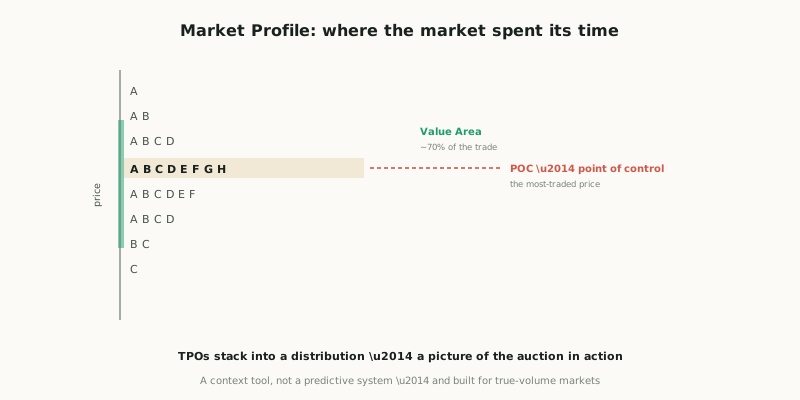
The building block is the TPO — Time Price Opportunity. The method divides the session into time periods (classically 30-minute brackets, each assigned a letter: A, B, C…) and marks, at each price level, a letter for every period during which that price traded. Stacking these letters horizontally builds up a distribution: prices that traded across many periods accumulate many TPOs (a long row of letters), while prices that traded only briefly get few. The result is a horizontal histogram of how much time was spent at each price — the "profile." Because the market spends most of its time around fair value (per auction theory) and little at the rejected extremes, the profile usually takes a roughly bell-shaped form: fat in the middle (value), tapering at the top and bottom (the rejected highs and lows). That shape is the auction, drawn.
The key concepts
From the TPO distribution come several key reference concepts, summarised below.
Core Market Profile concepts
The Value Area (VA) is the price range containing roughly 70% (about one standard deviation) of the period's trading activity — the "fair value" zone where most business was done. Its edges (the value area high and low) are watched as key levels. The Point of Control (POC) is the single price with the most TPOs (or volume) — the most-traded, most-accepted, "fairest" price of the session, and an important reference level around which price often gravitates. Together, the VA and POC give a trader a map of where value is. The profile shape itself is informative: a roughly normal/bell-shaped profile indicates a balanced day (a complete two-way auction around fair value — a range); an elongated, directional profile indicates a trend day (the auction travelling to find new value, with little time spent at any one price); other shapes (such as a double distribution, where value formed at two separate levels) tell their own stories. Reading the shape tells you what kind of day or auction occurred — balanced or trending — which (per auction theory) shapes how to approach it.
Put to use, Market Profile provides context and reference levels: it identifies where value lies (the VA and POC), whether the market is balanced or trending (the shape), and key levels (value-area edges, the POC, prior-session value) where price may react. Traders use it to gauge market structure — for instance, noting whether price is trading inside or outside the prior day's value, whether it's accepting or rejecting a new area, and where the high-business prices sit. It's a way of seeing the auction's footprint and orienting yourself within it.
Honest assessment and the forex caveat
Market Profile is a legitimate, respected organising tool — it genuinely visualises the auction (auction market theory in practice), and many traders, particularly in futures, find it valuable for understanding market structure, identifying value, and reading context. Its strength is that it provides a richer, more informative view of where business was done than a conventional chart, and useful reference levels (POC, value area) for orientation. But it's important to be clear about what it is: a way of organising and viewing data, not a predictive system or a guaranteed edge. It describes where trade occurred; reading it to inform trades is interpretive and skilful — the profile doesn't tell you what will happen next, only what has happened, and turning that into decisions requires judgement (and, as always, risk management). Like every tool on this site, it's an aid to understanding and context, not a money-making machine.
There's also a crucial caveat for forex traders. Market Profile was designed for centralised futures markets, which have a single exchange and true, consolidated traded volume. Spot forex, by contrast, is decentralised — there's no central exchange and no true consolidated volume; charts show only tick volume (the number of price changes), an imperfect proxy for real traded volume, and each broker/feed sees only its own slice. This matters because Market Profile's richest form leans on volume/activity. In forex, the method is adapted — typically using time-based TPOs (which work regardless of volume) or imperfect tick volume — which makes it less precise than in its native futures setting. It can still provide useful structure and value-area context in forex (the time-based profile is meaningful), but the forex trader should understand they're working with a proxy, not the true-volume tool Steidlmayer designed. The honest framing: Market Profile is a legitimate, respected method for visualising the auction — using TPOs to build a price-time distribution that reveals the value area, the point of control, and whether the market is balanced or trending. It offers valuable context and reference levels and is widely used (especially in futures), but it's a way of organising data, not a predictive system or guaranteed edge, and reading it takes skill. For forex specifically, remember it was built for true-volume centralised markets; in decentralised spot forex (tick volume only) it's adapted and less precise. A useful context tool — understood for what it is, applied with skill and risk management.
Using Market Profile in practice
In practice, traders use Market Profile mainly for context and key reference levels rather than as a signal generator. A few concepts make it actionable. The initial balance — the range established in the first part of the session — sets an early reference; whether price later breaks out of or holds within it hints at whether the day is balancing or trending. Reading the developing day type from the profile shape (a balanced, bell-shaped rotational day versus an elongated trend day) tells you what kind of session you're in and how to approach it — in a balanced day you might expect rotation around value (fade the extremes toward the POC), in a trend day you'd respect the directional travel. This is auction market theory made concrete: the profile shape is the balance-versus-imbalance read, drawn from real data.
The most common practical use is trading relative to value. The value-area edges (the value-area high and low) and the point of control act as reference levels: traders watch whether price is trading inside the value area (suggesting balance, with the POC as a magnet) or has moved outside it (suggesting a possible imbalance, with the question being whether the new area is accepted — real business done there — or rejected back into value). Prior-session value areas and POCs are watched too, since the market often reacts to where it previously found fair value. A typical approach is to use these levels as a framework: noting where value sits, where price is relative to it, and where the high-business prices are, then combining that context with other analysis (price action, support/resistance, your own setups) to make decisions — rather than trading the profile mechanically. Crucially, Market Profile is at its best as a context and structure tool layered onto your existing approach, not as a standalone system: it tells you where value is and what kind of auction is unfolding, and you bring the rest. Remember, too, the forex caveat in this practical setting — in spot FX you're reading a time-based (or tick-volume) profile rather than a true-volume one, so treat forex profiles as a useful but less precise structural guide. Used as informed context within disciplined risk management, Market Profile sharpens your read of where the market values price and what state the auction is in — a genuine aid to judgement, not a mechanical edge.
Market Profile (Peter Steidlmayer, 1980s) visualises the auction by displaying price distribution over time. Its building block is the TPO (Time Price Opportunity — a letter for each time period a price traded); stacking TPOs forms a (usually bell-shaped) profile of where the market spent its time. Key concepts: the Value Area (~70% of the trade — the fair-value zone), the Point of Control (the single most-traded price), and the profile shape (bell = balanced/range day; elongated = trend day). It provides context and reference levels for reading market structure — but it's a way of organising/viewing data, not a predictive system or guaranteed edge, and reading it takes skill. Crucial forex caveat: built for centralised, true-volume futures markets; spot forex is decentralised with only tick volume, so forex Market Profile uses time-based TPOs/tick volume and is less precise. A useful context tool — with risk management.