
Are markets random, or predictable? The long argument between the efficient-market camp (random, unbeatable) and the technical camp (patterned, predictable) misses a third possibility that chaos theory offers: markets are complex. Deterministic yet practically unpredictable, ordered yet disorderly, they may be governed by rules and yet resist precise forecasting. It's a humbling, genuinely insightful lens — one that explains why precise prediction may be impossible while structure (trends, patterns) nonetheless exists. This guide explains chaos theory in trading: the core concepts, its practical interpretation in Bill Williams' work, and its honest status as a framework for understanding complexity rather than a predictive system.
It's closely related to the fractal market hypothesis, and it sits between the extremes of random walk theory and efficient markets as a third view of how markets behave.
Key takeaways
Q: What is chaos theory in markets?
A: Chaos theory applies the mathematics of complex, nonlinear dynamic systems to markets. It views prices as deterministic yet practically unpredictable — highly sensitive to initial conditions (the 'butterfly effect'), nonlinear, and fractal, with apparent randomness that may contain underlying order. It suggests markets are neither perfectly predictable nor purely random, but complex.
Q: What is the butterfly effect in trading?
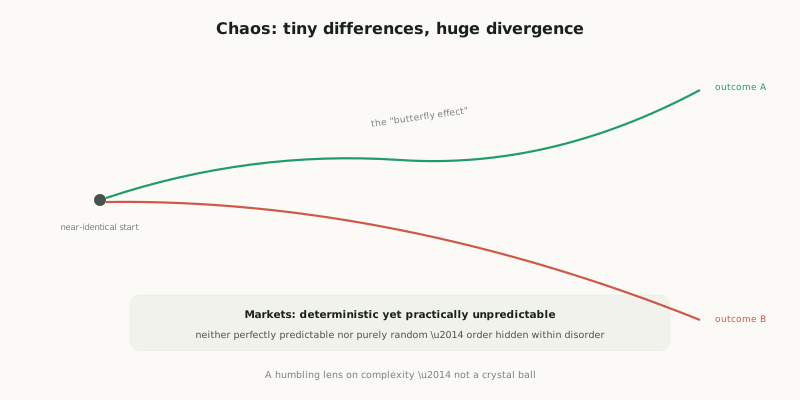
A: The butterfly effect is sensitivity to initial conditions: in a chaotic system, tiny differences in starting conditions lead to vastly different outcomes over time. Applied to markets, it implies that small, unmeasurable factors can compound into large, unpredictable price movements — which is why precise long-term price prediction may be fundamentally impossible.
Q: What is Bill Williams' Trading Chaos?
A: Bill Williams' Trading Chaos is one practical interpretation of chaos-theory ideas for trading, using tools such as the Alligator (a set of smoothed moving averages), Fractals, the Awesome Oscillator and the Gator Oscillator to trade with the market's underlying structure. Like any indicator-based method, it carries the usual caveats — no indicator is magic, and confirmation and risk management still apply.
The core concepts
Chaos theory is the branch of mathematics concerned with complex, nonlinear dynamic systems — systems (like weather, turbulence, populations, and arguably markets) that are governed by deterministic rules yet behave in ways that appear random and defy long-term prediction. Applied to markets, it yields a set of striking ideas, summarised below.
Key ideas of chaos theory in markets
The most famous concept is sensitivity to initial conditions — the "butterfly effect" — the idea that tiny differences in starting conditions compound into vastly different outcomes (a butterfly's wing-flap eventually altering a distant storm). In markets, this implies that small, immeasurable factors can cascade into large, unpredictable moves, which is precisely why precise long-term prediction may be impossible even if markets are deterministic: you can never measure the starting state finely enough. The systems are also nonlinear (cause and effect aren't proportional — a small input can produce a huge output, or vice versa) and fractal (self-similar across scales, linking directly to the fractal market hypothesis). Yet — and this is the subtle, valuable part — chaotic does not mean random: beneath the apparent disorder there may be underlying structure and patterns ("strange attractors," recurring forms), so the system exhibits order within disorder. This is what makes chaos theory a genuine third position: it challenges both the pure randomness of the random walk (there is structure) and naive predictability (you can't forecast precisely), portraying markets as complex adaptive systems that are partly ordered and partly unpredictable — which neatly reconciles two everyday observations: markets clearly trend (order) yet are maddeningly unpredictable in their detail (chaos).
Bill Williams and the practical strand
Alongside the conceptual strand sits a practical one: trader Bill Williams popularised a chaos-theory-inspired methodology in his book Trading Chaos, built around a suite of tools — the Alligator (a set of smoothed, displaced moving averages representing trend), Fractals (recurring five-bar reversal patterns), the Awesome Oscillator and the Gator Oscillator — with the aim of trading in harmony with the market's underlying structure rather than against it. It's one practical interpretation of chaos ideas, and some traders use it productively, but it should be understood as a trading method (carrying the same caveats as any indicator-based approach) rather than a direct, rigorous application of chaos mathematics. As with every indicator system, the tools are aids to interpreting price, not magic, and they require confirmation and risk management.
The honest status of chaos theory matters. It is largely descriptive and conceptual — it powerfully explains why markets are hard to predict (sensitivity, nonlinearity, complexity) more than it provides a reliable edge. The tantalising idea of "finding the order within the chaos" — detecting the hidden structure to forecast moves — is extremely difficult and has not been demonstrated as a consistent money-maker; markets may be complex enough that exploitable order is faint, fleeting and hard to distinguish from noise. So the greatest value of chaos theory for a trader is humility and perspective: it explains why precise prediction is a fool's errand, why small surprises can cause outsized moves, why both pure-random and naively-predictive models are wrong, and why robust risk management (preparing for the unpredictable, the fat tail, the butterfly) matters more than forecasting. The honest framing: chaos theory views markets as complex, nonlinear systems — deterministic yet practically unpredictable (sensitive to initial conditions, the butterfly effect), fractal, with order hidden within apparent disorder. It's a humbling, insightful lens: markets are neither perfectly predictable nor purely random, but complex — explaining why precise long-term prediction may be impossible while structure (trends, fractals) still exists. Bill Williams' Trading Chaos is one practical application (Alligator, Fractals, Awesome Oscillator). But chaos theory is largely descriptive — it explains why markets are hard to predict more than it gives a reliable edge; "finding the order in chaos" is extremely difficult and unproven as a consistent money-maker, and the practical methods carry the usual indicator caveats. A valuable humbling framework for understanding market complexity, unpredictability and the importance of risk management — not a predictive system.
What chaos theory means for traders
The most useful way to absorb chaos theory isn't to hunt for a hidden formula but to let it reshape how you think about markets and risk. Its first lesson is humility about prediction. If markets really are sensitive to initial conditions, then precise long-term forecasting is not merely difficult but, in principle, impossible — small, unmeasurable factors will always compound into large, unforeseeable moves. This is a healthy antidote to the overconfidence that ruins traders: it argues against betting heavily on specific predictions, against elaborate forecasts of exactly where price will be, and in favour of probabilistic thinking and adaptability. The trader who internalises chaos doesn't ask "what will happen?" but "what's likely, what could go wrong, and am I prepared for the surprise?"
The second lesson is the primacy of risk management. If outsized, unpredictable moves are an inherent feature of complex systems — not rare anomalies but expected behaviour — then surviving them matters more than forecasting them. Chaos theory thus reinforces the case for robust risk control: sensible position sizing, stops, and exposure limits that assume the occasional violent, unforecastable move will occur (the same fat-tail awareness the fractal market hypothesis demands). Prepare for the butterfly rather than trying to predict it. The third lesson is a more balanced view of the random-versus-predictable debate. Chaos theory says markets are neither the pure coin-flips of the random walk nor the precisely-readable machines some technical enthusiasts imagine — they're complex, with real structure (trends, regimes, fractal patterns) that's nonetheless hard to exploit reliably because it shifts and hides within noise. This validates the intuition that markets do have patterns worth studying, while explaining why those patterns are never perfectly dependable — a more honest middle ground than either extreme. Practically, this favours robust, adaptive approaches (systems that work across conditions and degrade gracefully) over fragile, over-optimised ones tuned to a pattern that complexity will soon dissolve. The overarching message: chaos theory's gift to traders isn't a prediction engine but a mindset — humble about forecasting, serious about risk, realistic about structure, and prepared for the unpredictable. That mindset, quietly, improves more trading outcomes than any indicator.
Chaotic is not the same as random
One distinction is worth underlining, because it's the source of most confusion about chaos theory: chaotic and random are not the same thing. A random system has no underlying order — each outcome is independent, like a fair coin flip, and the past tells you nothing about the future. A chaotic system is deterministic — it follows precise rules and does have underlying structure — but that structure is so sensitive to conditions and so complex that it looks random and resists prediction. This is exactly why chaos theory occupies its distinctive middle ground in the markets debate: against the random walk it insists there is order (markets aren't pure coin flips), yet against naive technical determinism it insists that order is practically unexploitable with any precision. The danger for traders is over-claiming in the other direction — seizing on "there's hidden order!" to justify elaborate prediction schemes or to sell "chaos-based" systems that promise to decode the markets. The honest reading is more sober: yes, structure exists; no, you almost certainly can't extract it reliably enough to forecast precisely; and the most you can do is recognise the structure that's robust (trends, regimes, fractal self-similarity), trade it probabilistically, and manage the ever-present risk of the unpredictable. Respecting both halves of that truth — order and unpredictability — is what keeps chaos theory a useful lens rather than a marketing slogan.
Chaos theory views markets as complex, nonlinear systems: deterministic yet practically unpredictable, highly sensitive to initial conditions (the "butterfly effect"), fractal, with order hidden within disorder (chaotic ≠ random). It's a genuine third view between the random walk (it says there is structure) and naive predictability (it says you can't forecast precisely) — reconciling why markets trend yet resist prediction. Bill Williams' Trading Chaos is one practical application (Alligator, Fractals, Awesome Oscillator), with the usual indicator caveats. But chaos theory is mostly descriptive: it explains why markets are hard to predict more than it gives an edge — "finding the order in chaos" is extremely hard and unproven as a money-maker. Its real value is humility and risk management: prepare for the unpredictable rather than trying to forecast it. A humbling lens on complexity, not a crystal ball.