
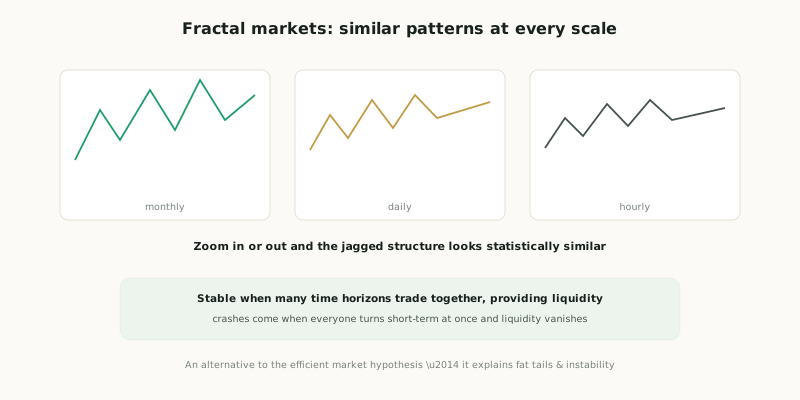
Zoom in or out on a price chart and something strange becomes apparent: the jagged structure looks eerily similar at every scale. A monthly chart, a daily chart and an hourly chart, stripped of their axis labels, can be almost impossible to tell apart. The Fractal Market Hypothesis (FMH) builds an entire theory of markets on that observation — and, crucially, on the role of liquidity and investor time horizons — offering an alternative to the efficient market hypothesis that explains crashes and "fat tails" far better. This guide explains the FMH: its core ideas, how it accounts for instability, how it contrasts with the efficient-market view, and its honest status as a hypothesis.
It's a direct alternative to the efficient market hypothesis and random walk theory, kin to chaos theory, and lends support to multi-timeframe analysis.
Key takeaways
Q: What is the Fractal Market Hypothesis?
A: The Fractal Market Hypothesis (FMH), developed by Edgar Peters building on Benoit Mandelbrot's work, models markets as fractal — statistically self-similar across timeframes — and emphasises the role of liquidity and a diversity of investor time horizons. It's offered as an alternative to the efficient market hypothesis, explaining fat tails and crashes that the efficient-market view struggles with.
Q: How does the FMH explain market crashes?
A: It argues markets are stable when participants with many different time horizons trade together, providing liquidity to one another — when short-term traders sell, long-term investors buy. Crashes occur when these horizons collapse to the same short horizon: everyone becomes a short-term seller at once, no one provides liquidity, and prices fall sharply.
Q: How is the FMH different from the efficient market hypothesis?
A: The efficient market hypothesis assumes rational investors, efficient pricing and normally distributed returns. The FMH assumes markets are fractal, that different time horizons process information differently, that liquidity and horizon diversity drive stability, and that returns have fat tails with more extreme events than a normal distribution predicts.
The core ideas
The FMH was developed by Edgar Peters, building on the pioneering work of mathematician Benoit Mandelbrot (the father of fractal geometry, who showed that financial price series are fractal and have "fat tails"). It rests on a few linked ideas. First, markets are fractal: price behaviour is statistically self-similar across different time scales — the patterns and "roughness" of a long-term chart resemble those of a short-term chart (self-similarity and scaling). Second, the market is composed of participants with many different time horizons — from high-frequency traders and day traders through swing traders to long-term investors, pension funds and central banks — each processing information and reacting on their own timescale. Third, and most importantly, liquidity and stability come from the diversity of those horizons. When the market contains a healthy mix of horizons, participants provide liquidity to one another: when short-term traders panic and sell, longer-term investors — who value the asset on a different timescale and see a bargain — step in to buy, absorbing the selling and stabilising the market. The variety of horizons is what keeps markets functioning smoothly.
Instability, fat tails, and the contrast with EMH
This framework gives the FMH a compelling account of instability and crashes. A market becomes unstable when its time horizons collapse to the same (short) horizon — when, in a moment of panic, everyone suddenly adopts a short-term view at once. The long-term investors who would normally provide liquidity by buying instead join the rush for the exit (or stand aside), so there's no one to take the other side; liquidity evaporates, and prices fall sharply and discontinuously — a crash. This is a far more satisfying explanation of market crashes and "fat tails" (extreme moves occurring far more often than a normal distribution predicts) than the efficient-market framework offers. The table contrasts the two views.
FMH vs the efficient market hypothesis
| Aspect | Fractal Market Hypothesis | Efficient Market Hypothesis |
|---|---|---|
| Market structure | Fractal, self-similar across scales | Random walk, no usable structure |
| Investors | Many different time horizons | Rational, homogeneous |
| Stability comes from | Diversity of horizons & liquidity | Assumed efficient pricing |
| Crashes | Horizons collapse, liquidity vanishes | Hard to explain |
| Return distribution | Fat tails (extreme events common) | Normal distribution |
The implications are rich. The FMH explains why crashes and extreme moves happen more often than "normal" models predict (liquidity collapse when horizons align), and its self-similarity idea lends theoretical support to the practice of multi-timeframe analysis and to the notion that technical patterns can recur across timeframes (if structure is genuinely fractal, the same patterns should appear at every scale). It sits alongside the adaptive market hypothesis and chaos theory as part of a family of frameworks portraying markets as complex, non-normal and only partly efficient. In forex, the FMH resonates strongly: the FX market is enormously liquid and populated by an exceptionally diverse set of horizons (HFT algorithms, day traders, corporates hedging, carry investors, central banks), and its periodic liquidity crises — flash events where prices gap violently as liquidity briefly vanishes — look very much like the horizon-collapse the FMH describes.
The honest status is important: the FMH is a hypothesis — a model and framework, not proven fact — and it remains debated. It's primarily descriptive and explanatory rather than predictive: it gives a compelling account of why markets behave as they do (fat tails, crashes, self-similarity) but does not hand you a trading system or precise forecasts, and its central concepts (fractals, time horizons, liquidity dynamics) are more illuminating than directly actionable. So value it as a lens for understanding market structure, liquidity and instability — and for appreciating why patterns recur across timeframes and why crashes are more common than tidy models suggest — rather than as a mechanical edge. The honest framing: the Fractal Market Hypothesis (Peters, building on Mandelbrot) is a hypothesis offering a compelling alternative to the efficient market view — markets as fractal (self-similar across timeframes) and stabilised by a diversity of investor time horizons providing liquidity, with crashes occurring when horizons collapse to short-term and liquidity vanishes; it explains fat tails and instability far better than the normal-distribution assumptions of EMH. But it's still a hypothesis (descriptive and debated), doesn't give precise predictions or a system, and its concepts are more explanatory than actionable. A valuable lens for understanding market structure, liquidity, crashes and cross-timeframe self-similarity — not a mechanical edge.
What the FMH means for traders
Although the FMH isn't a trading system, several practical lessons flow from it. The first concerns multi-timeframe analysis: if market structure is genuinely fractal, then the techniques you use to read a chart should work, in principle, across timeframes — a head-and-shoulders or a trendline is meaningful on an hourly chart and a weekly one alike. This is a theoretical underpinning for the common practice of analysing several timeframes together and expecting patterns to recur at different scales. It also cautions against assuming any one timeframe is "the right" one; the fractal view says structure exists at all of them.
The second lesson concerns liquidity and regime. The FMH frames stability as a function of horizon diversity, which implies you should respect the market's liquidity state: conditions are calmest when many participant types are active, and most dangerous when the market is thin or when horizons are aligning (everyone watching the same event, poised to act the same way). Periods around major news, holidays, or stressed markets — when long-term participants step back and short-term reaction dominates — are exactly when the horizon-collapse the FMH describes can produce violent, illiquid moves. The third, and perhaps most important, lesson is about fat tails and risk management. Because the FMH (following Mandelbrot) insists that returns are not normally distributed — extreme moves happen far more often than tidy models assume — it argues powerfully for risk management that respects tail risk: position sizing, stops and exposure limits that assume the occasional move will be far larger than "normal," rather than risk models that quietly bet against ever seeing one. Traders who size as if a six-standard-deviation move "can't happen" are repeatedly surprised; the fractal view tells you to expect the unexpected and survive it. Finally, the FMH sits comfortably alongside the adaptive market hypothesis, chaos theory and behavioural finance as part of a realistic, post-efficient-markets picture: markets are complex, only partly efficient, shaped by human horizons and liquidity, and prone to extremes. None of these is a money-printing formula, but together they encourage the humility, risk-awareness and structural thinking that genuinely help traders — which is exactly how the FMH is best used.
FMH, chaos and the bigger picture
It's worth distinguishing the FMH from its close relative, chaos theory, since they overlap and are easily confused. Both draw on Mandelbrot's fractal mathematics and both reject the tidy normal-distribution world of efficient markets. But their emphasis differs: chaos theory stresses nonlinear dynamics and unpredictability (sensitivity to initial conditions, deterministic-yet-unforecastable behaviour), whereas the FMH stresses market structure — specifically the role of investor time horizons and liquidity in producing stability or crashes. The FMH is, in a sense, a more institutional theory: it explains market behaviour through the ecology of participants and their differing horizons, rather than through pure mathematics. Together with chaos theory, behavioural finance and the adaptive market hypothesis, it forms part of a coherent modern picture in which markets are complex, human, only partly efficient, fractal in structure, and prone to fat-tailed extremes. None replaces careful trading craft, but each chips away at the false comfort of the efficient-market model and points toward the same practical conclusions: respect liquidity, expect extremes, and manage risk for a world that is rougher and more interconnected than the textbooks assume.
The Fractal Market Hypothesis (Edgar Peters, building on Mandelbrot) is an alternative to the efficient market hypothesis. Its ideas: markets are fractal (statistically self-similar across timeframes); participants have many different time horizons; and stability comes from that diversity — horizons provide liquidity to each other (when short-term traders sell, long-term investors buy). Crashes occur when horizons collapse to short-term at once — everyone sells, liquidity vanishes, prices gap down. It explains fat tails (extreme moves) and instability far better than EMH's normal-distribution view, and its self-similarity supports multi-timeframe analysis. Forex relevance: diverse FX horizons and flash-crash liquidity events. But it's a hypothesis — descriptive and debated, not a predictive system; its concepts are more explanatory than actionable. A valuable lens on structure, liquidity and crashes — not a mechanical edge.