Copy trading offers a tempting shortcut: instead of learning to trade yourself, you automatically mirror the positions of a more experienced trader, taking the same trades they do. For beginners daunted by the difficulty of trading, the appeal is obvious — leverage someone else's apparent skill, no expertise required. But copy trading carries real risks that the marketing rarely emphasises: you take on the lead trader's risk, not just their returns, and the impressive headline numbers that attract you to a trader often hide exactly the danger that should warn you away. This guide explains how copy trading works, its genuine appeal, the real risks, and the due diligence essential before copying anyone — in the honest, risk-aware spirit of the rest of the site.
It overlaps with the warnings in common forex scams, demands the principles of risk management, and is best judged through the lens of expectancy and risk.
Key takeaways
Q: What is copy trading?
A: Copy trading (or social trading) lets you automatically mirror the trades of another, usually more experienced, trader. You allocate funds to copy a chosen 'lead' trader, and their positions are replicated proportionally in your account, so you take the same trades they do without making the decisions yourself.
Q: What are the risks of copy trading?
A: You take on the lead trader's risk, not just their returns — if they trade recklessly or blow up, so do you. Past performance doesn't guarantee future results, high headline returns usually mean high risk, and 'star' traders regularly blow up. You also have less control and may copy someone using dangerous methods like martingale.
Q: How do you choose a trader to copy safely?
A: Do due diligence focused on risk, not just headline returns: examine the lead trader's maximum drawdown, consistency, how long they've traded, and how the returns were achieved. Treat very high returns as a warning of high risk, diversify across traders, copy conservatively, and understand you bear their risk.
How copy trading works
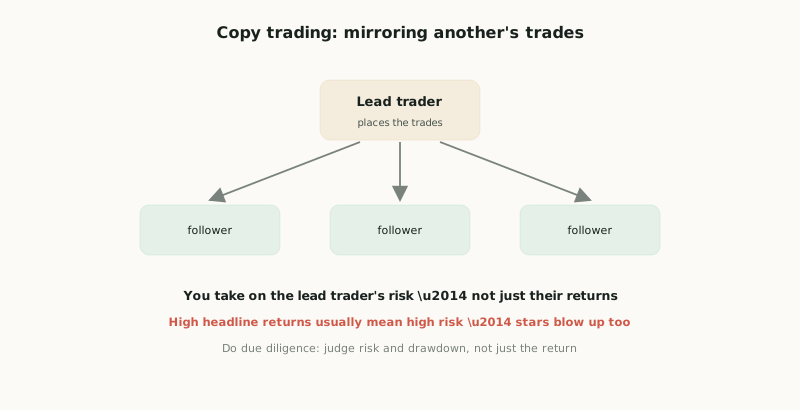
Copy trading (also called social trading or mirror trading) is a model in which you automatically replicate the trades of another trader in your own account. Platforms that offer it let you browse "lead" traders (sometimes called signal providers or strategy providers), view their track records, and allocate funds to copy one or more of them. Once you copy a lead trader, their positions are mirrored proportionally in your account: when they open a trade, a corresponding trade opens in yours (scaled to your allocated capital); when they close it, yours closes too. You take the same trades they do, automatically, without making the individual decisions yourself.
The model exists on a spectrum of "social" trading features — from simply following and manually imitating traders, to fully automatic proportional copying — but the core idea is consistent: someone else makes the trading decisions, and you ride along. This is fundamentally different from the other strategies on this site, which involve you making decisions; copy trading instead delegates the decisions to a lead trader. That delegation is the source of both its appeal (you don't need the skill yourself) and its risks (you are dependent on someone else's skill and risk management). Understanding copy trading as "automatically taking another trader's trades — delegating the decisions to them" is the key to grasping why it appeals and where its dangers lie. Everything follows from the fact that you are entrusting your money to another person's trading.
The genuine appeal
Copy trading has genuine appeal, particularly for beginners, and it is fair to acknowledge this before turning to the risks. Most obviously, it lowers the barrier to entry: trading well is genuinely hard and takes time to learn (as this entire site attests), and copy trading offers a way to participate without first developing that expertise — you can begin "trading" by copying someone who, ostensibly, already has the skill. For a beginner intimidated by the learning curve, this is attractive. It can also offer a degree of diversification: copying several different lead traders with different approaches spreads your dependence across multiple strategies rather than betting everything on your own (untested) skill or a single trader.
On reputable platforms, copy trading can additionally offer transparency (lead traders' track records, including their history and risk metrics, are displayed, in principle letting you assess them before copying) and a learning opportunity (by watching what a skilled lead trader does — which trades, when, how managed — a beginner can learn, treating copying as a form of education rather than just a shortcut). Used thoughtfully, copy trading is a legitimate model: it can let beginners participate while learning, diversify across strategies, and benefit from genuinely skilled traders — and many regulated brokers offer it as a real product. The appeal is not illusory. The problem is that the same features that make it appealing — delegating to others, headline track records, the promise of effortless returns — also create real risks that are easy to overlook in the excitement of "just copy a pro and profit." The honest picture requires weighing the genuine appeal against those risks, which are substantial.
The real risks
The central risk of copy trading follows directly from its nature: you take on the lead trader's risk, not just their returns. When you copy someone, you don't just get their profits — you get their entire approach, including their risk-taking, their mistakes, and their potential for catastrophic loss. If the lead trader trades recklessly, over-leverages, or blows up their account, you blow up with them. You have delegated not only the decisions but the risk, and you are exposed to however dangerous their trading is — which the headline return figure does not reveal.
The lead traders with the most eye-catching returns are often those taking the most reckless risk — heavy leverage, no stops, or martingale — which produces spectacular numbers right up until they blow up. Many "star" copied traders post huge gains for months, attract a flood of followers, then lose everything (and their followers' money) in a single bad run. Judging a trader by headline return alone selects for exactly the hidden recklessness most likely to ruin you. A high return is a warning to investigate the risk, not a reason to copy.
This connects to the deeper risks. Past performance doesn't guarantee future results — a lead trader's impressive history may reflect luck, a favourable period, or unsustainable risk-taking, and may not continue (the same caution as for backtests and the adaptive-markets edge-decay lesson). "Star" traders regularly blow up: the trader showing the best returns is disproportionately likely to be taking the most risk, and the very traders that attract the most copiers (via spectacular numbers) are often those most likely to eventually suffer a catastrophic loss — a selection effect that actively works against the naive copier. There is the specific danger of copying a martingale or grid trader (from the grid-trading guide): such traders can show a long, smooth run of small profits that looks wonderfully consistent, masking the near-certain eventual blow-up — and a copier drawn in by the smooth track record inherits the catastrophe. You also have less control (you are subject to the lead trader's decisions, which may not match your risk tolerance or react to your circumstances), face fees (copy trading often carries costs that eat into returns), and confront the reality that the lead trader's risk tolerance may differ wildly from yours — a level of risk they find acceptable might be ruinous for you. And crucially, copy trading does not remove the need to understand risk; it just changes whose trading you must evaluate, which most beginners (the main audience) are least equipped to do well. The marketing of copy trading, like that of robots and signals, frequently veers into get-rich-quick territory (overlapping the scams guide), showcasing star traders' returns while obscuring the risks — luring beginners with the dream of effortless profit from copying a "pro."
Due diligence and a balanced verdict
If you choose to copy trade, the essential protection is due diligence focused on risk, not headline returns — evaluating a potential lead trader the way the expectancy and risk-management guides teach you to evaluate any strategy. Look hard at the lead trader's risk metrics: their maximum drawdown (how much they have lost peak-to-trough — a trader with huge returns but a 70% drawdown is taking dangerous risk), the consistency of their returns (smooth, steady growth is more reassuring than spectacular spikes — though beware the deceptively smooth martingale curve), how long they have traded (a long track record through varied conditions is far more meaningful than a few stellar months), and, as far as possible, how the returns were achieved (sound risk-managed trading, or reckless leverage and no stops?). Treat very high returns as a red flag prompting investigation of the risk, not as an attraction — the inversion of the naive instinct, and the single most important mindset shift for copy trading safely.
Beyond evaluating the trader, protect yourself structurally: diversify across multiple lead traders rather than betting on one; copy conservatively (allocate only capital you can afford to lose, sized so that a copied trader blowing up is survivable); understand that you bear their risk and could lose money; and never abandon the risk-management principles that apply to all trading. The balanced verdict: copy trading is a legitimate model with real appeal — it can let beginners participate and learn, offer diversification, and provide access to genuinely skilled traders — but it is not a shortcut to guaranteed or effortless profits, it transfers another person's risk onto you, and its headline-return marketing selects for exactly the reckless traders most likely to ruin their copiers. Approached with eyes open — with risk-focused due diligence, conservative sizing, diversification, deep scepticism of high-return stars, and full awareness that you are taking on someone else's risk — it can be a reasonable way for a beginner to participate while learning. Approached naively — chasing the biggest headline returns in hope of easy money — it is a fast way to inherit a stranger's blow-up. As with every approach on this site, the safety lies in honest risk-awareness, not in the comforting fantasy of effortless gains.
Copy trading (social/mirror trading) automatically replicates a lead trader's positions in your account — delegating the decisions to them. Its appeal: low barrier for beginners, diversification across traders, transparency and learning on good platforms. But the key risk is that you take on their risk, not just returns — if they're reckless or blow up, so do you. Past performance doesn't guarantee the future, high headline returns usually mean high (often hidden) risk, "star" traders regularly blow up, and you might copy a martingale trader whose smooth run masks certain ruin. Do due diligence on risk not returns (drawdown, consistency, longevity, how returns were made), treat high returns as a warning, diversify, copy conservatively, and know you bear their risk. Legitimate model, not a shortcut to easy profit.