Selling the exact top and buying the exact bottom is seductive — and one of the fastest ways to lose money. Counter-trend trading means deliberately fighting the prevailing momentum, trying to catch reversals or fade overextended moves — and the uncomfortable truth is that trends tend to win. This guide takes an honest look at counter-trend trading: what it is, why it's so much harder and riskier than trading with the trend, and — if you're going to do it anyway — how to approach it with the caution it demands. In keeping with this site's risk-first philosophy, the emphasis here is on the danger, because counter-trend trading is where many traders, especially beginners, do themselves serious harm.
It's the opposite of trend-following, closely tied to mean reversion, and demands the strictest risk management.
Key takeaways
Q: What is counter-trend trading?
A: Counter-trend trading (also called fade or reversal trading) means trading against the prevailing trend — for example, shorting an uptrend expecting a reversal, or buying a downtrend expecting a bounce. It tries to catch turning points or fade overextended moves, rather than trading with the trend.
Q: Why is counter-trend trading risky?
A: Because you're fighting the prevailing momentum, and trends tend to persist far longer and further than expected. Catching the exact reversal is very hard — entering early means repeated losses as the trend continues. It has a lower probability of success than trading with the trend and is generally not recommended for beginners.
Q: How can you trade counter-trend more safely?
A: If you trade counter-trend at all, it's safer to do so only at major levels or genuine extremes, with strong evidence of exhaustion or reversal (reversal patterns, divergence, key support/resistance), strict risk management (small size, tight stops), and a willingness to cut losses quickly and accept the lower odds.
What it is, and why people do it
Counter-trend trading (also called fade trading or reversal trading) means trading against the prevailing trend. In an uptrend, that means looking to sell (short), expecting a reversal or pullback; in a downtrend, looking to buy, expecting a bounce or reversal. Rather than aligning with the trend's momentum (trend-following), the counter-trend trader bets against it — trying to catch the turning point, or to fade a move that's gone "too far." It's the conceptual opposite of the trend-following approach.
The appeal is understandable. Trends don't last forever — every trend eventually ends and reverses, and catching that reversal early can be very profitable (you enter near the extreme, before the new trend is obvious). Markets overextend — prices sometimes run further than fundamentals justify and then snap back toward a mean (the mean-reversion idea), so fading an overextended move can pay. And there's a psychological pull: selling the top and buying the bottom feels clever, the mark of someone who "saw the turn" when others were caught out, and the idea of buying something "cheap" after a fall (or selling it "expensive" after a rally) is intuitively appealing. These motivations are real, and counter-trend trading can work — reversals do happen, and overextended moves do revert. But the appeal masks how difficult and dangerous the approach is, which is the crucial point.
Why it's so dangerous
Counter-trend trading is substantially riskier and harder than trading with the trend, for reasons every trader should take seriously before attempting it.
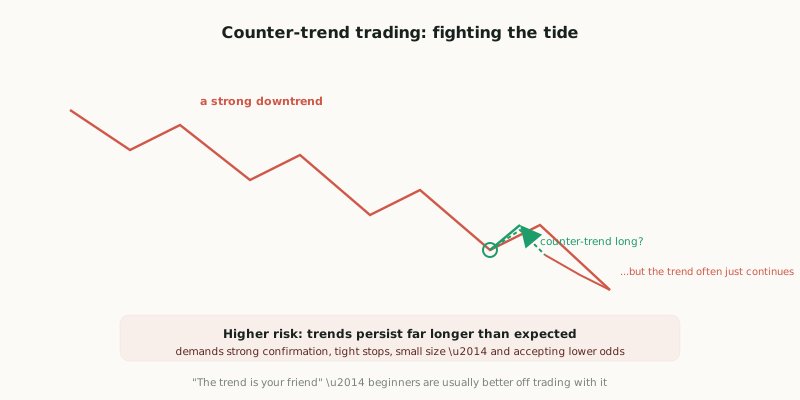
Counter-trend trading means fighting the prevailing momentum, and momentum is powerful. The old wisdom — "the trend is your friend," "don't fight the tape" — exists because trends persist far longer and further than expected. An overextended move can get more overextended; a trend that "must" reverse can keep going, stopping out fader after fader. Catching the exact reversal is extremely hard: enter early (the usual outcome) and you take loss after loss as the trend grinds on. Counter-trend trading has a lower probability of success than trading with the trend, and is not recommended for beginners — it's where many blow up, repeatedly fading a strong trend until it ruins them.
Unpack the warning. First, momentum is real and powerful: a trend reflects a genuine prevailing force (buyers or sellers in control), and betting against it means betting that force is about to fail — which, at any given moment, is usually the lower-probability bet. Second, trends overshoot: markets routinely extend further than seems reasonable, so "it's gone too far, it must reverse" is a famously unreliable basis for a trade — the move can go further still, and the trader who keeps fading it accumulates losses (the market can "stay irrational longer than you can stay solvent"). Third, timing the reversal is brutally hard: even when a reversal does eventually come, catching the precise turn is very difficult, and being early — the normal experience — means being wrong (and stopped out) before being right. The cumulative result is that counter-trend trading has a lower win rate and a tendency to produce a string of losses against a persistent trend, which is psychologically and financially punishing. This is why the strong, honest advice — especially for beginners — is to trade with the trend, not against it: trend-following stacks the odds in your favour, while counter-trend trading fights them. Beginners, in particular, are far better off mastering trading with the trend before ever attempting to fade one.
If you must: doing it more carefully
Counter-trend trading is not forbidden — experienced traders do it, and there are situations where fading a move is reasonable — but if you're going to do it, it must be done with great care and the recognition that you're taking the harder, lower-probability path. Several principles make it less dangerous (though never safe). First, demand strong evidence: don't fade a trend on a whim or just because it's "gone far." Look for genuine signs of exhaustion or reversal — reversal chart patterns (head and shoulders, double/triple tops), divergence (fading momentum, from the divergence guide), rejection at a major key level (significant support/resistance), clear overextension (a move stretched well beyond normal, e.g., far from key moving averages) — ideally several of these in confluence. Counter-trend trades are most defensible at major levels or genuine extremes with real confirmation, not in the middle of a healthy trend.
Second, use strict risk management — this is non-negotiable for counter-trend trading. Because you're fighting the trend and will be wrong often, being wrong must be cheap: small position sizes and tight stops (so each losing fade is a small loss), and a willingness to cut the trade quickly if it doesn't work (don't marry a counter-trend bet — if the trend keeps going, get out). The whole approach only survives if losses are kept small while the occasional well-caught reversal pays enough to justify them. Third, accept the lower odds: go in knowing the win rate is lower than trend-following, sizing and managing accordingly, and never betting big on a single "the top is in" conviction. It's also worth noting the mean-reversion connection: in a range-bound market, fading the range extremes (selling resistance, buying support) is actually sensible range trading (covered in its own guide) — the real danger is fading a genuine trend. Distinguishing "fading extremes in a range" (reasonable) from "fighting a strong trend" (dangerous) is part of doing counter-trend trading intelligently. The honest, overriding framing: counter-trend trading is an advanced, higher-risk approach that fights the odds; trends usually persist; catching reversals is hard; and the strong default — especially for beginners — is to trade with the trend. If you do fade, do it only at major levels with strong confirmation, with strict small-size, tight-stop risk management, quick to cut losses, and clear-eyed about the lower probability. Respect the trend, and treat counter-trend trading as the dangerous, demanding discipline it is — not the clever shortcut it can seem.
Why counter-trend trading tempts us
It's worth understanding why counter-trend trading is so seductive, because the pull is largely psychological — and recognising it is part of resisting it (the trading-psychology material applies directly). The deepest draw is the desire to be right and look clever: calling the top or bottom that everyone else missed is the trade that feels brilliant, the mark of a trader who "saw it coming." Trading with the trend, by contrast, can feel boring or like "following the herd," even though it's the higher-probability path. This ego pull — wanting the impressive, contrarian win rather than the unglamorous trend-following one — leads many traders to fade trends not because the evidence is strong, but because being the one who caught the reversal is emotionally appealing.
Several other biases reinforce it. There's the intuitive sense that something which has risen a lot is "too high" and must come down (or is "cheap" after a fall) — a gambler's-fallacy-like feeling that a move is "due" to reverse, which markets routinely violate by trending further. There's the memory of the one great reversal a trader once caught (or saw), which looms larger than the many failed fades (a recency and salience bias), making counter-trend trading seem more rewarding than its actual odds warrant. And catching a reversal delivers a powerful emotional hit when it works, which can be quietly addictive, pulling a trader back to fade again even after losses. The antidote is the discipline this whole site emphasises: trade the process and the probabilities, not the ego — favour the higher-probability trend direction, demand strong evidence before ever fading, keep losses small, and recognise the emotional pull of "calling the top" for the trap it often is. The trader who understands why counter-trend trading tempts them is far better placed to resist fading a strong trend on a whim, and to reserve counter-trend trades for the rare, well-confirmed setups that genuinely warrant them. Self-awareness here is itself risk management.
Counter-trend (fade/reversal) trading means trading against the prevailing trend — shorting uptrends, buying downtrends — to catch reversals or fade overextended moves. It's tempting (trends end, markets overshoot, selling tops feels clever) but substantially riskier and harder than trend-following: trends persist far longer and further than expected, catching the exact turn is very hard, and it has a lower probability of success. "The trend is your friend" — fighting it is where many, especially beginners, blow up. If you do it: demand strong evidence (exhaustion patterns, divergence, major key levels, overextension — ideally in confluence), use strict risk management (small size, tight stops, cut losses fast), and accept the lower odds. Note: fading extremes in a range is sensible range trading; fighting a real trend is the danger. Default — especially as a beginner — to trading with the trend.