
The cup and handle is one of the most recognisable bullish patterns in technical analysis: a rounded consolidation shaped like a teacup, followed by a small handle-like pullback, and then a breakout that resumes the prior uptrend. Its rounded shape is the giveaway and the key to reading it — a gradual, orderly base that distinguishes a genuine cup and handle from a sharp, less-reliable V-reversal. This guide explains how the pattern forms (the cup, the handle, the breakout), why the rounded shape matters, the bearish inverse version, and how to trade it with confirmation — deepening the chart-patterns material with a classic continuation pattern.
It's a deep-dive within chart patterns, closely related to the rounding bottom (the cup is essentially a rounding bottom with a handle), and relies on support and resistance at the rim.
Key takeaways
Q: What is the cup and handle pattern?
A: The cup and handle is a bullish continuation pattern. It consists of a rounded, U-shaped consolidation (the 'cup'), followed by a smaller downward pullback (the 'handle'), and then a breakout above the cup's high that resumes the prior uptrend.
Q: Is the cup and handle bullish or bearish?
A: The classic cup and handle is bullish — a continuation pattern signalling the resumption of an uptrend after a rounded consolidation. There is also an inverse (bearish) version, an upside-down cup and handle, that signals a continuation of a downtrend.
Q: Why does the cup need to be rounded?
A: The rounded, U-shaped cup (rather than a sharp V) reflects a gradual, orderly consolidation — a slow shift from selling back to buying — which is considered a healthier base than an abrupt V-reversal. The smooth rounding is the pattern's signature and part of what distinguishes a genuine cup and handle.
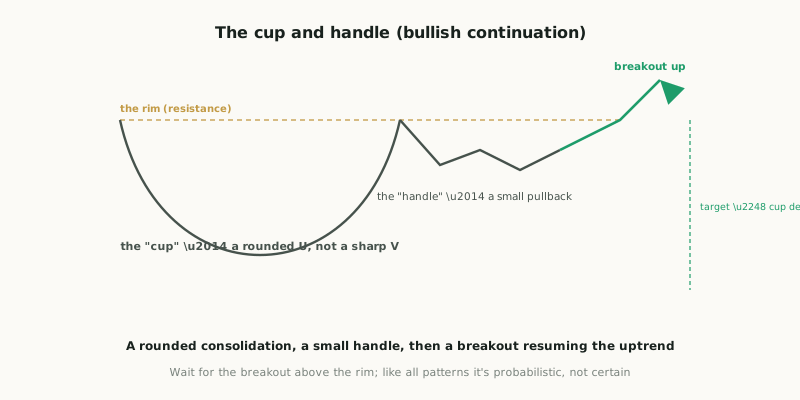
The structure: cup, handle, breakout
The cup and handle is a bullish continuation pattern — it forms after an uptrend, represents a consolidation, and signals the uptrend resuming on the breakout. It has three distinct parts, summarised below.
Cup and handle structure
The cup is the main body: after an uptrend, price undergoes a consolidation or correction that forms a rounded, U-shaped bottom — declining gradually, bottoming in a smooth, rounded fashion, and recovering back up to roughly the level where it started (the prior high, which becomes the "rim" of the cup, a resistance level). The crucial feature is that the cup is rounded (a gentle U), not a sharp V: the gradual rounding reflects an orderly, healthy consolidation — a slow shift from selling pressure to buying pressure — which is considered a more reliable base than an abrupt V-shaped reversal. The cup is, in effect, a rounding bottom (covered in its own guide) forming the base of the pattern. The handle forms next: after recovering to the rim, price makes a smaller, brief pullback — a modest downward drift or short consolidation near the cup's high (often resembling a small flag or a slight dip). This handle represents a final, minor shakeout or pause before the breakout, typically much smaller and shorter than the cup. Finally, the breakout: price breaks above the rim (the cup's high / the resistance, often confirmed above the handle's high), completing the pattern and signalling the uptrend's resumption. These three parts in sequence — rounded cup, small handle, breakout above the rim — define the cup and handle.
Why the shape matters, and the inverse
The rounded shape is not incidental — it's central to the pattern's meaning and reliability. The smooth, U-shaped cup reflects a gradual, orderly consolidation: price doesn't crash and snap back (a volatile V), but eases down, bases out, and recovers in a measured way, indicating an orderly transition from the correction back toward the uptrend. This gradual rounding is read as a healthier, more sustainable base than a sharp reversal, because it suggests a genuine, considered shift in the balance from sellers to buyers rather than a momentary spike. A proper cup and handle therefore has a recognisably rounded cup (the longer and smoother, the better, within reason) and a relatively small, contained handle — these proportions are part of what distinguishes a genuine pattern from a vaguely cup-like squiggle. The handle's modest size matters too: it should be a minor pullback, not a deep decline (a handle that drops too far, especially below the midpoint of the cup, undermines the pattern's bullish integrity).
There is also a bearish inverse: the inverse (or inverted) cup and handle, an upside-down version — a rounded inverted-U "cup" forming after a downtrend, followed by a small upward handle, then a breakdown below the pattern — signalling a continuation of the downtrend. It's the mirror image, with the same logic in reverse (a rounded distribution top rather than a rounded accumulation base). The standard, more commonly discussed pattern is the bullish version, but the inverse applies the same principles to a downtrend. Understanding why the rounded shape matters — orderly consolidation, healthy base, genuine shift in balance — is what lets a trader distinguish a real cup and handle (worth attention) from a superficial resemblance, and is the conceptual heart of the pattern.
Trading the cup and handle
Trading the cup and handle follows the disciplined, confirmation-first approach of all chart patterns. The entry comes on the breakout above the rim (the cup's high / resistance, typically confirmed above the handle's high) — the point at which the pattern completes and signals the uptrend resuming. As always, the discipline is to wait for the breakout rather than anticipating it, since the pattern is only confirmed when price breaks out, and many traders seek further confirmation (a convincing close above the rim, a pickup in volume on the breakout, or confluence with other factors) to guard against a false break. For the target, the conventional measured move projects the depth of the cup (from the rim down to the cup's bottom) upward from the breakout point, giving a rough objective. The stop is typically placed below the handle (or below the breakout level), so that a failed breakout — price falling back below the handle/rim — is cut quickly, defining the risk in the disciplined way risk management requires.
The honest framing applies as to every pattern: the cup and handle is a probabilistic pattern, not a guarantee — it can fail, breakouts can be false, and the pattern can be tricky to identify cleanly in real time (the "ideal" textbook shape is clearer in hindsight than in the moment, and not every rounded dip with a pullback is a tradeable cup and handle). It should be traded with confirmation, sensible targets and stops, and awareness of context (it works best as a continuation within a genuine uptrend), never mechanically or as a sure thing. Used well — recognising the rounded cup and small handle, waiting for the breakout above the rim with confirmation, projecting a measured target, and managing risk with a stop below the handle — the cup and handle is a useful, well-regarded continuation pattern that captures an orderly consolidation resolving back into an uptrend. But like all patterns, it's an edge to be traded with discipline and humility, not a crystal ball: respect the rounded shape that gives it meaning, demand confirmation, and manage the risk.
Identifying a genuine cup and handle
Because "a rounded dip with a small pullback" is vague, it helps to know the proportions and features that distinguish a genuine cup and handle from a superficial resemblance — a common source of error, since traders eager to find the pattern can see it where it isn't. The cup should be a smooth, rounded U — not a sharp, narrow V (which signals a hurried, less reliable reversal rather than an orderly base) and not jagged or erratic. A reasonably symmetrical, gently curved cup that forms over a meaningful period is the ideal; a cup that's too shallow may lack significance, while one that's excessively deep starts to look more like a major reversal than a continuation consolidation. The cup should follow a genuine prior uptrend, since this is a continuation pattern — a cup-like shape without a preceding uptrend isn't a textbook setup.
The handle has its own important guidelines. It should be a small, contained pullback relative to the cup — a minor dip or short consolidation near the rim, not a deep decline. A widely-cited rule of thumb is that the handle should not retrace too far down the cup (a handle dropping below roughly the cup's midpoint is a warning sign that undermines the pattern's bullish integrity, suggesting the consolidation isn't as healthy as a true cup and handle requires). The handle typically forms in the upper portion of the cup, near the rim, and is shorter in duration than the cup. Finally, the rim — the resistance level across the top of the cup — should be a recognisable level that the breakout must clear. Watching volume can add confirmation: volume often diminishes through the cup and handle (the quiet of consolidation) and ideally expands on the breakout, lending it credibility. None of these are rigid laws — real patterns are imperfect — but checking the proportions (rounded U cup, small handle not retracing too deep, a genuine prior uptrend, a clear rim) helps you distinguish a real, tradeable cup and handle from wishful pattern-spotting, which is the difference between trading the edge and trading an illusion.
The cup and handle is a bullish continuation pattern: a cup (a rounded, U-shaped consolidation — not a sharp V — after an uptrend, recovering to a prior high that becomes the "rim"), a handle (a small, brief pullback near the rim), and a breakout above the rim resuming the uptrend. The rounded shape reflects an orderly, healthy consolidation. To identify a genuine one: a smooth U cup (reasonably symmetrical, after a real uptrend), a small handle that doesn't retrace too deep (a warning sign if it drops below the cup's midpoint), a clear rim, and ideally volume expanding on the breakout. There's a bearish inverse version for downtrends. Trade it on the breakout above the rim (wait for it; seek confirmation), with a measured target (cup depth projected up) and a stop below the handle. Probabilistic and clearer in hindsight — trade with confirmation and risk management.