Not every reversal is a sharp spike. Sometimes a trend turns slowly, in a long, gradual curve — the rounding bottom or rounding top (also called saucer patterns). These patterns trade patience for clarity: they're hard to spot early and take time to form, but they paint a clear picture of control shifting gradually from one side to the other. This guide explains how rounding bottoms and tops form, why the slow rounding signals a genuine shift in control, how they differ from sharp V-reversals (and relate to the cup and handle), and how to trade them — deepening the chart-patterns material with a gradual, often longer-term reversal.
It's a deep-dive within chart patterns, the foundation of the cup and handle (whose "cup" is a rounding bottom), and another reversal pattern alongside the double top and bottom.
Key takeaways
Q: What is a rounding bottom pattern?
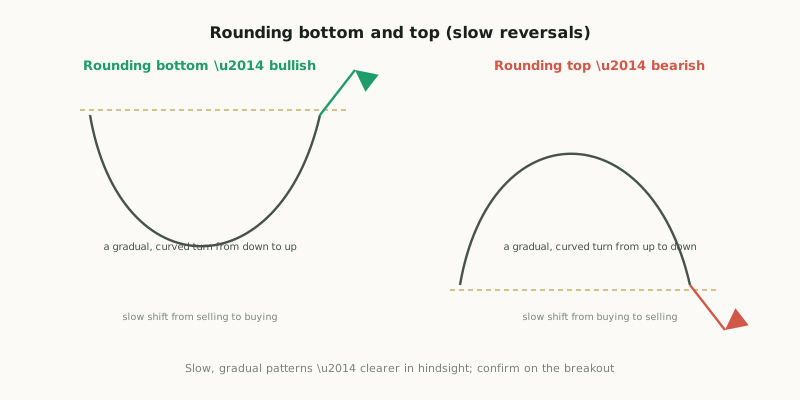
A: A rounding bottom (or saucer bottom) is a bullish reversal pattern in which price forms a gradual, U-shaped curve at the end of a downtrend — slowly decelerating its decline, bottoming smoothly, and gradually turning up. It signals a slow shift from selling to buying pressure, confirmed by a breakout above resistance.
Q: What is a rounding top pattern?
A: A rounding top is the bearish mirror image — a gradual, inverted-U curve at the end of an uptrend, where price slowly decelerates its rise, tops out smoothly, and gradually turns down. It signals a slow shift from buying to selling pressure, confirmed by a breakdown below support.
Q: How is a rounding bottom different from a V-reversal?
A: A rounding bottom is gradual and curved — a slow, smooth turn over time — whereas a V-reversal is sharp and sudden. The rounding reflects a gradual, orderly shift in the balance of buyers and sellers, which can make it a more deliberate (if slower-developing) signal than an abrupt spike reversal.
The pattern at a glance
Rounding patterns profile
How they form
Rounding patterns are reversal patterns characterised by a gradual, curved shape rather than a sharp turn. A rounding bottom (or saucer bottom) forms at the end of a downtrend: price slowly decelerates its decline, the selling pressure gradually easing, until it bottoms out in a smooth, U-shaped curve, and then just as gradually begins to turn up as buying pressure slowly builds. The result is a long, rounded, saucer-like bottom — a gentle curve from down to up, rather than an abrupt low. It's a bullish reversal, signalling the downtrend giving way to an uptrend, and is confirmed when price eventually breaks above the resistance level at the pattern's "rim" (roughly the level where the rounding began). A rounding top is the exact mirror: forming at the end of an uptrend, price slowly decelerates its rise, tops out in a smooth inverted-U curve, and gradually turns down — a bearish reversal, confirmed by a breakdown below the support at the rim.
What the gradual rounding represents is a slow shift in the balance of control between buyers and sellers. In a rounding bottom, the smooth curve reflects selling pressure gradually fading and buying pressure gradually building — a slow, orderly transition from sellers being in control (the downtrend) to buyers taking over (the new uptrend), often described as a shift from distribution to accumulation. There's no sudden, dramatic turn; instead, the change of control happens incrementally over time, which is exactly what the gradual curve depicts. In a rounding top, the reverse occurs: buying pressure slowly fades and selling pressure slowly builds, a gradual shift from buyers to sellers (accumulation to distribution). This slow, gradual nature is the defining feature of rounding patterns — they capture a reversal that unfolds smoothly over an extended period, rather than the abrupt turn of a spike reversal. Because of this, rounding patterns are often longer-term formations, taking considerable time to develop fully.
Gradual versus sharp, and the cup link
It's worth contrasting rounding patterns with their opposite, the sharp V-reversal. A V-reversal is sudden and dramatic — price plunges and then snaps back sharply (a V at the bottom) or spikes and reverses abruptly (an inverted V at the top) — reflecting a rapid, often emotional change of direction. A rounding pattern is the opposite: a slow, smooth, gradual turn. The difference matters for interpretation: where a V-reversal is abrupt and can be volatile and harder to trust (a sharp spike can be a temporary overreaction), the gradual rounding reflects a more deliberate, orderly shift in the balance of buyers and sellers, which some traders consider a more considered (if slower-developing) basis for a reversal — the change of control is being built steadily, not snapped into place. This is the same logic that makes the rounded "cup" of the cup-and-handle pattern attractive (a healthy, orderly base).
Indeed, the connection to the cup and handle is direct: the "cup" in a cup-and-handle pattern is essentially a rounding bottom (a rounded U-shaped base), with the cup-and-handle simply adding a small "handle" pullback before the breakout and being classed as a continuation pattern within an uptrend. A standalone rounding bottom, by contrast, is treated as a reversal at the end of a downtrend (no handle required), though the rounded-base shape and bullish bias are shared. Understanding the rounding bottom thus illuminates the cup and handle, and vice versa — they're close relatives built on the same rounded-base idea. The key distinction to hold onto is the gradual, curved nature of rounding patterns (versus sharp V-reversals) and what it signifies: a slow, orderly shift in control, captured in a smooth curve.
Trading rounding patterns
Trading rounding patterns follows the disciplined, confirmation-first approach of all chart patterns, with one extra consideration: their slow, gradual nature. Confirmation comes on the breakout — above the rim resistance for a rounding bottom (bullish), below the rim support for a rounding top (bearish) — and, as always, the discipline is to wait for that breakout rather than anticipating it. Some traders project a measured-move target based on the depth of the pattern from the breakout, with a stop beyond the rim (or the pattern) to cut a failed breakout — the usual risk-defining approach.
The extra consideration is that rounding patterns are slow and can be hard to identify in real time. Because the turn is gradual and unfolds over a long period, a rounding bottom or top is often much clearer in hindsight than in the moment — while it's forming, it can be difficult to know whether a gradual curve is genuinely a rounding reversal or just a slow drift that may continue or fail. This is a real practical limitation: the patterns require patience to develop, can be ambiguous as they form, and confirmation (the breakout) may come only after a long wait. As with every pattern, the honest framing is essential: rounding bottoms and tops are probabilistic tools, not guarantees — they can fail, they're harder to identify cleanly than sharper patterns, and they must be traded with confirmation, sensible targets and stops, and patience, never mechanically. Used well — recognising the gradual curve, understanding it as a slow shift in control, waiting for the breakout beyond the rim with confirmation, and managing risk with a measured target and protective stop — rounding patterns are a useful addition to the reversal toolkit, capturing the trends that turn slowly rather than sharply. But they demand patience and humility above all: a gradual pattern rewards the trader who waits for it to complete and confirm, and punishes the one who anticipates a rounding reversal that hasn't yet proven itself. Like all patterns, an edge to be traded with discipline — here, with an extra measure of patience.
Spotting them: timeframes and volume
Because rounding patterns are gradual and slow, a few practical pointers help in spotting and confirming them. On timeframes, rounding bottoms and tops tend to appear most clearly on higher timeframes (daily, weekly) and often represent longer-term reversals that develop over weeks or months — the gradual change of control they depict simply takes time to unfold. This means they're generally more relevant to longer-term traders and investors than to short-term scalpers, and that patience is intrinsic to them: a genuine rounding pattern is rarely a quick intraday affair. It also explains why they're clearer in hindsight — a slow curve developing over months is hard to confirm as a rounding reversal while you're in the middle of it, and only resolves into an obvious pattern once complete.
On volume, the classic rounding bottom often shows a distinctive, telling volume profile: volume tends to be higher at the start (the tail end of the downtrend), diminish toward the middle (the bottom of the curve, where activity and conviction are lowest — the market quiet and undecided), and then build back up as price rounds upward and approaches the breakout — a "U-shaped" volume pattern that mirrors the price curve and lends the pattern credibility. A breakout above the rim on expanding volume is the most convincing confirmation. Finally, a note on distinguishing a rounding pattern from a range: a rounding bottom is a curved, directional turn (down, bottoming, then up), whereas a rectangle/range is flat (sideways between horizontal boundaries) — the rounding's gentle curve and gradual change of direction is what sets it apart from a featureless sideways range. As with every pattern, the honest caution holds: rounding patterns are probabilistic, slow, sometimes ambiguous as they form, and best confirmed on the breakout with supportive volume — rewarding the patient trader who waits for the gradual picture to complete rather than anticipating a slow reversal that hasn't yet proven itself.
Rounding bottoms and tops (saucer patterns) are gradual, curved reversal patterns. A rounding bottom is a smooth U-shaped base ending a downtrend — bullish, a slow shift from selling to buying — confirmed by a breakout above the rim resistance. A rounding top is the inverted-U mirror ending an uptrend — bearish — confirmed by a breakdown below the rim support. The gradual rounding (versus a sharp V-reversal) signals a deliberate, orderly change of control; the cup in a cup-and-handle is essentially a rounding bottom plus a handle. They appear mainly on higher timeframes as longer-term reversals, are clearer in hindsight, and often show a U-shaped volume profile (volume low at the bottom, building into the breakout). Distinguish them from flat ranges by their curve. Trade them on the breakout beyond the rim (wait for it), with a measured target and a stop beyond the pattern. Slow and patience-demanding — and, like all patterns, probabilistic, not guaranteed; trade with confirmation and risk management.