
When price climbs to new highs but the momentum behind it quietly fades, something has to give. Divergence — price and a momentum oscillator moving apart — is the market's early warning that a move is running out of steam. It's a powerful clue that many traders watch closely, but a treacherous one: divergence can persist far longer than you expect, so trading it carelessly is a fast way to lose. This guide explains divergence trading: how it works, the crucial distinction between regular divergence (a reversal signal) and hidden divergence (a continuation signal), and — most importantly — why divergence needs confirmation and is best used as a supporting factor rather than a standalone signal.
It's built on momentum oscillators like the RSI, the MACD and the stochastic, and works best as one factor within confluence.
Key takeaways
Q: What is divergence in trading?
A: Divergence occurs when price and a momentum oscillator (such as RSI, MACD or the stochastic) move in opposite directions. It signals that the momentum behind a price move is weakening, which can warn of a potential reversal (regular divergence) or, in some cases, support a continuation (hidden divergence).
Q: What's the difference between regular and hidden divergence?
A: Regular divergence is a potential reversal signal — for example, price makes a higher high while the oscillator makes a lower high (bearish), warning the uptrend may reverse. Hidden divergence is a continuation signal — for example, price makes a higher low while the oscillator makes a lower low (bullish), suggesting an uptrend will continue.
Q: Is divergence reliable on its own?
A: No. Divergence is an early warning of fading momentum, not a standalone entry signal. It can persist for a long time (price keeps trending while divergence builds), so it produces false signals if traded alone. It works best as a supporting or confluence factor, confirmed by price action before entering.
What divergence is
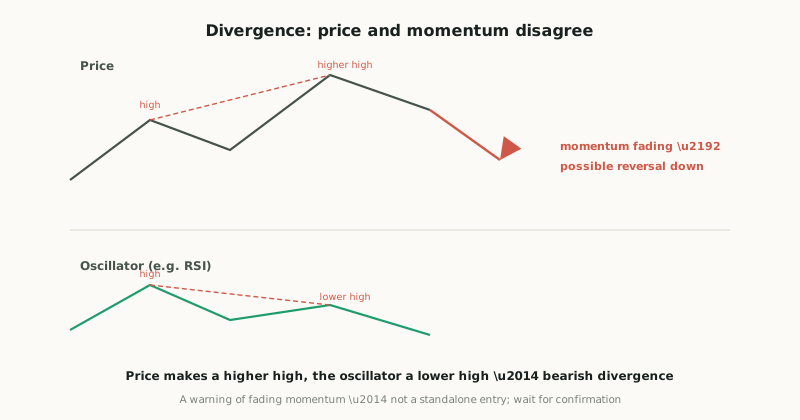
Divergence occurs when price and a momentum oscillator move in opposite directions. Momentum oscillators — such as the RSI, MACD or stochastic (each covered in its own guide) — measure the strength or momentum behind price moves. Usually, price and momentum agree: as price makes higher highs in an uptrend, the oscillator also makes higher highs, confirming the move has momentum behind it. Divergence is when they disagree — price makes a new extreme (a higher high, say) but the oscillator fails to confirm it (making a lower high instead). This disagreement reveals that the momentum behind the price move is weakening, even as price still pushes to new extremes — the move is losing its internal strength, like a car still rolling forward but with the engine cutting out.
This is why divergence is watched as a meaningful clue: it's an early warning that a trend or move is running out of momentum, often before price itself turns. A trend driven by strong, confirming momentum is healthy; a trend where price advances but momentum is fading (divergence) may be tiring, vulnerable to stalling or reversing. Divergence can appear with various oscillators (RSI and MACD are the most common for it), and the principle is the same regardless of which: a mismatch between price's direction and momentum's direction, signalling that the move's underlying force is ebbing. Crucially, though, divergence describes a condition (fading momentum), not a guaranteed outcome — and as we'll see, that distinction is everything. There are also two types of divergence with opposite meanings, which must be kept straight.
Regular versus hidden divergence
The essential distinction in divergence trading is between regular divergence (a potential reversal signal) and hidden divergence (a continuation signal). They're easy to confuse but mean opposite things, as the table shows.
Regular vs hidden divergence
| Type | What price does | What the oscillator does | Signal |
|---|---|---|---|
| Bearish regular | Higher high | Lower high | Reversal down (at tops) |
| Bullish regular | Lower low | Higher low | Reversal up (at bottoms) |
| Hidden bearish | Lower high | Higher high | Downtrend continues |
| Hidden bullish | Higher low | Lower low | Uptrend continues |
Regular (classic) divergence is a potential reversal signal, appearing at the end of a move. Bearish regular divergence (at a top): price makes a higher high but the oscillator makes a lower high — upward momentum is fading, warning of a possible reversal down. Bullish regular divergence (at a bottom): price makes a lower low but the oscillator makes a higher low — downward momentum is fading, warning of a possible reversal up. Regular divergence is the more commonly discussed type, used to anticipate trend reversals. Hidden divergence is the opposite — a continuation signal, appearing during a pullback within a trend. Hidden bullish divergence (in an uptrend): price makes a higher low (a healthy pullback) but the oscillator makes a lower low — suggesting the uptrend will continue. Hidden bearish divergence (in a downtrend): price makes a lower high but the oscillator makes a higher high — suggesting the downtrend will continue. The mnemonic that helps: regular divergence signals a possible reversal (the trend may turn), while hidden divergence signals a continuation (the trend likely resumes after the pullback). Keeping these straight is essential, since acting on the wrong interpretation means trading the wrong direction. In practice, regular divergence (especially bearish at tops and bullish at bottoms) is what most traders mean by "divergence," used to spot tiring trends, while hidden divergence is a useful complement for confirming trend continuation on pullbacks.
Why divergence needs confirmation
Here is the most important lesson in divergence trading, and the one most often learned the hard way: divergence is not a standalone entry signal, and trading it alone is dangerous. The reason is that divergence can persist — a divergence can keep building while price keeps trending, sometimes for a long time, before any reversal actually occurs (if it occurs at all). A famous market adage captures it: the market can stay irrational — or in this case a trend can keep diverging — longer than you can stay solvent. A trader who sees bearish divergence and immediately shorts a strong uptrend may find the uptrend simply continues (with divergence persisting or repeating), stopping them out repeatedly. Divergence tells you momentum is fading, but a fading-momentum trend can still run for a while, and divergence frequently produces false signals when traded in isolation. This is why divergence, for all its appeal as an early-warning clue, is unreliable on its own.
The sound approach is to treat divergence as a warning and a supporting factor, confirmed by price action before acting. Divergence flags that a move may be tiring — a reason to pay attention, tighten stops on an existing position, or watch for a reversal — but the entry should come from confirmation, not the divergence alone. Confirmation can be a break of structure (price breaking a relevant swing level in the reversal direction — the market-structure and break-of-structure guides), a candlestick reversal signal, a trendline break, or other price-action evidence that the turn (or continuation) is actually happening, not just threatening to. Divergence is also at its best as one factor in confluence (the confluence guide): divergence plus a key resistance level plus a bearish candlestick signal is a far stronger case than divergence alone. In this role — an early warning that fading momentum may be setting up a reversal or supporting a continuation, to be confirmed by price action and combined with other factors — divergence is a genuinely useful tool. The honest framing, in keeping with this site's spine: divergence is a probabilistic clue about momentum, not a magic reversal signal; it can persist and mislead if traded alone; it must be confirmed and is best used in confluence; and, like everything, it requires risk management (stops), because even a confirmed divergence trade can fail. Used as a supporting factor with confirmation — not as a standalone trigger — divergence earns its place in a trader's toolkit; used as a mechanical "see divergence, take the trade" rule, it's a reliable way to get run over by a trend that wasn't finished.
Divergence in practice
A few practical points help in using divergence well rather than seeing it everywhere. On which oscillator: the RSI and the MACD are the most popular tools for spotting divergence (the stochastic is also used). The RSI is a clean momentum gauge whose swing highs and lows are easy to compare against price; the MACD (its histogram or line) is likewise widely used. Which you choose matters less than using it consistently — the divergence principle is the same regardless of oscillator. On how to spot it: you compare the swing highs (for bearish/top divergence) or swing lows (for bullish/bottom divergence) of price against the corresponding peaks or troughs of the oscillator. The technique is to identify two relevant price extremes and check whether the oscillator's matching extremes confirm them (agreement — no divergence) or contradict them (divergence). Clear, comparable swing points make for clearer divergence; messy, choppy price makes divergence readings dubious.
On timeframe: as with most signals, divergence on higher timeframes tends to carry more weight than on very short ones, where noise generates frequent, low-quality divergences. And on common mistakes — the biggest is seeing divergence everywhere. Because oscillators wiggle constantly, an eager trader can find "divergence" on almost any chart if they look hard enough, much of it meaningless. The discipline is to focus on clear divergences at meaningful swing points (ideally near significant levels or after extended moves), not to hunt for faint mismatches in the noise. The other classic mistake, already stressed, is trading divergence alone and too early — fading a strong trend the moment a divergence appears, only to be run over as it persists. The practical takeaway: pick an oscillator and use it consistently, compare clear swing points, favour higher timeframes and significant locations, resist the temptation to see divergence everywhere, and always wait for price-action confirmation before acting. Disciplined and selective, divergence is a valuable clue; loose and over-eager, it's a source of constant false signals.
Divergence is when price and a momentum oscillator (RSI, MACD, stochastic) move in opposite directions, signalling that the momentum behind a move is fading. Regular divergence is a potential reversal signal (e.g., bearish: price higher high, oscillator lower high → possible reversal down; bullish: price lower low, oscillator higher low → possible reversal up). Hidden divergence is a continuation signal (e.g., hidden bullish: price higher low, oscillator lower low → uptrend continues). Mnemonic: regular = reversal, hidden = continuation. Crucially, divergence is not a standalone entry — it can persist far longer than you expect ("longer than you can stay solvent") and gives false signals alone. Treat it as an early warning and a confluence factor, confirmed by price action (a break of structure, a candlestick signal) before entering, always with stops. A useful clue, not a magic signal.