When the forex market re-opens after the weekend, price sometimes leaps to a new level, leaving an empty gap on the chart between Friday's close and the new open. Those gaps tend to behave in recognisable ways — often filling, sometimes running — and exploiting that behaviour is a niche but well-defined strategy. This guide explains gap trading: what gaps are in forex, the all-important gap-fill tendency, the two main approaches (fade versus continuation), and the risks.
It builds on price gaps (the what) and the related gap risk, and overlaps with news trading when a gap is news-driven.
Key takeaways
Q: What is gap trading?
A: Gap trading is a strategy that aims to profit from price gaps — jumps where price opens significantly away from its previous close, leaving an empty 'gap' on the chart. In forex, gaps occur mainly at the weekly re-open after the weekend (and around major news), since the spot market trades continuously through the week. Gap traders position based on how gaps tend to behave, most commonly the tendency for many gaps to 'fill'.
Q: What does it mean for a gap to fill?
A: A gap 'fills' when price returns to the level it gapped from — closing the empty space on the chart. Many gaps (especially smaller weekend gaps without strong news behind them) tend to fill relatively soon, as price drifts back to the prior close. This tendency is the basis of the most common gap strategy: fading the gap, meaning trading in the direction that would close it (selling an up-gap, buying a down-gap).
Q: What are the risks of gap trading in forex?
A: The big one is that not all gaps fill — gaps driven by significant news or a genuine shift in sentiment can 'run' (continue in the gap's direction) rather than fill, so a fade trade gets caught in a continuing move. Weekend gaps can also be small and infrequent in forex, limiting opportunities, and the re-open can be illiquid with wider spreads. The gap-fill tendency is an edge, never a guarantee, and needs stops and risk management.
Gaps in forex
First, a forex-specific point: where do gaps even come from in a market that trades nearly 24 hours? Because spot forex runs continuously from the Sunday/Monday open through to the Friday close, intraday gaps are rare — price usually moves smoothly tick to tick. The main gaps in forex occur at the weekly re-open: the market is closed over the weekend, so if news or developments occur while it's shut, price can open on Sunday/Monday at a level away from Friday's close, leaving a weekend gap (see price gaps and gap risk). Smaller gaps can also appear around major scheduled news or in thin conditions. So in forex, "gap trading" is largely weekend-gap trading — a more limited, periodic opportunity than in stocks (which gap at every daily open), which is why it's a niche rather than a core strategy.
Fade vs continuation
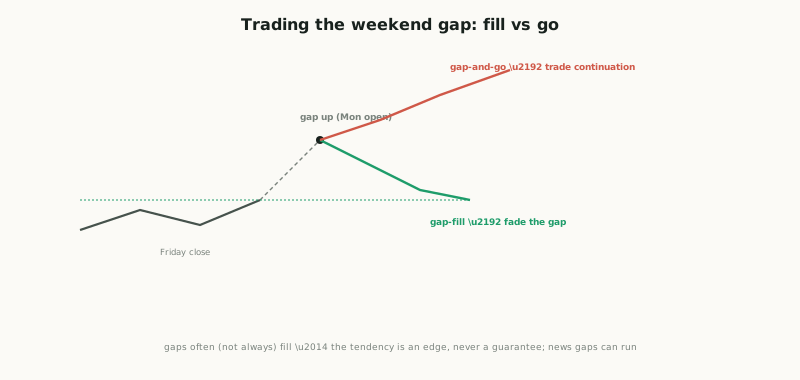
The central observation gap traders exploit is the gap-fill tendency: a gap "fills" when price returns to the level it gapped from, closing the empty space on the chart, and many gaps — especially smaller weekend gaps without strong news behind them — tend to fill relatively soon, as price drifts back toward the prior close. This gives rise to two opposing approaches.
| Approach | The bet | Best when |
|---|---|---|
| Fade the gap | Gap fills — trade toward the prior close | Small gap, no strong news driver |
| Trade the gap (go) | Gap runs — trade with the gap direction | Large gap on significant news/sentiment |
Fading the gap is the most common gap strategy: betting the gap fills, so you trade in the direction that would close it — selling an up-gap (expecting price to fall back to the prior close) or buying a down-gap (expecting a rise back). The target is the prior close (the gap-fill level), the stop sits beyond the gap (if it keeps running, you're wrong), and the edge is the statistical tendency of small, news-less gaps to revert. Trading the gap (gap-and-go / continuation) is the opposite: betting the gap runs, so you trade with its direction — this suits larger gaps driven by significant news or a genuine shift in sentiment, where the gap reflects a real repricing that's likely to continue rather than reverse. The skill is judging which regime you're in: small, unexplained gaps lean toward filling (fade), while large, news-driven gaps lean toward running (continuation) — though neither is guaranteed.
And that uncertainty is exactly the risk. The cardinal danger is that not all gaps fill: a gap driven by important news or a true sentiment shift can run instead of reverting, so a fade trade gets caught in a continuing move against you — which is why a stop beyond the gap is essential, and why judging the driver (is there a big news reason?) matters so much before fading. Other practical risks in forex: weekend gaps are infrequent and often small, limiting opportunities; the weekend re-open can be illiquid, with wider spreads and possible slippage right when you're trying to trade the gap; and a gap can be a sign of exactly the kind of gap risk that hurts positions held over the weekend. So the honest framing, as always: the gap-fill tendency is a real, exploitable edge — but a statistical tendency, never a guarantee. Gap trading works for those who respect that distinction: trade the right gap type with the right approach, judge the news driver, always use a stop (gaps that run can run far), size sensibly, and treat it as a periodic, niche opportunity rather than a reliable bread-and-butter strategy. The honest framing: gap trading profits from price gaps — in forex, mainly weekend gaps at the weekly re-open (and around major news), since spot FX trades continuously midweek. The key tendency is gap-fill: many small, news-less gaps revert to the prior close. Two approaches: fade the gap (bet it fills — trade toward the prior close; best for small, unexplained gaps) or trade the gap/continuation (bet it runs — trade with it; best for large, news-driven gaps). The main risk is that not all gaps fill — news-driven gaps can run — so judge the driver, always use a stop beyond the gap, mind thin re-open liquidity, and treat the fill tendency as an edge, not a guarantee.
Practical rules and judgement
Trading gaps well comes down to a short checklist applied with judgement. Measure the gap: note its size relative to the pair's normal range — a small weekend gap (a modest fraction of the average daily range) leans toward filling and suits a fade, while a large gap suggests something significant happened and is more likely to run. Check the driver: this is the crucial judgement — why did the gap occur? A gap with no clear news behind it (just thin weekend conditions) is a classic fade candidate, whereas a gap driven by a major weekend development (a geopolitical event, an election, a central-bank surprise) reflects a real repricing that may well continue, favouring continuation or standing aside — so always glance at what happened over the weekend before fading. Wait for confirmation rather than acting on the very first tick of the re-open: let price show its hand (e.g. begin to drift back toward the prior close for a fade, or push on for a continuation) before committing, since the chaotic first moments of the re-open are unreliable.
Then define the trade precisely: for a fade, the target is the gap-fill level (the prior close) and the stop sits beyond the gap (if it keeps running, the fade thesis is wrong — exit); for a continuation, trade with the gap with a stop on the other side. Mind the re-open conditions: the weekend re-open is often illiquid with wider spreads and possible slippage, so the practical cost of trading right at the open can be higher — some traders wait for liquidity to normalise before acting. Consider a time-based exit too: if a fade hasn't filled within a reasonable window, the tendency may not be playing out, and exiting beats hoping. And keep the opportunity in proportion: forex gaps are infrequent (mainly weekends) and often small, so gap trading is a periodic, niche add-on, not a core strategy — don't force trades on tiny or absent gaps just to be active. Above all, hold the gap-fill tendency as exactly that — a tendency, not a rule: it gives a real statistical edge on the right gaps, but plenty of gaps don't fill, so the stop and sizing are what make the strategy survivable when a gap you faded decides to run. The honest reminder: measure the gap size, check the news driver (no-news small gaps fade; big news-driven gaps may run), wait for confirmation, define target (prior close for a fade) and stop (beyond the gap), mind thin/wide-spread re-open liquidity, consider a time-based exit, and treat it as a periodic niche edge — the fill is a tendency, never a rule.
Gap trading profits from price gaps — in forex, mainly weekend gaps at the weekly re-open (and around major news), since spot FX trades continuously midweek (so it's a niche, periodic opportunity). The key tendency is the gap-fill: many small, news-less gaps revert to the prior close. Two approaches: fade the gap (bet it fills — sell an up-gap / buy a down-gap toward the prior close; best for small, unexplained gaps) or trade the gap / continuation (bet it runs — trade with it; best for large, news-driven gaps). The main risk: not all gaps fill — news-driven ones can run — so judge the driver, always use a stop beyond the gap, mind thin/wide-spread re-open liquidity, and treat the fill tendency as an edge, never a guarantee.