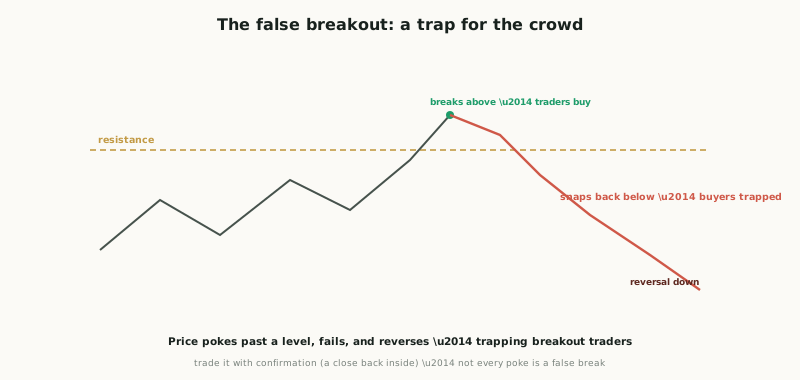
Price breaks above resistance, the breakout traders pile in expecting a run — and then it snaps back below the level, trapping every one of them. The false breakout, or "fakeout," is one of the market's most reliable traps, and learning to trade it flips the script: the crowd's mistake becomes your edge. This guide explains false breakout trading: what a fakeout is, why it happens so often, how to trade the reversal, and how to manage its risks.
It's the shadow side of breakout trading, it exploits the liquidity clustered around obvious levels, and it's common in ranging markets.
Key takeaways
Q: What is a false breakout?
A: A false breakout (or 'fakeout') is when price breaks beyond a key level — above resistance or below support — appearing to start a new move, but then quickly reverses back inside the range, trapping the traders who entered on the breakout. Instead of continuing, the move fails, and the reversal often accelerates as those trapped traders are forced to exit at a loss.
Q: How do you trade a false breakout?
A: You trade the reversal back into the range. After price breaks a level and then closes back inside it (the confirmation that the breakout has failed), a trader enters in the opposite direction — short after a failed upside break, long after a failed downside break — placing the stop just beyond the false-break extreme and targeting the other side of the range or the next level.
Q: Why do false breakouts happen so often?
A: Because obvious levels attract clustered stop and breakout orders just beyond them, which larger participants can exploit: a push past the level triggers those orders, creating a burst of liquidity to trade against, after which price reverses. Whether deliberate 'stop hunting' or simply the natural failure of weak breakouts, the result is the same — false breaks are common, especially in ranging markets and around obvious levels.
What it is, and why it happens
A false breakout occurs when price breaks beyond a key level — above resistance or below support — appearing to begin a new move, but then quickly reverses back inside the prior range, trapping the traders who entered on the breakout. The genius (and cruelty) of the pattern is that it weaponises the crowd's own behaviour: breakout traders enter long on the break above resistance, placing stops just below the level; when price fails and snaps back, those traders are trapped in losing longs, and as they're forced to exit (selling), their exits accelerate the reversal downward — the very people who bought the breakout become the fuel for the move against it. Why does this happen so often? Because obvious levels attract clustered orders: breakout entry orders and protective stop-losses pile up just beyond well-watched support and resistance, creating a pool of liquidity. A push past the level triggers all those orders at once — whether through deliberate "stop hunting" by larger participants seeking liquidity to fill into, or simply the natural failure of a weak breakout with no real momentum behind it — and once that order flow is exhausted, price reverses. The result is the same regardless of intent: false breaks are common, especially in ranging markets and around the most obvious levels, precisely because those levels are obvious.
How to trade it
The false breakout is traded by fading the failed break — entering on the reversal back into the range. The crucial element is confirmation: you don't trade the break itself (that's the trap), you wait for evidence that the breakout has failed. The cleanest confirmation is a close back inside the level: after price pokes above resistance, it closes back below it, signalling the break didn't hold. At that point a trader enters in the opposite direction — short after a failed upside break, long after a failed downside break — placing the stop just beyond the false-break extreme (above the high of the failed upside break) and targeting the other side of the range or the next level. The setup often appears as a specific candlestick: a pin bar rejecting the level (a long wick poking past and closing back inside) is essentially a one-candle false breakout, which is why the two ideas are closely linked. The appeal is a favourable risk-reward: the stop is tight (just beyond the false-break extreme), while the target (the far side of the range) can be substantial, and the trapped traders' forced exits give the move momentum.
The honest cautions matter. The biggest is that not every poke past a level is a false breakout — sometimes a break is real and runs, so fading every break without confirmation is how you end up short into a genuine breakout (the mirror-image trap). This is exactly why confirmation (the close back inside) is non-negotiable: it's the difference between trading a failed break and guessing that a break will fail. False-breakout trading also works best in ranging or consolidating markets and around obvious, well-watched levels (where the liquidity and the trap exist); in a strong trend, breaks are more likely to be genuine. As ever, the setup offers a probabilistic edge, not certainty, and demands a stop and sensible sizing — a "confirmed" false break can still resume in the breakout direction. There's also a nice synergy with breakout trading and trading the retest: understanding how breaks fail makes you a better breakout trader too, more selective about which breaks to trust. The honest framing: a false breakout (fakeout) is when price breaks a key level, appears to start a move, then reverses back inside, trapping breakout traders — whose forced exits accelerate the reversal. It happens often because obvious levels attract clustered breakout and stop orders (liquidity) that get triggered then exhausted, whether by stop-hunting or weak breaks failing. Trade it by fading the failed break with confirmation (a close back inside the level), entering opposite, stop beyond the false-break extreme, targeting the range's far side — a tight-risk, favourable reward setup, best in ranges and at obvious levels. But not every poke is false (real breaks run), so confirmation is essential; manage risk.
Telling false breaks from real ones
The hardest and most valuable skill here is distinguishing a false break from a genuine one in real time — because fading a real breakout is just as costly as chasing a false one. No single tell is definitive, but several clues, taken together, tilt the odds. Close versus wick: a break where price merely wicks past the level and closes back inside is far more likely false than one where a full candle closes decisively beyond the level and holds — which is exactly why "wait for the close back inside" is the core confirmation for fading. Momentum and conviction: a genuine breakout typically shows strong, expanding candles and follow-through, while a false break often looks hesitant — a tentative poke that stalls immediately. Volume (where available): real breaks tend to come on rising participation, false breaks on weak or fading volume (a caveat in spot forex, where only tick volume exists). Context: breaks of obvious, heavily-watched levels in ranging markets are more prone to failure (more clustered orders to trap), while breaks aligned with a strong trend are more likely genuine. And retest behaviour: a real breakout that pulls back often holds the broken level as new support/resistance (the basis of trading the retest), whereas a false break fails to hold and pushes back through.
This points to a deeper, liberating insight: studying false breakouts makes you a better breakout trader, and vice versa — they're two views of the same event. The trader who understands why breaks fail (clustered liquidity, stop hunts, weak conviction at obvious levels) becomes naturally more selective about which breakouts to trust, waiting for the close, the momentum and the context that mark a genuine break — and is equally ready to flip and trade the reversal if the break fails instead. Rather than being dogmatically a "breakout trader" or a "fade trader," the skilled trader reads each situation and trades whichever the evidence supports. This connects the false breakout to the wider toolkit: it's the failure mode that breakout strategies must respect, the reversal that rejection candles often signal, and a vivid lesson in how the market uses obvious levels against the crowd. The honest reminder: even with every clue pointing one way, breaks can fool you in either direction, so confirmation, a stop beyond the extreme and sensible sizing remain essential — the goal is to tilt the odds, not to achieve certainty.
Where false breaks cluster
It helps to know where false breakouts concentrate, since they're far from random — they gather wherever stop and breakout orders pile up most predictably. The prime spots are the boundaries of obvious ranges (the clean high and low everyone can see), round numbers (psychologically significant levels like 1.2000, where orders cluster), prior swing highs and lows (where breakout traders expect continuation and where trapped traders from before hold stops), and session or daily highs and lows (reference points the whole market watches). The common thread is obviousness: the more clearly a level stands out, the more orders accumulate just beyond it, and the more attractive it becomes as a target for the liquidity grab that produces a false break. This is genuinely useful intelligence — it tells you both where to be sceptical of breakouts (the most obvious levels are the most fade-prone) and where to watch for fade setups (a poke past a glaring level that closes back inside is a textbook candidate). It also reinforces a humbling truth: the levels that look most "certain" to break are often precisely the ones engineered to trap those who think so.
A false breakout ("fakeout") is when price breaks a key level, appears to start a move, then reverses back inside — trapping breakout traders, whose forced exits accelerate the reversal. It's common because obvious levels attract clustered breakout and stop orders (liquidity); a push triggers and exhausts them, then price turns — whether by stop-hunting or a weak break simply failing. Trade it by fading the failed break with confirmation: wait for a close back inside the level, enter in the opposite direction, place the stop just beyond the false-break extreme, and target the range's far side — a tight-risk, favourable-reward setup, best in ranges and at obvious levels. The key caution: not every poke is false (real breaks run), so confirmation is non-negotiable, and you still need a stop and sensible sizing.