When price breaks through an important level, the impatient chase it — jumping in as it breaks, often at a poor price and into a possible false breakout. The patient wait for the retest: price breaking out, then coming back to the broken level before continuing. A held retest does two things — it confirms the breakout was genuine, and it hands you a better entry than chasing. The catch is that sometimes there's no retest at all, and you miss the move. This guide explains trading the retest: the role-reversal principle behind it, why it beats chasing the breakout, how to execute it, and the trade-off of missed moves — a refinement of breakout trading and a close cousin of pullback trading.
It's a refinement of breakout trading, built on the role-reversal of support and resistance, and a sibling of pullback trading (both wait for a retracement rather than chasing).
Key takeaways
Q: What is trading the retest?
A: Trading the retest means waiting for price to break through a level (support or resistance), then come back to 'retest' that broken level before continuing, and entering when the retest holds. Broken resistance often becomes new support (and vice versa), so the retest tests whether that role reversal holds.
Q: Why trade the retest instead of the breakout?
A: Because the retest provides confirmation (a held retest shows the breakout was genuine, filtering false breakouts) and a better entry (you enter back near the level, with a tighter stop, rather than chasing the extended breakout). It improves both the reliability and the risk/reward of the trade.
Q: What is the downside of waiting for a retest?
A: Not every breakout retests. Sometimes price runs away in the breakout direction without looking back, so a trader waiting for a retest misses the move entirely. There's also the risk the retest fails (price breaks back through), though that itself is a clear signal to stay out or exit.
The role reversal
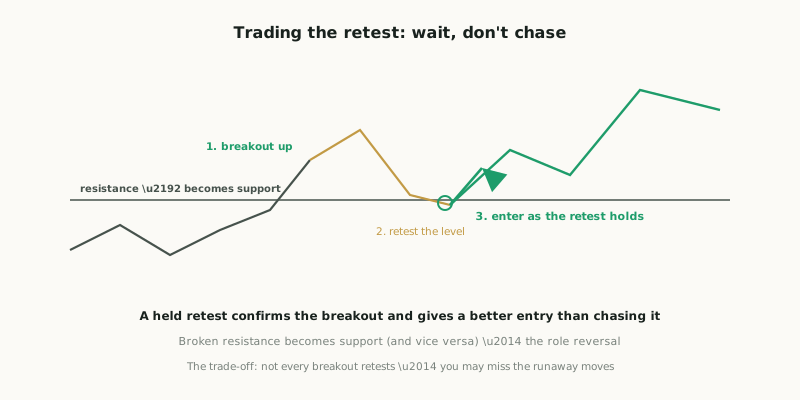
Trading the retest rests on a well-known principle of support and resistance: role reversal (or polarity). When price decisively breaks through a level, that level often switches roles — broken resistance becomes new support, and broken support becomes new resistance. The logic is intuitive: a resistance level that price has now broken above is a level where sellers previously dominated; once price breaks above and holds, that former ceiling becomes a floor (support) on any pullback, as the balance has shifted. The same in reverse for broken support becoming resistance. This role reversal is a cornerstone of price-action analysis, and the retest strategy is built directly on it.
The retest is precisely the test of this role reversal. After breaking out, price frequently returns to the broken level — a pullback back toward it — and this return "retests" whether the level now holds in its new role. In an upside breakout, price breaks above resistance, then pulls back down to that broken resistance (now acting as support); if it holds as support (price bounces off it and resumes up), the role reversal is confirmed and the breakout validated. If instead price breaks back through the level (the former resistance fails to hold as support), the role reversal failed — a sign the breakout was false. So the retest is a real-time test: does the broken level now hold in its new role (confirming the breakout) or not (signalling a false breakout)? This is what makes the retest so informative — it doesn't just offer an entry, it provides evidence about whether the breakout was genuine, by watching whether the role reversal holds.
Why it beats chasing the breakout
Trading the retest has two clear advantages over chasing the breakout (entering immediately as price breaks the level), and both flow from the role-reversal test.
Waiting for the retest rewards you twice over. First, confirmation: a held retest shows the broken level now acts in its new role, confirming the breakout was genuine — filtering out many false breakouts (where price pokes through and snaps back), which are the bane of breakout chasers. Second, a better entry: you enter back at the level on the retest, rather than chasing the extended breakout — a better price, a tighter stop (just beyond the level), and therefore better risk/reward. Chasing gets you a worse price and exposes you to false breaks; the retest gives confirmation and a better entry. Patience pays.
The first advantage — confirmation — directly addresses the biggest weakness of breakout trading: false breakouts. A trader who chases every breakout gets caught by the many that fail (price breaks out, then reverses). By waiting for the retest, you only enter once the breakout has proven itself by the broken level holding in its new role on the retest — a powerful filter against false breakouts. The second advantage — a better entry — addresses breakout trading's other weakness: chasing an extended move means a poor entry price and a wide stop. Entering on the retest puts you back near the level, with a tight stop just beyond it (if the retest fails, you're out cheaply), giving far better risk/reward than chasing. So the retest converts the breakout's two weaknesses (false breaks and poor entries) into strengths (confirmation and a good entry). Execution: wait for the breakout, then for price to return and retest the broken level; enter when the retest holds and price shows resumption in the breakout direction (a bounce off the level, a confirming signal); place the stop just beyond the level (if the retest fails and price breaks back through, exit — the breakout was false); target the breakout's continuation or measured move. This is essentially the pullback approach applied specifically to a broken level — the retest is a pullback to the breakout level — with the added role-reversal confirmation.
The trade-off: missed moves
The retest strategy's great strength — patience — is also the source of its main drawback: not every breakout retests. Sometimes a breakout is so strong that price simply runs away in the breakout direction without ever looking back to retest the level — and a trader waiting for a retest that never comes misses the move entirely. This is the real cost of the strategy: by insisting on a retest entry, you forgo the strong, runaway breakouts (often the best moves) that don't pull back. It's the same trade-off as pullback trading: you trade a better, confirmed entry for the risk of missing moves that don't offer one.
This trade-off must be accepted honestly. The retest strategy is not universally superior to chasing the breakout — it's a different choice with a different profile: higher-quality, confirmed entries with better risk/reward, at the cost of missing the breakouts that don't retest. Which is preferable depends on the trader and the situation, and many traders blend the two (e.g., taking a partial position on a breakout and adding on the retest, or chasing only the most powerful breakouts while waiting for retests on others). There's also the secondary risk that the retest fails — price returns to the level and breaks back through it, meaning the breakout was false — but this is largely a feature, not a bug: the failed retest is exactly the confirmation-filter working, telling you to stay out (or exit if you'd entered), with the stop beyond the level keeping the loss small. The honest, practical framing: trading the retest is a high-quality, confirmation-based way to trade breakouts — entering on the held retest of a broken level (the role reversal confirming the breakout) for a better, lower-risk entry than chasing — with the accepted trade-off that you'll miss the breakouts that run away without retesting. Used well, with patience, a stop beyond the level, and acceptance of the missed-move cost, it's one of the most reliable entry techniques in trading. But, like every method, it's probabilistic, not perfect: the retest confirms but doesn't guarantee, missed moves are real, and sound risk management (the stop on a failed retest) remains essential.
Where retests work best
Not all breakouts are equally likely to retest, and not all retests are equally trustworthy, so it helps to know where the strategy is most effective. The significance of the level matters most: a retest is most meaningful when the broken level was a genuinely important one — a well-established support or resistance that had been tested several times, a key swing high/low, or a major structural level (from the market-structure guide) — because the role reversal of a significant level is more reliable than that of a minor, barely-noticed one. A retest of a level that the whole market was watching carries more weight than a retest of an arbitrary line. Timeframe also plays in: retests on higher timeframes (a daily or 4-hour level) tend to be more significant and reliable than those on very short timeframes, where noise produces frequent, low-quality retests.
The strength of the breakout cuts both ways for this strategy. A powerful, decisive breakout (a strong move on good momentum) is more likely to be genuine — but, as noted, is also the kind that may not retest (it runs away), so the strongest breakouts are precisely the ones you may miss by waiting. A more measured breakout is more likely to offer a retest entry. As for handling a failed retest: if price returns to the broken level and breaks back through it (the role reversal fails), the message is clear — the breakout was likely false, so you stay out (or exit on your stop if already in). This is the strategy protecting you, not failing you: the failed retest is the confirmation filter doing its job, and the stop just beyond the level keeps the cost of a false breakout small. The practical upshot is to apply the retest approach to significant levels on meaningful timeframes, accept that the strongest breakouts may not give you an entry, and treat a failed retest as useful information rather than a disaster. Used selectively this way — on important levels, with patience and a protective stop — the retest is among the higher-quality entries available; applied indiscriminately to every minor break, it loses much of its edge.
Trading the retest waits for price to break a level, then return to "retest" it, and enters when the retest holds. It's built on role reversal: broken resistance becomes new support (and vice versa), and the retest tests whether that flip holds — confirming the breakout if it does, signalling a false breakout if price breaks back through. It beats chasing the breakout two ways: confirmation (a held retest filters false breakouts) and a better entry (back at the level, tighter stop, better risk/reward). Execute by entering on the held retest with resumption, stop just beyond the level, target the continuation. The trade-off: not every breakout retests — strong runaway moves are missed by waiting. It's essentially a pullback to the breakout level, with role-reversal confirmation. Probabilistic, not perfect — patience and a stop on a failed retest are essential.