"The trend is your friend" — but chasing a trend means buying high (or selling low), a poor entry. Pullback trading solves this: instead of chasing, you wait for a temporary dip against the trend, then enter on the resumption — trading with the trend (the higher-probability direction) while getting a better price and a tighter stop. It's one of the most popular and sensible ways to enter trending markets. The art, and the main risk, is telling a genuine pullback (temporary) from a reversal (the trend ending). This guide explains how pullback trading works, where pullbacks are bought, how it compares with breakout entries, and how to manage the pullback-versus-reversal challenge.
It's a core way to trade within a trend, the complement to breakout entries, and often uses Fibonacci retracements and support and resistance to locate entries.
Key takeaways
Q: What is pullback trading?
A: Pullback trading means entering in the direction of an established trend on a temporary retracement against it — buying the dips in an uptrend, or selling the rallies in a downtrend. It combines trading with the trend (higher probability) with a better entry price by waiting for a pullback rather than chasing.
Q: Where are pullbacks typically bought?
A: Pullbacks are often bought (in an uptrend) at support levels, moving averages, Fibonacci retracement levels, prior breakout levels, or rising trendlines — ideally where several of these align (confluence). Traders wait for price to pull back to such a level and show signs of resuming the trend before entering.
Q: What's the main risk in pullback trading?
A: Distinguishing a genuine pullback (a temporary retracement before the trend resumes) from a reversal (the trend actually ending). Entering on what looks like a pullback that turns out to be a reversal leads to losses, so traders watch trend structure, the depth of the pullback, and confirmation of resumption.
What pullback trading is
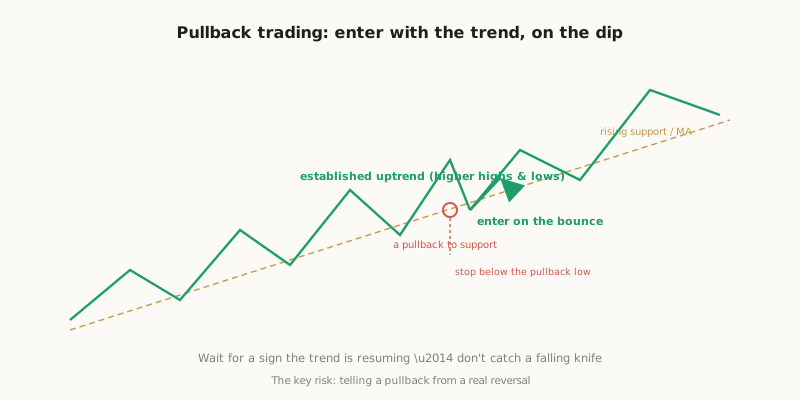
Pullback trading means entering in the direction of an established trend on a temporary retracement against it. In an uptrend, you "buy the dips" — wait for price to pull back (retrace down) to a support area, then enter long as it resumes upward. In a downtrend, you "sell the rallies" — wait for price to bounce up to a resistance area, then enter short as it resumes downward. Either way, the strategy combines two sound ideas: trade with the trend (the higher-probability direction, per the trend-following logic), and get a better entry by waiting for a pullback rather than chasing price after it's already moved.
The benefits explain its popularity. Better entry price: by buying a dip rather than chasing a rally, you enter nearer to a support level, not at an extended high. Better risk/reward: entering on a pullback lets you place a tight stop just below the pullback low (in an uptrend), so your risk is small and well-defined, while the target (the trend continuing to new highs) can be large — a favourable risk/reward ratio. Trading with the trend: you're aligned with the prevailing momentum, the higher-probability direction, rather than fighting it. This combination — a high-probability direction and a good entry with tight risk — is what makes pullback trading so attractive, and it's a staple of trend traders. The core principle is patience: rather than jumping in when a trend is already extended (chasing), the pullback trader waits for the trend to "go on sale" with a retracement, then buys in at the better price as it resumes.
Where pullbacks are bought, and entering well
Pullbacks don't happen in a vacuum — they typically find support (in an uptrend) or resistance (in a downtrend) at identifiable levels, and these are where pullback traders look to enter. Common pullback levels include: support and resistance (prior levels that may halt the retracement), moving averages (price often pulls back to a key MA like the 20 or 50 EMA in a trend, which acts as dynamic support/resistance — the moving-averages guide), Fibonacci retracement levels (the 38.2%, 50%, 61.8% retracements of the prior move, where pullbacks often end — the Fibonacci guide), prior breakout levels (a broken resistance that's now support — linking to the retest idea), and trendlines (a rising trendline supporting an uptrend's pullbacks). The strongest pullback entries occur where several of these align (confluence — e.g., a pullback to a 50% Fib level that coincides with the 50 EMA and prior support), since a confluence of levels is more likely to hold.
Crucially, entering well means waiting for confirmation of resumption, not blindly catching the falling knife. A pullback is price moving against the trend, so entering the instant price reaches a level is risky — the pullback might continue (or be a reversal). The disciplined approach is to wait for price to reach the level and show a sign that the trend is resuming: a bounce off the level, a bullish candlestick signal (in an uptrend), momentum turning back up, or a small structure break in the trend's direction. This confirmation — evidence the pullback is ending and the trend resuming — is what separates a sound pullback entry from a guess. The stop goes just beyond the pullback extreme (below the pullback low in an uptrend), so that if the "pullback" keeps going (a reversal), you're cut quickly with a small loss; the target is the trend's continuation (prior highs, a measured move, or trailing with the trend). This structure — enter at a confluence level on confirmation of resumption, stop beyond the pullback, target the trend continuation — is the essence of a well-executed pullback trade.
Pullback versus breakout entries
Pullback and breakout entries are the two main, complementary philosophies for entering trending markets, and contrasting them clarifies both. The table summarises the difference.
Pullback vs breakout entries
| Aspect | Pullback entry | Breakout entry |
|---|---|---|
| When you enter | On a retracement, as the trend resumes | As price breaks through a level |
| Entry price | Better (nearer support) | Worse (chasing the move) |
| Stop distance | Tighter (below the pullback) | Often wider |
| Main risk | Pullback is really a reversal | The breakout is false |
| Main drawback | May miss runaway moves (no pullback) | Poorer price; false breakouts |
A breakout entry (the breakout guide) gets you in as price breaks through a level, capturing the momentum of the move — but at a worse (chased) price, with a wider stop, and exposure to false breakouts. A pullback entry waits for a retracement and enters on resumption — a better price and tighter stop, but with the risk that no pullback comes (price runs away and you miss the trade) or that the pullback is actually a reversal. Neither is universally "better"; they suit different situations and temperaments, and many traders use both (e.g., trade a breakout, then look to add or enter on the subsequent pullback/retest — the retest strategy bridges the two). The key insight is that pullback trading trades a better price for the chance of missing the move, while breakout trading trades a worse price for not missing it — a fundamental trade-off in trend entry. Understanding both lets a trader choose the entry approach that fits the setup and their style.
The pullback-versus-reversal challenge
The central challenge — and main risk — of pullback trading is distinguishing a pullback from a reversal. A pullback is a temporary retracement after which the trend resumes (the trade works); a reversal is the trend actually ending and turning (the "pullback" keeps going against you — the trade fails). They look the same at the start — both begin as price moving against the trend — so the risk is entering on what seems a pullback that proves to be a reversal, leading to a loss as price continues against you. Managing this challenge is what makes pullback trading skilful rather than mechanical.
Several things help. Trend structure: in a healthy uptrend, the structure of higher highs and higher lows should remain intact — a pullback that holds above the prior higher low keeps the uptrend's structure, whereas a "pullback" that breaks below it may signal a reversal (the market-structure guide). Depth of the pullback: shallow pullbacks (e.g., to the 38.2% Fib, or a brief dip to the 20 EMA) are typically healthy pullbacks in a strong trend, while very deep retracements (well beyond the 61.8% level, erasing most of the prior move) raise the odds of a reversal. Confirmation of resumption: waiting for actual evidence the trend is resuming (a bounce, a signal) before entering, rather than anticipating, filters out many would-be reversals. And, critically, risk management: because you cannot reliably know in advance whether it's a pullback or reversal, the stop (beyond the pullback extreme) is what makes the strategy safe — if it turns out to be a reversal, the stop cuts the loss small. This is the honest framing throughout this site: pullback trading is a probabilistic strategy, not a certainty; you trade pullbacks expecting the trend to resume most of the time (a favourable edge when trading with a real trend), accept that some "pullbacks" will be reversals, and rely on tight stops and sound risk management to keep the losers small while the winners (trend continuations) run. Used well — trading with a genuine trend, entering at confluence levels on confirmation of resumption, with tight stops beyond the pullback and an eye on structure and depth to gauge the pullback-versus-reversal odds — pullback trading is a high-quality way to enter trends with a favourable risk/reward. But it's an edge to be traded with discipline and humility about the reversal risk, not a guaranteed method.
Pullback trading enters with an established trend on a temporary retracement — buying dips in an uptrend, selling rallies in a downtrend — combining the higher-probability trend direction with a better entry and tighter stop than chasing. Pullbacks are bought at levels: support/resistance, moving averages, Fibonacci retracements (38.2/50/61.8%), prior breakout levels, trendlines — best where several align (confluence). Enter on confirmation of resumption (a bounce or signal), not by catching the knife; stop beyond the pullback extreme; target the trend's continuation. Versus breakout entries: pullback gives a better price but may miss runaway moves; breakout doesn't miss but chases. The key risk is a "pullback" that's really a reversal — manage it with trend structure, pullback depth, confirmation, and above all tight stops. Probabilistic, not certain — trade with discipline and risk management.