
A single candle with a long tail can tell a vivid story: price pushed firmly in one direction, was rejected, and snapped back to close near where it began. That rejection is the essence of the pin bar — one of the most popular price-action setups in trading, and also one of the most misused, because traders fixate on the candle's shape while ignoring the context that actually makes it meaningful. This guide explains pin bar trading: what a pin bar is, the anatomy of the setup, how to trade it, and the context that separates a real signal from noise.
The pin bar is the tradeable form of the hammer and shooting star candlesticks, a cornerstone of price-action trading, and most powerful at support and resistance.
Key takeaways
Q: What is a pin bar?
A: A pin bar (short for 'Pinocchio bar') is a candlestick with a long wick or 'tail' on one side, a small body at the opposite end, and little or no wick on the other side. The long tail shows that price pushed strongly in one direction during the period but was firmly rejected and reversed, leaving the close near where it opened. It's essentially the hammer and shooting-star candlestick used as a trading signal.
Q: How do you trade a pin bar?
A: The core idea is to trade the rejection: a bullish pin bar (long lower tail) at support suggests buyers rejected lower prices, so a trader might enter long with a stop below the tail; a bearish pin bar (long upper tail) at resistance suggests the opposite. Pin bars work best at a significant level and in the direction of the prevailing trend, and they should be confirmed and risk-managed rather than traded in isolation.
Q: Are pin bars reliable on their own?
A: No — context is everything, and this is the most common mistake. A pin bar in the middle of nowhere means little; a pin bar rejecting a key support or resistance level, in line with the trend, with confirmation, is a far higher-quality signal. Pin bars appear constantly on charts, and most are noise. Location, trend context and confirmation separate a tradeable pin bar from a meaningless one.
What it is and the setup
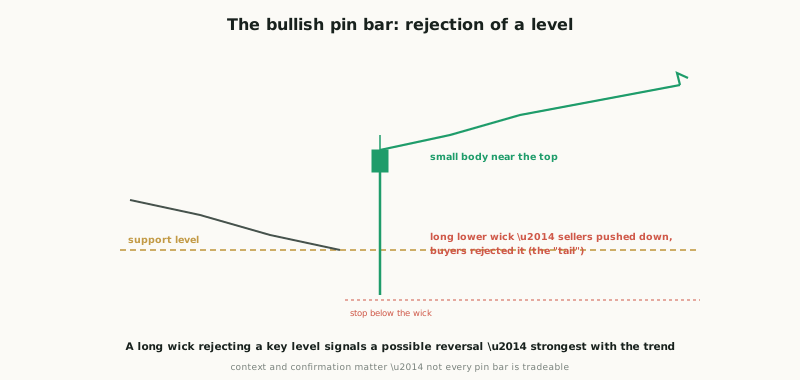
A pin bar (short for "Pinocchio bar," because its long nose "lies" about where price wants to go) is a candlestick with a long wick or "tail" on one side, a small body at the opposite end, and little or no wick on the other side. That long tail is the whole point: it shows price pushed strongly in the tail's direction during the period, then was firmly rejected and driven back, closing near the open — a vivid sign that one side tried to take control and failed. It's the same shape as the hammer (bullish) and shooting star (bearish) candlesticks, used here as a trading signal.
Pin bar criteria
To trade it, you trade the rejection. A bullish pin bar (long lower tail) signals that sellers pushed price down but buyers rejected those lower prices — so a trader looks to enter long, typically on a break of the pin bar's high or at its close, with a stop below the tail (below the rejection low) and a target at the next resistance or a multiple of the risk. A bearish pin bar (long upper tail) is the mirror image: higher prices rejected, enter short with a stop above the tail. The long tail conveniently defines the stop location — if price trades back beyond the rejection point, the signal has failed.
Context is everything
Here is the lesson that separates profitable pin bar trading from the frustration most beginners experience: the candle's shape is necessary but nowhere near sufficient — context is everything. Pin bars appear constantly on charts, and the overwhelming majority are noise, meaningless wicks in the middle of aimless price action. What turns a pin bar into a high-quality signal is where and when it forms. Location: a pin bar rejecting a significant level — a key support or resistance zone, a trendline, a prior swing point — carries real meaning, because the rejection is happening at a price the market clearly cares about. A pin bar nowhere near such a level carries little. Trend context: pin bars are generally most reliable when traded with the prevailing trend — a bullish pin bar at support within an uptrend (a rejection of a pullback) is far stronger than one fighting a strong downtrend, where pin bars frequently get steamrolled. Counter-trend pin bars (trying to call a reversal) are lower-probability and best left to experienced traders with additional confirmation. Confirmation and quality also matter: a longer, more pronounced tail is a stronger rejection; a pin bar that aligns with other signals (structure, a level, momentum) is more compelling; and waiting for a close or a follow-through can filter out failures.
Treated this way — as a rejection signal that only matters at a meaningful level, ideally with the trend, confirmed and risk-managed — the pin bar is a genuinely useful, readable piece of price action. Treated as "long tail = trade," it produces a stream of losing trades, because most pin bars are exactly the noise the disciplined trader ignores. As with every setup, the pin bar offers a probabilistic edge in the right context, not a guarantee, and demands a stop, sensible sizing and acceptance that a good-looking pin bar can still fail. The honest framing: a pin bar is a candle with a long tail (rejection), a small body at the opposite end, and little opposite wick — the bullish form (long lower tail) rejects lower prices, the bearish form (long upper tail) rejects higher prices. Trade the rejection: enter in the rejection's direction with a stop beyond the tail and a target at the next level. But context is everything — a pin bar only matters at a significant level, is strongest with the trend, and needs confirmation; most pin bars are noise. A useful price-action signal in the right context, never a standalone guarantee; manage risk.
Common pin-bar mistakes
Because the pin bar looks so simple, it's worth cataloguing the mistakes that turn it from a useful tool into a losing habit — nearly all of which come back to ignoring context. The first and biggest is trading every pin bar: pin-shaped candles appear constantly, and a trader who reacts to each one is trading mostly noise, racking up losses on meaningless wicks. The discipline is to wait for pin bars at significant levels and ignore the rest. The second is ignoring the trend — taking counter-trend pin bars (trying to pick tops and bottoms against a strong move), which is low-probability; pin bars are generally far more reliable with the trend, as rejections of pullbacks. The third is ignoring location: a pin bar that isn't at a key support/resistance level, trendline or other meaningful area lacks the "rejection of something important" that gives the signal its meaning. The fourth is poor candle quality — accepting weak pin bars with stubby tails or large bodies; the strongest pins have a long, pronounced tail (a clear, dramatic rejection) and a genuinely small body. And the fifth is careless stop placement — putting the stop too close (inside the noise) rather than just beyond the tail, where a move through it genuinely invalidates the setup.
A quick comparison makes the difference concrete. A low-quality pin bar: a smallish lower wick on a candle floating in the middle of a range, against a mild downtrend, nowhere near a level — a trader who buys it is essentially guessing. A high-quality pin bar: a long-tailed bullish pin rejecting a well-established support zone, within an uptrend (so it's a pullback rejection), with the tail clearly spiking below support and closing back above it, and perhaps confirmed by the next candle pushing higher — here the rejection has a clear story (buyers defending a key level in the direction of the trend), a logical stop (below the tail and the level), and a sensible target (the prior swing high). Same candle shape; completely different trade. Internalising that the shape is just the alert, and that location, trend and quality are what create the edge, is the whole skill of pin-bar trading — and it's why patient pin-bar traders take few trades but better ones. The honest reminder stands: a good-looking, well-located pin bar can still fail, so a stop and sensible sizing are non-negotiable on every one.
Pin bars across timeframes
One more factor strongly influences pin-bar quality: the timeframe it forms on. A pin bar on a higher timeframe — the daily or 4-hour chart — carries considerably more weight than one on a 5-minute chart, because it represents a rejection that took a whole day (or four hours) of trading to form, reflecting a more significant battle between buyers and sellers, whereas a low-timeframe pin is far more likely to be fleeting noise. Many experienced price-action traders focus on daily and 4-hour pin bars at key levels for exactly this reason, treating lower-timeframe pins with much more caution (or using them only to refine entries into a higher-timeframe setup). If you're drawn to pin bars, favouring the higher timeframes is one of the simplest ways to raise the average quality of your signals — fewer pins, but each one more meaningful. As always, even a beautiful daily pin bar at a major level can fail, so the stop beyond the tail and sensible sizing remain essential.
A pin bar has a long tail (the rejection), a small body at the opposite end, and little opposite wick — a bullish pin (long lower tail) rejects lower prices, a bearish pin (long upper tail) rejects higher prices. Trade the rejection: enter in its direction, stop beyond the tail, target the next level. But context is everything: a pin bar only matters at a significant level (support/resistance, trendline), is strongest with the trend, and needs confirmation — the vast majority of pin bars are noise to be ignored. "Long tail = trade" is the classic mistake; location, trend and confirmation make the difference. A useful price-action signal in the right context, not a standalone guarantee — always use a stop and sensible sizing.