Sometimes price doesn't move — it jumps, opening a visible space on the chart where no trading happened at all. These price gaps carry information about a trend's birth, strength or exhaustion, and reading them is a classic piece of chart analysis. But there's an important forex-specific twist: because the currency market trades around the clock, gaps are rarer here than you might expect. This guide explains price gaps: what they are, the four types, the gap-fill tendency, the forex caveat, and how to use them.
This is the analysis side of gaps; the risk side — how gaps jump stops — is covered in gap risk in forex. Gaps also interact with support/resistance and chart patterns.
Key takeaways
Q: What is a price gap?
A: A price gap is a discontinuity on a chart where price jumps from one level to another with no trading in between — a candle opens significantly away from the previous candle's close, leaving an empty space. Gaps form when significant new information or order imbalance hits while the market is closed or moving too fast for continuous trading, and they often carry signals about a trend's strength or stage.
Q: What are the types of price gaps?
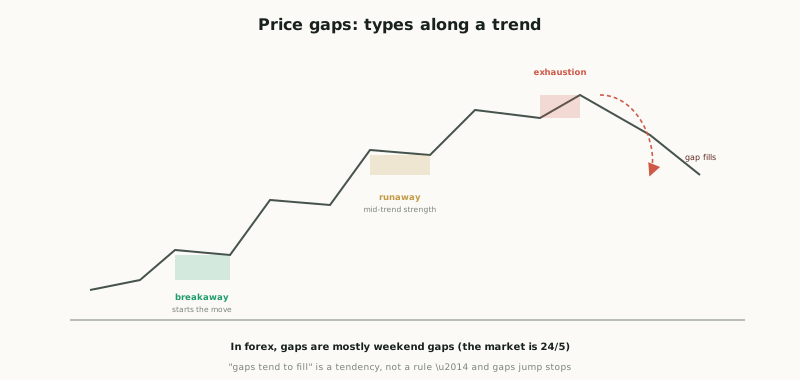
A: Four main types: a common gap occurs within a range, has little significance and usually fills quickly; a breakaway gap starts a new move or breakout from a pattern and is significant, often not filling soon; a runaway (or measuring) gap appears mid-trend and signals continuation and strength; and an exhaustion gap appears near the end of a trend as a last gasp, often followed by a reversal and a fill.
Q: Why are gaps rare in forex?
A: Because the forex market trades 24 hours a day, five days a week, so prices move continuously through most of the week with little chance to gap. The main gaps in forex are weekend gaps — between the Friday close and the Sunday or Monday open — when news breaks while the market is shut. This contrasts with stocks, which gap regularly at each daily open after the overnight close.
What a gap is, and the four types
A price gap is a discontinuity where price moves from one level to another with no trading in between — a candle opens significantly away from the previous candle's close, leaving an empty band on the chart. Gaps form when significant new information or a sharp order imbalance arrives while the market is closed (or moving too fast for continuous trading) so that price simply reopens elsewhere. Classic chart analysis recognises four types, distinguished by where in a trend they occur.
The four types of gap
A common gap occurs within a range, carries little significance, and tends to fill quickly (price soon trades back through it). A breakaway gap appears at the start of a move — breaking out of a pattern or range — and is significant, signalling the birth of a new trend; it often does not fill soon, as the breakout runs. A runaway gap (also called a measuring or continuation gap) appears in the middle of a strong trend, signalling continuation and strength (and, classically, sometimes marking roughly the midpoint of the move, hence "measuring"). An exhaustion gap appears near the end of a trend — a final, climactic "last gasp" — and is often followed by a reversal, tending to fill as the trend rolls over. Reading which type a gap is helps interpret what the trend is doing — though, honestly, the classification is frequently only clear in hindsight.
The gap fill, the forex caveat, and trading them
A key concept is the gap fill: the tendency for price to retrace and trade back through the gapped area, "filling" the empty space. The saying "gaps tend to get filled" captures a real tendency — strong for common and exhaustion gaps, weaker for breakaway and runaway gaps, which often run for a while before any fill — but it is a tendency, not a rule: some gaps take a long time to fill, and some effectively never do. Now the crucial forex caveat: because the forex market trades 24 hours a day, five days a week, price moves continuously through most of the week, so intraday gaps are rare. The gaps forex traders actually encounter are overwhelmingly weekend gaps — between the Friday close and the Sunday/Monday open — when news or events shift prices while the market is shut. This is quite different from stocks, which gap regularly at each daily open after the overnight and pre-market period. So while gap analysis is a rich part of stock charting, its role in forex is more limited, centred on the weekend gap.
For trading, this leaves a couple of practical applications in forex: reading a weekend gap's likely type (does it look like a breakaway continuation or an exhaustion move?), and the gap-fade idea — anticipating that a modest weekend gap may fill as the new week's liquidity returns price toward Friday's close — always with confirmation rather than blind faith in the fill. But the more important point for most forex traders is the risk one: a weekend gap can open past your stop-loss, so your stop may fill far worse than its level (or your position may already be deep in loss at the open), which is exactly the gap risk that makes carrying large leveraged positions over the weekend hazardous. The honest framing: a price gap is a discontinuity where price jumps with no trading in between (a candle opens away from the prior close). In forex, because the market is 24/5, intraday gaps are rare — the main ones are weekend gaps (Friday close to Sunday/Monday open) from news while the market's shut (unlike stocks, which gap at daily opens). Types: common (in a range, insignificant, fills fast), breakaway (starts a new move, significant, often doesn't fill soon), runaway/measuring (mid-trend, continuation/strength), exhaustion (end of trend, a last gasp, often reverses and fills). "Gaps tend to fill" is a tendency (strong for common/exhaustion, weaker for breakaway/runaway), not a rule. Use gap type to read trend, and trade fills or breakaways with confirmation; classification is often only clear in hindsight. And remember gaps carry real risk — they jump stops — so manage risk.
Trading the forex weekend gap
Since the weekend gap is the gap forex traders actually deal with, it's worth understanding specifically. It forms because the market closes on Friday evening and reopens on Sunday evening (or Monday, depending on your broker and instrument), and anything that happens in between — a geopolitical event, an election result, a surprise policy announcement, weekend news — gets priced in all at once at the reopen, so price can open away from where it closed. Most weekend gaps are small (quiet weekends produce little movement), but an eventful weekend can produce a large one. The popular gap-fade idea anticipates that a modest weekend gap will fill — that as the new week's liquidity returns, price tends to drift back toward Friday's close — and traders may look to trade toward the gap's fill. There's a real tendency here, especially for small gaps with no major news behind them, but it is far from guaranteed: a gap driven by genuine weekend news may be a breakaway that keeps running rather than filling, and fading it means trading against fresh, significant information — a good way to be steamrolled.
For most retail traders, the more important lesson about weekend gaps is defensive rather than opportunistic. A weekend gap can open past your stop-loss: if you hold a position over the weekend and price gaps through your stop, the stop becomes a market order that fills at the new price, potentially a long way beyond where you intended — so your realised loss can be substantially larger than planned, and no stop can protect you against the gap itself. This is the gap risk that makes carrying large, leveraged positions over the weekend genuinely hazardous, and it's why many traders reduce size before the weekend, close short-term positions on Friday, or simply accept and size for the gap risk on any position they choose to hold. The sensible framing is that weekend-gap trading (fading or following the gap) is a niche, advanced tactic with real risks, while weekend-gap risk management (sizing so a bad gap can't do serious damage) is something every forex trader who holds over the weekend should attend to. Don't over-rely on the gap-fill tendency as a strategy; do respect the gap as a risk. The honest reminder: forex gaps are mostly weekend gaps, the fill is a tendency not a rule, and the gap's real significance for most traders is the risk it poses to stops — so manage size and risk accordingly.
A note on island reversals
One advanced gap pattern worth knowing is the island reversal, which combines two gaps into a notable reversal signal. It forms when price gaps in the direction of a trend (often an exhaustion gap near the top of an uptrend), trades for a while at that elevated level as a small cluster of candles, and then gaps back the other way — leaving that cluster stranded as an "island" of price, isolated by a gap on each side. The two gaps top-and-tailing an isolated group of bars suggest a sharp shift from buying to selling exhaustion to reversal, and island reversals are regarded as meaningful turning signals when they appear. In forex they're uncommon (gaps being mostly weekend events), so you'll see them far more on stock charts, but the concept reinforces the broader theme: gaps mark moments where sentiment shifts abruptly, and clusters of gaps at a trend's extreme can flag exhaustion. As ever, treat it as one signal among many, confirmed by price and managed with risk control.
A price gap is a discontinuity where price jumps with no trading in between (a candle opens away from the prior close). Four types by trend stage: common (in a range, insignificant, fills fast), breakaway (starts a new move/breakout, significant, often doesn't fill soon), runaway/measuring (mid-trend, signals continuation & strength), exhaustion (end of trend, a last gasp, often reverses and fills). "Gaps tend to fill" is a tendency (strong for common/exhaustion, weaker for breakaway/runaway), not a rule, and the type is often only clear in hindsight. The forex caveat: because the market is 24/5, gaps are rare — mostly weekend gaps (Friday close to Sunday/Monday open) from news while shut, unlike stocks. Use gap type to read trend and trade fills/breakouts with confirmation — and respect that gaps jump stops (see gap risk); manage risk.