One of forex's great features is that you can profit whether prices rise or fall — by going long or going short. Where a buy-and-hold investor only makes money when prices go up, a trader who understands both directions can find opportunity in any market. Grasping these two directions — and, in particular, how "shorting" actually works (a point that confuses many beginners) — unlocks half the opportunities the market offers. This guide explains going long and short: what each means, how you profit, how shorting works in forex, and why every trade is long one currency and short another.
It builds on what forex trading is, the mechanics in how a forex trade works, and reading the prices in how to read a forex quote.
Key takeaways
Q: What does going long and going short mean?
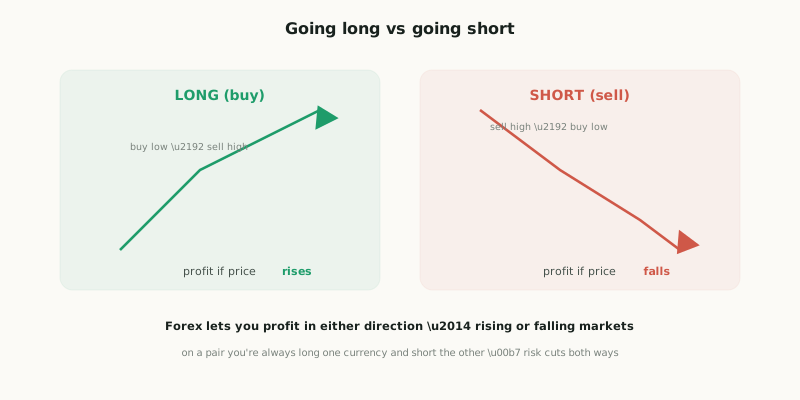
A: Going long means buying — you profit if the price rises. Going short means selling — you profit if the price falls. Going long, you aim to buy low and sell high; going short, you aim to sell high and buy back low. The two directions let you profit from either rising or falling markets.
Q: How does shorting work in forex?
A: In forex, shorting is as easy as going long because every trade is a currency pair — you're always buying one currency while selling the other. To 'go short' a pair, you simply sell it (sell the base currency, buy the quote), with no borrowing complexity like shorting a stock. You profit if the pair's price falls and you buy it back lower.
Q: Are you always long one currency and short another?
A: Yes. Because every forex trade is a pair, you're always simultaneously long one currency and short the other. 'Going long EUR/USD' means being long the euro and short the dollar — you profit if the euro rises against the dollar. 'Going short EUR/USD' means short the euro, long the dollar.
Long and short, side by side
The two directions are mirror images. Going long means buying: you're betting the price will rise, and you profit if it does (buy low, sell high). Going short means selling: you're betting the price will fall, and you profit if it does (sell high, buy back low). The table sets them side by side.
Long vs short
| Aspect | Long (buy) | Short (sell) |
|---|---|---|
| Your bet | Price will rise | Price will fall |
| You profit when | Price goes up | Price goes down |
| The idea | Buy low, sell high | Sell high, buy back low |
| You lose when | Price falls | Price rises |
The mechanics follow from your quote: when you go long, you buy at the ask price, profit as the price rises, and sell to close; when you go short, you sell at the bid, profit as the price falls, and buy back to close. Your profit and loss is simply the difference between your entry and exit, multiplied by your position size — a long gains when price ends above your entry, a short gains when price ends below it.
How shorting works in forex
The concept that trips up many beginners is how you can possibly profit from a falling market — selling something to buy it back cheaper. In some markets (like shorting a stock), this involves borrowing the asset to sell it, which adds complexity. But in forex, shorting is wonderfully simple and natural, because of how currency pairs work. Recall that every forex trade is a pair — you're always buying one currency while selling another. To "go short" a pair, you simply sell the pair: you sell the base currency and buy the quote currency. There's no special borrowing arrangement, no extra complexity — selling (going short) is as easy and direct as buying (going long). You sell the pair, and if its price falls, you buy it back at the lower price and keep the difference.
This connects to a deeper truth about forex: because every trade is a pair, you are always simultaneously long one currency and short the other. "Going long EUR/USD" means you're long the euro and short the dollar — you profit if the euro strengthens against the dollar. "Going short EUR/USD" means you're short the euro and long the dollar — you profit if the euro weakens against the dollar (equivalently, if the dollar strengthens against the euro). There's no such thing as just "buying euros" in isolation in a forex trade; you're always trading the relationship between two currencies, long one and short the other. This is why a forex price is a ratio and why a single trade is, in effect, two bets in one.
The practical significance is real: the ability to go short as easily as long means you can seek opportunity in both rising and falling markets — a key flexibility of forex (and most trading). In a falling market, you're not stuck waiting; you can profit by shorting. But this flexibility comes with the obvious symmetry of risk: a long position loses as price falls, and a short position loses as price rises — risk cuts both ways, and a trade that moves against you (in either direction) produces growing losses until you exit. So whichever way you trade, sound risk management (a stop-loss, sensible position sizing) is essential — going short is no riskier than going long in principle, but it's no safer either, and both demand the same disciplined risk control. The honest framing: going long means buying (profiting if price rises); going short means selling (profiting if price falls). In forex, every trade is a pair, so you're always long one currency and short the other, and shorting is as easy as going long — you simply sell the pair, with no borrowing complexity — letting you profit in both rising and falling markets, a key flexibility. But risk is symmetrical (a wrong-direction trade loses as it moves against you), so risk management and stops are essential regardless of direction. Understanding both directions — and that you can profit either way — is foundational to trading forex.
Long and short in practice
A couple of simple worked examples make the two directions concrete. Suppose you go long EUR/USD — buying the pair — at a price of 1.1000, expecting the euro to strengthen against the dollar. If the price rises to 1.1050 and you close, you've gained 50 pips (the pips link); multiplied by your position size, that's your profit. If instead the price falls to 1.0960 and you exit, you've lost 40 pips. Now suppose you go short EUR/USD — selling the pair — at 1.1000, expecting the euro to weaken. If the price falls to 1.0950 and you buy it back to close, you've gained 50 pips (you sold high at 1.1000 and bought back low at 1.0950). If it rises to 1.1040 against you and you exit, you've lost 40 pips. Notice the perfect symmetry: the short is simply the mirror image of the long — same mechanics, opposite direction — and in both cases your result is the distance between entry and exit, in your favour or against you, scaled by size.
Two practical points round this out. First, the psychology can differ even though the mechanics don't. Many beginners find going long more intuitive (buying something hoping it rises feels familiar) and shorting slightly unnatural at first (selling something you don't conventionally "own"). This is purely a matter of familiarity — in forex, as we've seen, shorting is mechanically no different or harder than going long, since you're just selling a pair. With a little practice on a demo account, shorting becomes as natural as buying. Second, beware a common bias toward only going long. Because buying feels more natural and because rising markets feel more "normal," many new traders instinctively look only for longs and ignore short opportunities — effectively trading with one hand tied behind their back, missing half the market's moves. A market falling is just as tradeable as one rising; training yourself to consider both directions objectively (going short when the analysis points down, long when it points up, without a directional prejudice) is part of becoming a complete trader. The market doesn't care which direction you prefer — it offers opportunities both ways, and the flexibility to take either is one of forex's real advantages. Whichever direction a given trade calls for, the discipline is the same: a clear reason for the trade, a defined stop, sensible position sizing, and the willingness to be wrong and cut the loss — applied equally to longs and shorts.
A note for beginners
If shorting still feels strange, here's a reframing that helps: in forex you're never "selling something you don't have" in the way stock-shorting implies — you're simply taking a position that one currency will weaken against another. Since a price like EUR/USD is just the ratio of two currencies, betting it will fall is exactly as natural as betting it will rise; you're choosing which side of the seesaw to sit on. There's no extra cost, no borrowing, and no special permission needed — the sell button sits right next to the buy button for a reason. The only thing that should ever decide your direction is your analysis: if your reasoning points to the pair rising, go long; if it points to the pair falling, go short. Let the market, not a preference for "buying," choose for you. Practise both directions on a demo until neither feels more foreign than the other, and you'll have doubled the opportunities available to you while keeping exactly the same disciplined approach to risk on every trade.
Going long = buying, profiting if price rises (buy low, sell high). Going short = selling, profiting if price falls (sell high, buy back low). In forex, shorting is as easy as going long because every trade is a pair: to go short you simply sell the pair (sell the base, buy the quote) — no borrowing complexity. This means you can profit in both rising and falling markets, a key flexibility of forex. And because it's a pair, you're always long one currency and short the other: "long EUR/USD" = long euro, short dollar (profit if EUR rises vs USD). Risk is symmetrical — a long loses as price falls, a short loses as price rises — so shorting is neither riskier nor safer than going long; both demand a stop-loss and sound position sizing. Understand you can profit either way, and manage risk either way.