Heikin-Ashi takes ordinary candlesticks and averages them into something smoother — a chart on which trends leap out and short-term noise seems to melt away. For traders who struggle to stay in a trend amid the chop of a normal candle chart, that clarity is genuinely useful. The trade-off is significant, though: the prices a Heikin-Ashi candle shows aren't real, and the smoothing means it always tells you a little late. This guide explains Heikin-Ashi: what it is, how to read it, its strengths, and the critical caveats.
It's a variant of standard candlestick charting that smooths much like a moving average, and it's best used to read trend rather than precise price.
Key takeaways
Q: What are Heikin-Ashi candlesticks?
A: Heikin-Ashi (Japanese for 'average bar') is a modified candlestick charting technique that uses averaged price data instead of raw open-high-low-close values, in order to smooth out market noise and make trends easier to see. Each Heikin-Ashi candle is calculated partly from the previous Heikin-Ashi candle, which produces the characteristic smoothing effect.
Q: How do you read Heikin-Ashi candles?
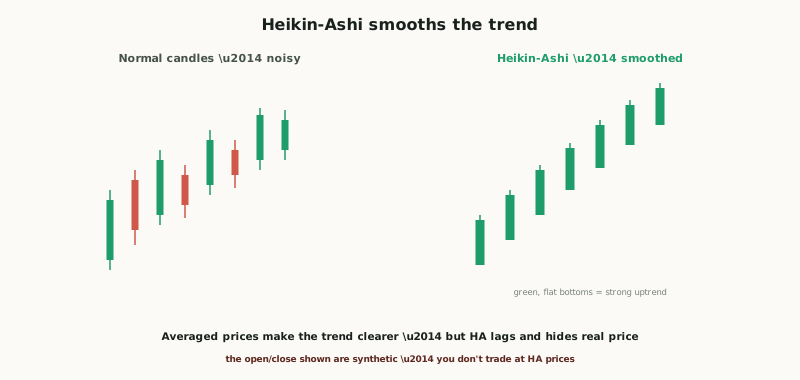
A: For trend and trend strength. A strong uptrend shows a run of green candles with little or no lower wick (flat bottoms); a strong downtrend shows red candles with little or no upper wick (flat tops). Small bodies with wicks on both sides suggest indecision or a possible reversal, and a change of colour can flag a potential shift in trend.
Q: What are the drawbacks of Heikin-Ashi?
A: The prices shown are averaged and synthetic — not the real market open and close — so you can't read true price from a Heikin-Ashi candle and you don't trade at those prices. It also lags, because the smoothing delays signals so trend changes appear later than on a normal chart, and it hides gaps and price detail. It's best used as a trend filter alongside a normal price chart.
What it is and how to read it
Heikin-Ashi — Japanese for "average bar" — is a modified candlestick technique that replaces raw open-high-low-close values with averaged ones, smoothing price action so trends are easier to see. The calculation is what creates the effect: the Heikin-Ashi close is the average of the current bar's open, high, low and close; the Heikin-Ashi open is the average of the previous Heikin-Ashi candle's open and close (with the high and low adjusted accordingly). Because each candle is built partly from the previous Heikin-Ashi candle, the series is smoothed — each bar is "anchored" to the one before, filtering out the jitter. Reading it is about trend and trend strength, not individual price levels: a strong uptrend shows a run of green candles with little or no lower wick (flat bottoms), a strong downtrend shows red candles with little or no upper wick (flat tops), small bodies with wicks on both sides suggest indecision or a possible turn, and a change of colour flags a potential shift in trend. The visual effect is striking — trends appear as clean, consistent runs of one colour, and choppy ranges as alternating small candles — which is exactly the appeal.
The strengths — and the critical caveats
The strengths follow directly from the smoothing. Heikin-Ashi filters noise, making the prevailing trend and its strength far easier to read at a glance; it can help traders stay in trends by visually quieting the minor pullbacks that often shake people out of good positions; and it gives a clean sense of momentum (long-bodied flat-bottomed candles screaming "strong trend," small two-sided candles whispering "indecision"). For trend-followers, it's a helpful lens.
But two caveats are serious enough that misunderstanding them causes real mistakes. First, and most important: the prices a Heikin-Ashi candle shows are averaged and synthetic — they are not the real market open and close. You cannot read the actual current price off a Heikin-Ashi chart, and you do not (and cannot) trade at Heikin-Ashi prices — your orders fill at real market prices, which may differ noticeably from what the smoothed candle displays. Traders who forget this and set entries, stops or targets based on Heikin-Ashi levels are working from prices that don't exist in the live market. Second, Heikin-Ashi lags: the very smoothing that clarifies the trend also delays signals, so a trend change shows up later on Heikin-Ashi than on a normal candle chart — you trade clarity for timeliness. It also hides gaps and the fine detail of individual bars. The practical resolution is to use Heikin-Ashi as a trend-visualisation filter — a clean read on direction and strength — alongside a normal price chart that you rely on for real prices, precise entries and exits, and actual levels. It's a complement, not a replacement, and certainly not a chart to base order prices on.
Understood for what it is, Heikin-Ashi is a useful addition to a trader's toolkit, particularly for trend-following and for keeping a cool head through normal noise. Misunderstood — treated as a source of tradeable prices or a timely reversal signal — it leads to confusion and mistimed orders. The honest framing: Heikin-Ashi ("average bar") is a modified candlestick technique using averaged OHLC to smooth price and clarify trends — the HA close is the average of the bar's OHLC, the HA open the average of the prior HA open/close, so each candle depends on the last (smoothing). Read it for trend: green with flat bottoms = strong up, red with flat tops = strong down, small two-sided candles = indecision, colour changes = possible shifts. Pros: filters noise, clarifies trend, helps you stay in trends. Critical caveats: the prices shown are averaged/synthetic — NOT real market prices (you can't read true price or trade at HA prices), it LAGS (smoothing delays signals), and it hides gaps and detail. Use it as a trend filter alongside a normal price chart for real prices and timing — a complement, not your sole chart; manage risk.
Using Heikin-Ashi well
Used for what it's good at, Heikin-Ashi has a clear and sensible role. Its core strength is as a trend filter and trend-holding aid, often on a higher timeframe: a trader might keep a Heikin-Ashi chart of the daily or 4-hour timeframe to read the prevailing trend cleanly — a run of strong green candles with flat bottoms saying "uptrend intact, stay long" — while making actual entry and exit decisions on a normal price chart of a lower timeframe. This pairing plays to each chart's strength: Heikin-Ashi for an uncluttered read on direction and strength, the real chart for precise, tradeable prices. The most common Heikin-Ashi signals follow naturally from how it's read: a strong run of one-colour, flat-based candles says "hold the trend, don't be shaken out by minor noise," while a shift to small bodies with wicks on both sides, or an outright colour change, says "momentum is fading — consider tightening up or preparing to exit." Many trend-followers use exactly this as a discipline for staying in winners longer, since the smoothing visually suppresses the small pullbacks that tempt premature exits.
Equally important is knowing what Heikin-Ashi is bad at, so you don't misapply it. It is poor in ranging, choppy markets: when there's no trend, the candles alternate colour frequently and the tool offers little of value (indeed it can whipsaw you, since its whole premise is trend clarity). It is not for precise timing, because of the lag — waiting for a Heikin-Ashi colour change to exit means giving back more of a move than a normal chart would, a real cost on faster timeframes. And, to repeat the non-negotiable point, it is never the chart to set order prices from, since its levels are synthetic. The practical rule of thumb: use Heikin-Ashi as a complementary trend lens — ideally higher-timeframe — to identify and hold trends, while relying on a standard candlestick or bar chart for entries, exits, stops and real prices, and lean on it least when markets are rangebound. Combined with genuine trend-following logic and proper risk management, it's a helpful instrument; treated as a complete, tradeable charting system on its own, it misleads on both price and timing. The honest reminder: it clarifies trend at the cost of timeliness and real prices — a filter, not a substitute for the actual chart.
Other smoothed and alternative charts
Heikin-Ashi belongs to a broader family of alternative chart types that, like it, trade away some information in exchange for clarity — and the same core caveat applies to all of them. Renko charts, for instance, plot fixed-size "bricks" only when price moves a set amount, ignoring time entirely to strip out noise and highlight trend; line-break and point-and-figure charts similarly filter out minor moves to emphasise direction. Each can make trends beautifully clear, and each, by design, discards detail — real prices, timing, or both — in the process. The unifying lesson is the one Heikin-Ashi teaches: these are filters and lenses, useful for seeing structure that standard charts can clutter, but not substitutes for the real price action when it comes to timing entries and exits or setting order levels. Whichever you use, keep a standard candlestick or bar chart at hand for the actual prices, and treat the smoothed view as a complement. The appeal of a clean trend is real; just never forget what was filtered out to produce it.
Heikin-Ashi ("average bar") smooths candlesticks using averaged OHLC: the HA close is the average of the bar's OHLC, the HA open the average of the prior HA candle's open/close — so each candle depends on the last, producing the smoothing. Read it for trend: green with flat bottoms = strong uptrend, red with flat tops = strong downtrend, small two-sided candles = indecision, colour changes = possible shift. It filters noise, clarifies trend strength, and helps you stay in trends. But the critical caveats: the prices shown are synthetic, not real — you can't read true price or place orders at HA prices (you fill at real prices); it lags (smoothing delays signals); and it hides gaps/detail. Use it as a trend filter alongside a normal price chart for real prices and timing — a complement, never your only chart.