At opposite ends of the conviction spectrum sit two single candles. The marubozu is a full body with little or no wicks — all dominance and no doubt, one side controlling the entire period. The spinning top is a small body with long wicks on both sides — all hesitation, a tug-of-war that ended in a draw. Between them, and alongside the doji, these candles teach you to read the mood of a single bar: how much conviction, or indecision, a period carried. This guide explains both: what they look like, what they mean, and how to read single candles in context (which is the whole skill).
They sit alongside the doji (another indecision candle) in the candlestick family, and are read as part of broader market structure and momentum.
Key takeaways
Q: What is a marubozu candle?
A: A marubozu is a candle with a full body and little or no wicks — the name means 'bald' or 'shaved head' (no shadow). It shows price moved strongly in one direction and closed at or near the extreme, with no rejection. A bullish marubozu signals strong buying conviction; a bearish one, strong selling conviction.
Q: What is a spinning top candle?
A: A spinning top is a candle with a small body and long wicks on both sides — price moved up and down significantly during the period but closed near where it opened. It signals indecision or equilibrium: neither buyers nor sellers won the period, a tug-of-war similar in meaning to a doji.
Q: How should you trade single candles like these?
A: Single candles are weak, context-dependent signals best read as pieces of the larger picture, not standalone triggers. A marubozu reads as strong momentum (continuation or breakout strength, or exhaustion if very extended); a spinning top reads as stalling momentum (possible pause or reversal after a trend). Both need confirmation and confluence.
The two candles
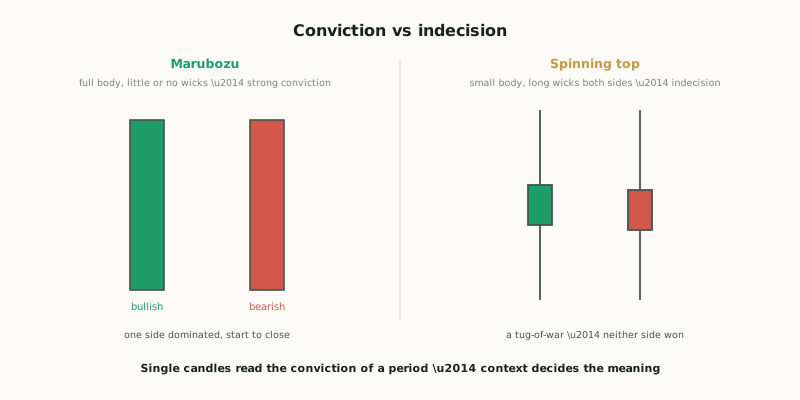
The marubozu is a candle with a full body and little or no wicks (shadows). The name comes from a Japanese term meaning "bald" or "shaved head" — referring to the absence of the wicks that normally poke out of a candle. A marubozu means price moved strongly in one direction and closed at or near the extreme, with essentially no rejection from the other side. A bullish marubozu (green) opens at or near its low and closes at or near its high, with no meaningful wicks — buyers were in complete control from open to close. A bearish marubozu (red) opens near its high and closes near its low — sellers dominated throughout. The lack of wicks is the key: it shows no opposition, no point at which the other side pushed back. The marubozu is therefore the candle of strong conviction and momentum.
The spinning top is the near-opposite: a candle with a small body and long wicks on both sides (upper and lower). Price moved significantly up and down during the period — hence the long wicks in both directions — but closed near where it opened, leaving only a small body. This means the period was a tug-of-war: buyers pushed price up, sellers pushed it down, but neither side won, and price ended roughly where it started. The spinning top is the candle of indecision and equilibrium. Its message is very similar to that of a doji — indecision — with the distinction that a doji has virtually no body (open and close essentially equal), while a spinning top has a small body. Both signal that the period ended in a standoff. The table summarises the contrast.
Marubozu vs spinning top
Reading them in context
Both candles are read for what they reveal about the conviction of a period — but, crucially, what that means for the trade depends entirely on context. A marubozu signals strong momentum, which can mean different things depending on where it appears. Within a trend, a marubozu in the trend's direction confirms continuation strength (a bullish marubozu in an uptrend shows buyers firmly in control — the trend is healthy). At a breakout, a marubozu can mark a strong, convincing break of a level (the decisive momentum lending the breakout credibility). However, a marubozu at the end of an extended move can signal exhaustion or a buying/selling climax — a final, dramatic surge that precedes a reversal (the same conviction that drives a trend can mark its blow-off top). So a marubozu's meaning ranges from "strong continuation" to "exhaustion climax" depending on its location — context decides.
A spinning top signals indecision, and its significance likewise depends on context. After a strong trend, a spinning top is a meaningful warning that momentum is stalling — like a doji, it suggests the trend's drive is fading and a pause or reversal may be coming (the tug-of-war showing the trend's controlling side has lost its dominance). In a range or choppy conditions, however, a spinning top is just noise — indecision in an already-indecisive market tells you little. So a spinning top after an extended trend is informative; one in the middle of chop is not. This context-dependence is the central lesson for all single candles: a marubozu or a spinning top means different things in different locations, and is a relatively weak signal on its own. Single candles are best read as pieces of the larger picture — contributions to your read of momentum and indecision — rather than as standalone triggers. They need confirmation (what follows) and confluence (the trend context, key levels, other evidence) to be actionable. The honest framing: the marubozu (full body, no wicks — strong conviction/momentum) and the spinning top (small body, long wicks — indecision) sit at opposite ends of the single-candle conviction spectrum, alongside the doji. Read them for momentum versus indecision, but always in context — a marubozu can mean continuation strength or exhaustion, a spinning top can mean a stalling trend or mere noise, depending on where it appears. They're weak alone, context-dependent, and need confirmation and confluence. Like all candlestick reading, the skill is interpreting these single candles as part of the larger story — not as isolated signals — and trading them with risk management.
Using single candles well
Marubozu and spinning tops are worth studying not only for themselves but because they teach the broader skill of reading single candles — a kind of language in which each candle is a word, and the sentence only makes sense in context. A few habits turn that skill into something usable. First, always read a single candle against its location: the trend it sits in, the level it forms at, what came before. The same marubozu means "strong continuation" mid-trend, "convincing breakout" at a level, and "possible exhaustion" at the end of a long, stretched move — so the question is never just "what is this candle?" but "what is this candle here?" Likewise a spinning top is a meaningful stall after a strong trend and mere noise in a chop. Training yourself to ask "where is this candle in the bigger picture?" is the core of reading candles well.
Second, read the relative size and the wick story. A marubozu is only impressive if its body is genuinely large relative to recent candles — a small "marubozu" says little. A spinning top's significance grows with how long its wicks are relative to its body and to surrounding candles. And the wicks tell their own story everywhere: long wicks mean price went somewhere and was rejected (the side that pushed there lost control by the close), which is exactly why a marubozu (no wicks, no rejection) signals conviction and a spinning top (long wicks both ways, rejected in both directions) signals a standoff. Learning to read wicks — where price was rejected, and how forcefully — is among the most useful candlestick skills. Third, use single candles as confluence, not triggers: a marubozu confirming a breakout you were already watching, or a spinning top warning that a trend you're in is stalling near resistance, is far more useful than reacting to a lone candle in isolation. The honest, practical summary: marubozu and spinning tops sit at opposite ends of the single-candle conviction spectrum, and reading them well means reading them in context — against the trend, the level, the relative size, and the wick story — and using them as pieces of confluence rather than standalone signals. Master this with these two candles (and the doji), and you've learned to read the conviction behind every bar on the chart — a foundational technical skill that informs everything from spotting reversals to confirming breakouts, always applied with confirmation and risk management.
A marubozu ("bald" — no wicks) is a full-bodied candle that opens and closes at its extremes: strong conviction and momentum (bullish = buyers dominated throughout; bearish = sellers did). A spinning top (small body, long wicks both sides) shows price moved up and down but closed near its open: indecision, a tug-of-war neither side won (similar message to a doji, which has no body). Both are read for the conviction of a period, but meaning is entirely context-dependent: a marubozu can signal continuation strength, a strong breakout, or — if very extended — exhaustion; a spinning top can signal a stalling trend (after a strong move) or just noise (in a range). Single candles are weak, context-dependent signals — read them as pieces of the larger picture, with confirmation and confluence, not as standalone triggers. Probabilistic, not magic — trade with risk management.