Do you trade by fixed rules, or by judgement? It's one of the deepest choices a trader makes, shaping everything from how decisions get made to how the approach can be tested and how vulnerable it is to emotion. Mechanical trading removes emotion and bias but can't adapt to the unexpected; discretionary trading adapts to context but invites the very emotions that wreck results. In truth, most traders live somewhere on the spectrum between the two, blending rules and judgement. This guide explains both: what they are, their pros and cons, the spectrum between them, and how to think about which suits you.
Mechanical trading at its fullest becomes algorithmic trading; both approaches connect to building a trading system and, ultimately, to discipline.
Key takeaways
Q: What is the difference between mechanical and discretionary trading?
A: Mechanical (systematic) trading follows a fixed set of rules — every decision is determined by the system, and the trader (or an algorithm) simply executes. Discretionary trading relies on the trader's judgement, experience and reading of context to make decisions within a general approach, rather than by rigid rules.
Q: Which is better, mechanical or discretionary trading?
A: Neither is inherently better — it depends on the person and approach. Mechanical suits those who value objectivity, testability and automation and who struggle with emotional discipline (the rules enforce it). Discretionary suits experienced traders who can read context and exercise good judgement while maintaining discipline. Most traders blend the two.
Q: Should beginners trade mechanically or discretionarily?
A: Beginners often benefit from more mechanical, rule-based approaches, because the fixed rules impose the discipline they may lack and can be tested for an edge. Trading discretionarily well requires significant experience and the ability to stay disciplined without rigid rules — so 'discretion' can too easily become an excuse for emotional, undisciplined trading early on.
The two approaches
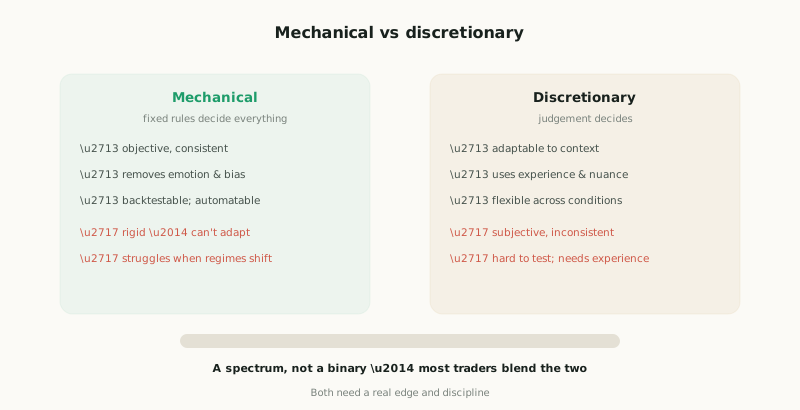
Mechanical (or systematic) trading means trading by a fixed set of rules: every decision — what to trade, when to enter, when to exit, how much to risk — is determined by the system, and the trader (or an algorithm) simply executes those rules without in-the-moment judgement. The system decides; the trader follows. At its fullest, mechanical trading can be entirely automated as algorithmic trading. Discretionary trading, by contrast, means trading by judgement: the trader uses experience, intuition and a reading of context to make decisions within a general approach, rather than by rigid, predetermined rules. The discretionary trader has a method and principles, but applies judgement to each situation rather than mechanically executing fixed rules. The table sets out the trade-offs.
Mechanical vs discretionary
| Aspect | Mechanical (systematic) | Discretionary |
|---|---|---|
| Decisions by | Fixed rules | Judgement & experience |
| Emotion | Removed by design | A constant risk |
| Testability | Backtestable | Hard to test |
| Adaptability | Rigid | Flexible to context |
| Main risk | Following a decayed edge | Undisciplined, emotional trading |
The pros and cons follow from these definitions. Mechanical trading's strengths: it removes emotion and bias (the rules don't feel fear or greed), it's consistent and objective, it's backtestable (you can test fixed rules on historical data to validate an edge — the backtesting link), it's disciplined by design (the rules enforce the discipline), and it's scalable and automatable. Its weaknesses: it's rigid (it can't adapt to unusual conditions the rules didn't anticipate), it can struggle when markets change (a regime shift or edge decay can break a system that can't adapt), it requires a genuine, tested edge to be worth following, and it may miss context a human would catch. Discretionary trading's strengths: it's adaptable (it can read context, handle unusual situations, and incorporate nuance a rule can't capture), it can use judgement and experience that resist codification, and it's flexible across conditions. Its weaknesses: it's subjective and inconsistent (prone to emotion, bias, and the psychology pitfalls — fear, greed, revenge), it's hard to backtest or measure (judgement can't easily be tested), it requires significant skill and experience, and its results vary with the trader's state (mood, fatigue, discipline on the day).
The spectrum and the blend
Crucially, mechanical versus discretionary is a spectrum, not a binary — and most traders are somewhere in between. Pure forms exist (a fully automated algorithm at one extreme; a completely intuitive trader at the other), but in practice most traders blend the two. A common middle ground is "systematic discretion": a defined process with clear guidelines and rules, but with room for judgement in applying them (for example, a discretionary trader who follows strict risk rules and a defined setup, but uses judgement on entry timing and trade selection). Conversely, some systematic traders allow occasional discretionary overrides of their system — though this is risky, since overriding a tested system on a hunch often does more harm than good (it reintroduces the very emotion and inconsistency the system was meant to remove, and undermines the ability to evaluate the system honestly). The point is that the choice isn't all-or-nothing: you can have rules and judgement, in varying proportions, and most successful traders find a personal balance.
So which is better? Neither, inherently — it depends on the person and the approach. Mechanical suits those who value objectivity, testability and automation, and — importantly — those who struggle with emotional discipline, since the rules enforce the discipline that the trader might not muster alone (a major advantage for the emotionally-driven). Discretionary suits experienced traders who can read context and exercise good judgement, and who can maintain discipline without rigid rules — which is harder than it sounds. This has a clear implication for beginners: they often benefit from more mechanical, rule-based approaches, because the rules impose the discipline they typically lack, and can be tested for an edge — whereas trading discretionarily well requires experience most beginners don't yet have. The danger, for beginners especially, is that "discretion" becomes an excuse for undisciplined, emotional trading (calling impulsive, rule-breaking decisions "judgement"). The mirror danger, for systematic traders, is rigidity — blindly following a system whose edge has decayed. The honest framing: mechanical (fixed rules — objective, testable, removes emotion, but rigid) and discretionary (judgement — adaptable, but subjective, hard to test, needs experience) are the two approaches to how trading decisions are made, really a spectrum most traders blend. Neither is inherently superior; choose based on your temperament and skill, with beginners often well served by rule-based discipline. Both require a genuine edge and discipline — the difference is only whether the edge is encoded in fixed rules or applied through judgement. Above all, don't let "discretion" become a licence for undisciplined trading, or "mechanical" become an excuse for following a dead edge. Whichever you lean toward, the constants — a real edge, risk management, and discipline — remain the same.
Choosing and evolving your approach
How do you actually find your place on the spectrum? Start by being honest about your temperament and circumstances. If you struggle to control emotions under pressure, find it hard to pull the trigger or cut losses, or simply want an objective, testable, low-emotion process — lean mechanical; the rules will do for you what willpower alone may not. If you have genuine market experience, can read context well, and can stay disciplined without rigid rules (a high bar), discretionary trading may let you exploit nuance a system would miss. Practical factors matter too: mechanical/automated approaches suit those short on screen time (the system or algo trades the rules), while discretionary trading demands active attention and presence. There's no single right answer — the right approach is the one that fits you and that you can execute consistently, because consistency is what turns any edge into results.
It also helps to recognise that most traders evolve along the spectrum over time. Many begin more mechanical (sensibly, to build discipline and learn what works), and some gradually incorporate judgement as experience accrues; others start discretionary, get burned by inconsistency, and impose more rules to rein themselves in. A common and healthy endpoint is a hybrid: a clearly defined process — fixed risk rules, defined setups, objective criteria — with a measured amount of judgement applied within those guardrails. The guardrails (especially the risk rules) stay mechanical and non-negotiable, while judgement operates only in defined areas like trade selection or entry timing. This captures much of the discipline of systematic trading while retaining some adaptability — provided the judgement is genuine skill, not disguised impulse. Which points to the two traps to watch as you choose and evolve. For the discretionary-leaning, the trap is letting "judgement" become a rationalisation for emotional, rule-breaking trades — the antidote is keeping firm, mechanical risk rules and journaling decisions to check that your "discretion" is actually adding value, not just excusing indiscipline. For the mechanical-leaning, the trap is rigidity — following a system long after its edge has decayed — the antidote being the ongoing monitoring and willingness to retire a dead system covered in building a system. The honest framing: choose your spot on the spectrum by your temperament, skill and circumstances; expect to evolve; and consider a hybrid that keeps risk rules mechanical while allowing disciplined judgement where it genuinely helps. Whatever you choose, hold the constants firm — a real edge, strict risk management, and the discipline to execute consistently — because those, not the mechanical-versus-discretionary label, are what actually determine whether you succeed.
Mechanical (systematic) trading follows fixed rules — the system decides every entry, exit and size, and the trader (or an algo) executes. Discretionary trading uses judgement, experience and context within a general approach. Mechanical pros: removes emotion, consistent, objective, backtestable, disciplined by design, automatable; cons: rigid, struggles when markets change, needs a tested edge, can miss context. Discretionary pros: adaptable, uses judgement/nuance, flexible; cons: subjective, inconsistent (emotion-prone), hard to test, needs experience. It's a spectrum, not a binary — most traders blend the two (e.g. a defined process with some judgement). Neither is inherently better; choose by temperament and skill. Beginners often benefit from rule-based discipline. Both need a genuine edge and discipline — don't let "discretion" excuse undisciplined trading, or "mechanical" excuse following a decayed edge.