A collection of indicators slapped on a chart is not a trading system. A system is something far more deliberate: a defined, rule-based method for finding, entering, managing and exiting trades — built on a genuine edge, tested for positive expectancy, and followed with discipline. Building one is among the most valuable skills a trader can develop, because it transforms trading from improvisation into a repeatable, testable process. This guide is the how-to: defining an edge, specifying precise rules, testing the system, refining it without overfitting, and trading it with discipline. It's the bridge from knowing strategies to building and running your own.
It builds on the strategy overview in forex trading strategies, depends heavily on backtesting and expectancy, and complements the broader trading plan (the system is the strategy within the plan).
Key takeaways
Q: What is a trading system?
A: A trading system is a defined set of rules for finding, entering, managing and exiting trades, built on an edge — a reason it should be profitable over time. It specifies the market and timeframe, precise entry and exit rules (including the stop-loss), and risk management, so that trading becomes a repeatable, testable process rather than improvisation.
Q: How do you build a trading system?
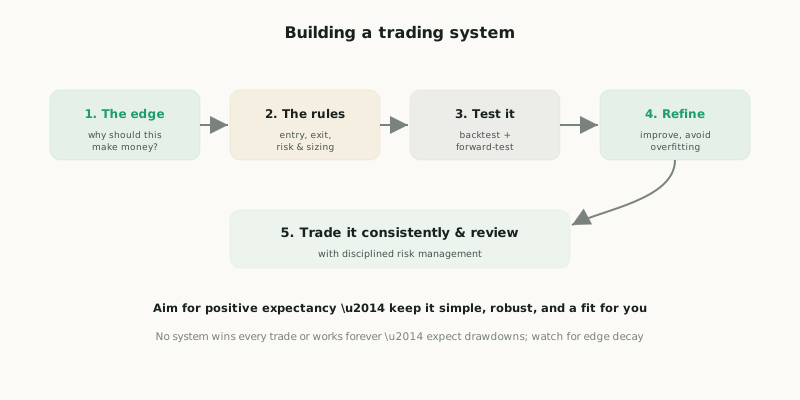
A: Define your edge (the core idea and why it should work), specify precise entry, exit and risk rules, test the system on historical data (backtesting) and then forward-test it for positive expectancy, refine it carefully without overfitting, and then trade it consistently with disciplined risk management — reviewing and monitoring it over time.
Q: What makes a good trading system?
A: A genuine edge with a clear rationale, positive expectancy over many trades (not a high win rate alone), objective rules you can follow consistently, simplicity and robustness over complexity, and a fit with your own style and personality. No system wins every trade or works in all conditions, so it must include risk management and tolerate drawdowns.
The components of a system
A complete trading system has several essential components, each of which must be defined. The table lists them, and the detail follows.
What a trading system must define
The foundation is the edge — the core idea and the reason it should make money. Every viable system rests on a hypothesis about market behaviour: that trends persist (the basis of trend-following), that price reverts to a mean, that breakouts continue, that certain patterns precede certain moves, and so on. The edge must have a rationale — a reason to believe it captures a real, recurring tendency — because without an edge, no amount of rules or testing will produce profit; you'd just be formalising randomness. Defining the edge clearly ("I believe X happens, and I can profit by doing Y") is the first and most important step. Around the edge, the system specifies the market and timeframe (which pairs, what chart timeframe), the entry rules (precise, objective conditions for entering — "enter long when these specific conditions are met"), the exit rules (both the stop-loss, defining where the trade is wrong, and the take-profit or trailing exit — exits being every bit as important as entries), and the risk management and position sizing (how much to risk per trade, the sizing rules — the risk management material). Crucially, the rules should be objective and clear enough to follow consistently and, ideally, to test — vague rules can't be applied consistently or verified.
The process of building one
With the components understood, the process of actually building a system follows a logical sequence. First, define the edge/idea — articulate your hypothesis about market behaviour and how you'll exploit it. Second, specify the rules precisely — turn the idea into concrete, objective entry, exit and risk rules that leave no ambiguity about what to do. Third, test it. This is essential and non-negotiable: backtest the system on historical data to see how it would have performed, then forward-test it (on a demo account or in real time) to validate it on unseen data. The key question the testing must answer is whether the system has positive expectancy — whether, over many trades, it makes more than it loses (accounting for both win rate and the size of wins versus losses — the expectancy guide). A system without demonstrated positive expectancy is not worth trading, however good the idea sounds.
Fourth, refine based on results — adjust the rules to improve performance — but with a critical caution: beware overfitting (curve-fitting). It's dangerously easy to tweak a system until it looks perfect on past data, only for it to fail on future data, because you've fitted it to historical noise rather than a real edge (the backtesting guide covers this pitfall). Refinement should make the system more robust, not more finely tuned to history. Fifth, trade it — begin trading the system (ideally starting small/live), and keep reviewing its performance over time. This sequence — define, specify, test, refine, trade and review — turns a trading idea into a validated, operational system, and the testing steps are what separate a real system from a hopeful guess. Skipping the testing (trading an untested idea with real money) is one of the most common and costly errors; the discipline of validating expectancy before risking capital is central to building systems well.
Principles for a robust system
Beyond the process, several principles distinguish good systems from fragile ones. Keep it as simple as reasonable. Simple, robust systems tend to generalise better (work across different conditions and into the future) than complex, heavily-optimised ones, which are more prone to overfitting and breaking when conditions change. Complexity is not sophistication; robustness is. Aim for positive expectancy, not a high win rate. A system can win most of its trades and still lose money (if the losses are large), or win less than half and be highly profitable (if the wins are large — as trend-following often is). What matters is the expectancy — the average profit per trade over many trades — not the win rate in isolation. Make it fit you. A system must suit your style, timeframe and personality, because a system you can't follow (too fast, too slow, too uncomfortable) is useless — the best system is the one you'll actually execute consistently.
And crucially, accept the honest realities. Consistency is essential: a system only delivers its edge if followed consistently over many trades (the discipline link) — cherry-picking which signals to take, or abandoning the system in a drawdown, destroys the edge. No system works always: every edge has conditions where it underperforms (a trend system struggles in ranges, a reversion system in strong trends), so drawdowns are inevitable — the goal is positive expectancy over many trades, not winning every trade or avoiding losing streaks. And edges can decay: markets change, and a system that worked can stop working as conditions shift or an edge gets competed away, so you must monitor performance and be prepared to adapt or retire a system whose edge has gone. The honest framing: a trading system is a defined, rule-based method built on a genuine edge — define the edge, specify precise entry/exit/risk rules, test it (backtest and forward-test) for positive expectancy, refine it without overfitting, and trade it consistently with risk management. Keep it simple and robust, make it fit you, expect drawdowns, and watch for edge decay. No system is magic or permanent; it's a positive-expectancy method applied with discipline, monitored over time. Build one well, and you've replaced guesswork with a tested process — which is the foundation of trading as a craft rather than a gamble.
Judging whether your system works
Once a system is built and trading, you need ways to judge it — to know whether it's genuinely working, struggling, or broken — and a few metrics make this objective rather than a matter of feeling. The headline measure is expectancy: the average profit (or loss) per trade over a meaningful sample, which combines win rate and the relative size of wins and losses. A positive expectancy means the system makes money on average; that, sustained over many trades, is the whole point. Closely related is the profit factor (gross profit divided by gross loss) — above 1.0 means profitable, with higher being better. Watching win rate alongside average win vs average loss (the reward:risk actually achieved) tells you how the system makes its money: a trend system might win under half its trades but profit handsomely from large winners, while a mean-reversion system might win often with smaller gains. Neither is "better" — but knowing your system's profile tells you what's normal for it, so a string of small losses doesn't panic you out of a low-win-rate system that's behaving exactly as expected.
Equally important is maximum drawdown — the largest peak-to-trough decline the system produces — because it tells you what pain to expect and whether you can stomach it. A system with a tested edge but a 30% drawdown is only tradeable if you can hold through that 30% without abandoning it; many traders quit perfectly good systems in a normal drawdown because they hadn't braced for it. Knowing your expected drawdown in advance (from testing) is what lets you distinguish a normal rough patch (within the system's historical range — keep going) from a sign the edge has decayed (performance falling well outside anything testing predicted — time to investigate or retire it). This is the crux of evaluation: judge results against a large enough sample and against the system's tested expectations, not against a handful of recent trades (which are dominated by noise). A few losers prove nothing; a deviation from expectancy over a substantial sample means something. The disciplined approach is to define, in advance, what normal performance looks like (expectancy, win rate, drawdown ranges from testing), then monitor live results against that benchmark — trusting the system through expected drawdowns, and re-examining it only when the evidence, over a meaningful sample, says the edge has genuinely changed. That turns "is my system working?" from an anxious daily question into an objective, evidence-based judgement.
A trading system is a defined, rule-based method built on an edge (a reason it should profit). Components: the edge (and its rationale), the market/timeframe, objective entry rules, exit rules (stop-loss and take-profit/trail), and risk management/sizing — all clear enough to follow and test. Process: define the edge → specify precise rules → test it (backtest + forward-test) for positive expectancy → refine without overfitting → trade it consistently and review. Principles: keep it simple and robust (generalises better), aim for positive expectancy not just a high win rate, and make it fit you (one you'll actually follow). Accept that no system wins every trade or works in all conditions — drawdowns are inevitable, edges can decay, so monitor and adapt. A tested, positive-expectancy method applied with discipline — not magic.