
When a candle reverses hard enough to reclaim more than half of the previous candle's body, momentum is clearly shifting. The piercing line and dark cloud cover patterns capture exactly that: a strong counter-move that pushes past the midpoint of the prior candle — not a full reversal, but halfway to one. They sit naturally between the gentle harami (momentum merely stalling) and the decisive engulfing pattern (a full takeover), marking a meaningful but partial shift. This guide explains both: their structure, the crucial midpoint rule, how they relate to engulfing patterns, and why confirmation still matters.
They're close relatives of the engulfing pattern (essentially "partial" engulfings), part of the candlestick family, and strongest at support or resistance.
Key takeaways
Q: What is a piercing line pattern?
A: A piercing line is a bullish reversal pattern in a downtrend: a long red (bearish) candle, followed by a green (bullish) candle that opens lower but rallies to close above the midpoint (50%) of the first candle's body. The strong recovery past the halfway point signals buyers stepping in — a possible bullish reversal.
Q: What is dark cloud cover?
A: Dark cloud cover is the bearish mirror image, in an uptrend: a long green (bullish) candle, followed by a red (bearish) candle that opens higher but sells off to close below the midpoint (50%) of the first candle's body. The sell-off past the halfway point signals sellers taking control — a possible bearish reversal.
Q: How do these relate to engulfing patterns?
A: They're like 'partial' engulfing patterns. In piercing line or dark cloud cover, the second candle reverses past the 50% midpoint of the first candle's body, but not all the way past it. If it closed beyond the entire first body, it would be a (stronger) engulfing pattern. Deeper penetration means a stronger signal.
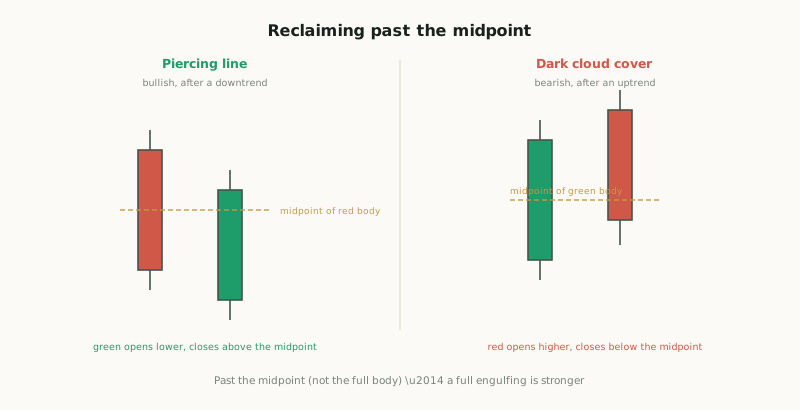
The two patterns
Both are two-candle reversal patterns, and they're mirror images. The piercing line is a bullish reversal that forms in a downtrend. The first candle is a long red (bearish) candle, continuing the down move. The second candle opens lower (at or below the prior close — classically with a small downward gap) but then rallies to close above the midpoint (50%) of the first red candle's body. The strong recovery — from a lower open all the way back up past the halfway point of the prior down candle — shows buyers stepping in forcefully, signalling a possible bullish reversal. The dark cloud cover is the bearish mirror, forming in an uptrend. The first candle is a long green (bullish) candle. The second opens higher (at or above the prior close, classically with a small upward gap) but then sells off to close below the midpoint (50%) of the first green candle's body. The sell-off back below the halfway point shows sellers taking control, signalling a possible bearish reversal. The table compares them.
Piercing line vs dark cloud cover
| Feature | Piercing line | Dark cloud cover |
|---|---|---|
| Direction | Bullish reversal | Bearish reversal |
| Appears in | A downtrend | An uptrend |
| First candle | Long red | Long green |
| Second candle | Opens lower, closes above midpoint | Opens higher, closes below midpoint |
The midpoint rule and the engulfing link
The key feature of both patterns — and the threshold that defines them — is that the second candle penetrates past the midpoint (50%) of the first candle's body, but not all the way past it. This 50% mark is the dividing line: a second candle that reverses past the halfway point of the prior body qualifies as a piercing line or dark cloud cover; one that doesn't reach the midpoint is a weaker, less significant counter-move (not the pattern). The reason the midpoint matters is that reclaiming more than half of the prior candle represents a substantial shift — the counter-move has undone the majority of the previous candle's progress, showing the other side has taken meaningful control. Crucially, the deeper the penetration into the prior body, the stronger the signal: a close that just clears the midpoint is a modest version; one that closes near the far end of the prior body (almost fully reversing it) is much stronger.
This naturally connects these patterns to the engulfing pattern, of which they are essentially partial versions. In an engulfing pattern, the second candle reverses all the way past the entire prior body — it completely engulfs the first — representing a full reversal of the prior candle and the strongest signal of the group. The piercing line and dark cloud cover are the halfway versions: the second candle reverses past the midpoint but stops short of fully engulfing the first. This gives a clear hierarchy of strength: a counter-move that doesn't reach the midpoint is weak; one that passes the midpoint (piercing/dark cloud) is a moderate reversal signal; one that fully engulfs the prior body (engulfing) is the strongest. Understanding this spectrum helps you gauge how convincing a given two-candle reversal is — it's all about how much of the prior candle the counter-move reclaims, from less than half (weak) to past half (piercing/dark cloud) to all of it (engulfing).
Confirmation and context
Like all candlestick patterns, the piercing line and dark cloud cover are potential reversal signals, not guarantees, and need context, confirmation and confluence. Context: they require a prior trend to reverse (a piercing line needs a downtrend, dark cloud cover an uptrend), and they're far more significant at a meaningful support or resistance level — a piercing line at established support, or dark cloud cover at resistance, is a much stronger case than the same pattern in open space. Confirmation: waiting for the next candle to continue in the reversal direction helps verify the reversal is real rather than a temporary counter-move. Confluence: combined with a key level, supportive indicators, or the broader market structure, the pattern becomes a useful piece of a reversal case rather than a standalone trigger.
One forex-specific note on the classic definition: traditionally these patterns involve a gap (the second candle opening beyond the first candle's close — below it for a piercing line, above it for dark cloud cover). But because the forex market trades nearly 24 hours and gaps are rare intraday (mostly occurring over the weekend), the gap requirement is often relaxed in forex — traders typically focus on the essential feature (the second candle reversing past the midpoint of the first's body) rather than insisting on a literal gap. As always, the patterns can fail (a partial reversal can fizzle and the trend resume), so they must be traded with risk management. The honest framing: the piercing line (bullish, in a downtrend) and dark cloud cover (bearish, in an uptrend) are two-candle reversals where the second candle reverses past the midpoint of the first candle's body — "partial engulfing" patterns whose strength grows with the depth of penetration (a full engulfing being stronger still). They're potential signals needing context (a prior trend, ideally a key level), confirmation and confluence, with the gap requirement usually relaxed in forex, and like all candlestick patterns they're probabilistic, not magic. Read as part of the spectrum of two-candle reversals, and traded with risk management, they're a useful read on shifting momentum.
Trading these patterns
Trading the piercing line and dark cloud cover follows the standard candlestick-reversal discipline, with the strength spectrum (relative to engulfing patterns) informing how much weight to give a given instance. As ever, start with location: these are most worth trading at a meaningful support or resistance level against an established trend — a piercing line at support after a downtrend, or dark cloud cover at resistance after an uptrend. The level and the pattern reinforce each other; in open space, the signal is far weaker. Then assess the depth of penetration, since it gauges the pattern's strength: a second candle that closes only just past the midpoint is a modest signal, while one closing near the far end of the prior body (almost a full engulfing) is much stronger and more worth acting on. If the second candle fully engulfs the first, you simply have the stronger engulfing pattern instead — which is fine; treat the whole family as a continuum of conviction.
For the entry, wait for confirmation — the next candle continuing in the reversal direction — rather than acting on the two-candle pattern alone, which filters out partial reversals that fizzle. For the stop, a logical level is just beyond the extreme of the pattern: below the low of the two candles for a piercing line (long), or above the high for dark cloud cover (short) — a break beyond there would negate the reversal thesis. Size the position by that stop distance and your risk, and set a take-profit at the next significant level or a favourable risk:reward multiple. Keep in mind the forex note on gaps (the classic gap is usually relaxed, since intraday forex gaps are rare), and remember that these are potential signals that can fail — a partial reversal can give way and the trend resume — so the stop and sizing are essential. The honest practical summary: trade piercing lines and dark cloud cover at meaningful levels, weight them by how deeply the second candle penetrates the first (deeper = stronger, full engulfing = strongest), enter on confirmation, stop beyond the pattern's extreme, and size to your risk. Read as part of the two-candle-reversal spectrum and traded with discipline, they're a useful, intermediate-strength read on shifting momentum — neither as tentative as a harami nor as decisive as a full engulfing.
Piercing line (bullish, in a downtrend): a long red candle, then a green candle that opens lower but closes above the midpoint (50%) of the red body — buyers stepping in. Dark cloud cover (bearish, in an uptrend): a long green candle, then a red candle that opens higher but closes below the midpoint of the green body — sellers taking over. The key feature is reversing past the midpoint (but not the full body); deeper penetration = stronger signal. They're "partial engulfing" patterns: a full engulfing (reversing past the entire prior body) is stronger; not reaching the midpoint is weaker. The classic gap requirement is usually relaxed in forex (gaps are rare intraday). Need context (a prior trend, ideally a key level), confirmation and confluence; probabilistic, not magic — trade with risk management.