
Pivot points hand you a ready-made map of support and resistance for the session — objective, pre-calculated from the prior period's price, and watched by traders worldwide. No subjective line-drawing required: the levels are computed by formula and the same for everyone looking. That makes them a day trader's staple, especially in forex. But, as with every support and resistance level, the honest truth is that pivot points are reference points, not a crystal ball. This guide explains pivot point trading: how the levels are calculated, how traders use them, why they're so popular, and why — like all levels — they work best with confirmation and confluence rather than as magic lines.
They're a specific application of support and resistance, a favourite of day traders, and at their best combined with other factors in confluence.
Key takeaways
Q: What are pivot points?
A: Pivot points are a set of horizontal support and resistance levels calculated from the prior period's high, low and close. The central pivot point (PP) is their average ((High + Low + Close) / 3), with resistance levels (R1, R2, R3) above and support levels (S1, S2, S3) below. They're widely used by day traders as objective intraday levels.
Q: How do traders use pivot points?
A: Traders use them as support/resistance: trading bounces off the levels or breaks through them, using the central PP as a rough bias (above it leans bullish for the session, below it bearish), and using R1–R3 / S1–S3 as potential targets or reaction points. They're stronger when they align with other levels (confluence).
Q: Are pivot points reliable?
A: Pivot points are objective, widely-watched reference levels, which gives them some self-fulfilling tendency, but they're support and resistance like any other — not magic. Price doesn't always respect them, so they work best with confirmation and confluence, as one tool among several rather than a standalone system.
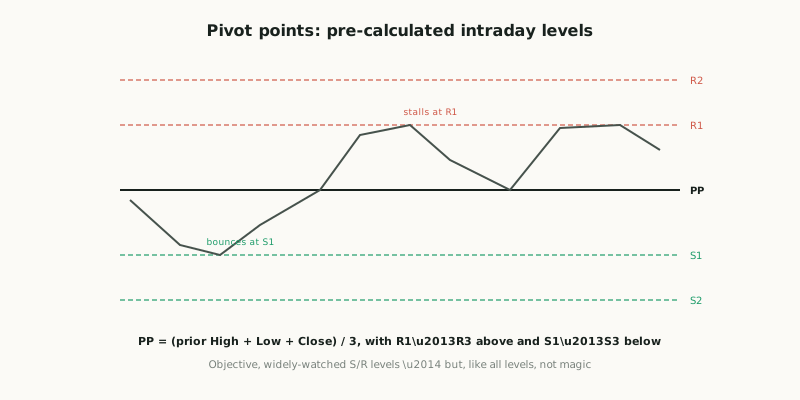
What pivot points are
Pivot points are a set of horizontal support and resistance levels calculated from the prior period's high, low and close. The central level, the pivot point (PP), is simply the average of those three: PP = (High + Low + Close) / 3. From the PP, further levels are derived by formula: resistance levels (R1, R2, R3) above the pivot, and support levels (S1, S2, S3) below it. The result is a ladder of objective S/R levels for the upcoming period, centred on the PP. Most commonly these are calculated daily (using the prior day's high, low and close to set today's levels), which suits intraday and day trading; they can also be calculated weekly or monthly for longer-term reference.
The pivot levels (standard)
The defining quality of pivot points is that they're objective and pre-calculated: unlike hand-drawn support and resistance (which is somewhat subjective — different traders draw lines slightly differently), pivot points come from a fixed formula, so they're the same for everyone who calculates them the same way. This objectivity, and the fact that they're widely watched, are central to their appeal (and to a degree their effectiveness, as we'll see). There are also several calculation methods — the standard (or classic) method described above is the most common, but variants exist (Fibonacci pivots, which space the levels using Fibonacci ratios; Camarilla; Woodie's), each with slightly different formulas. The standard method is the usual starting point, and the concept — a central pivot with resistance levels above and support levels below, derived from the prior period — is the same across methods.
How traders use them
Pivot points are used as support and resistance levels — in essentially the ways any S/R is used, but with the advantage of being objective and ready-made. There are a few common applications. As levels to trade off: traders watch how price behaves at each pivot level, trading bounces (e.g., buying near a support pivot like S1 expecting a bounce, selling near a resistance pivot like R1 expecting rejection) or breaks (trading a decisive break through a level in the breakout direction). As a session bias: the central PP serves as a rough directional reference — price trading above the PP leans bullish for the session, below the PP leans bearish — giving a quick read on the day's tone (a rough guide, not a rule). As targets: the R and S levels serve as natural profit targets or reaction points (e.g., a long from S1 might target the PP or R1). And, importantly, with confluence: pivot points are far more meaningful where they align with other factors — a pivot level coinciding with a prior swing high, a moving average, or a Fibonacci level is a stronger level than a pivot alone (the confluence guide).
The reasons pivot points are so popular, especially among day traders, follow from their nature. They're objective (no subjective drawing — the levels are calculated, removing guesswork). They're widely watched, which gives them a degree of self-fulfilling tendency: because so many traders are looking at the same pivot levels, those levels can attract orders and reactions simply because everyone sees them — a meaningful, if partial, reason they "work." They're well-suited to intraday trading (daily pivots give a fresh, relevant map of levels for each session, ideal for day traders working within the day). And they're ready-made (most charting platforms plot them automatically, requiring no analysis to generate). This combination — objective, widely-watched, intraday-friendly, automatic — makes pivot points a convenient and widely-used framework of levels, particularly for those trading within the day (and around the active sessions covered in the best-times-to-trade guide).
Useful, but not magic
For all their convenience and popularity, pivot points must be kept in honest perspective, consistent with this site's spine: they are support and resistance like any other — useful reference levels, but not magic. Price does not always respect them: pivots get broken, ignored, and blown through like any S/R level, and treating them as lines price must obey is a mistake. Their objectivity and wide following give them a real but partial edge (the self-fulfilling tendency is genuine but not reliable enough to trade blindly). So pivot points should be used the way all levels should: as reference points that inform decisions, confirmed by price action (watching how price actually behaves at a level before acting — a bounce, a rejection, a break) and combined with other factors in confluence, rather than as a standalone, mechanical system. A pivot level is a place to watch for a reaction, not a guaranteed turning point.
In practice, this means pivot points are best as one tool among several: a convenient, objective framework of levels that complements (not replaces) other analysis. A day trader might use daily pivots to map the session's key levels, note the PP for a rough bias, watch for reactions at the pivots, and trade those reactions with confirmation and ideally where pivots align with other levels — while managing risk with stops, since any pivot-based trade can fail. Used this way, pivot points are a genuinely useful, popular tool that brings objective structure to intraday trading. Used as magic lines that price must respect, they disappoint like any over-trusted indicator. The honest summary: pivot points give objective, pre-calculated, widely-watched support and resistance levels (PP, R1–R3, S1–S3) that are convenient and popular, especially for day trading, and carry a partial self-fulfilling edge — but they're S/R like any other, to be used with confirmation, confluence and risk management, as one tool among many rather than a crystal ball.
Calculation methods and choosing a period
Two practical choices shape how pivot points are used: the calculation method and the period. On methods, while the standard (classic) formula described above is the most common and the usual default, several variants exist, each spacing the levels a little differently. Fibonacci pivots place the support and resistance levels at Fibonacci ratios of the prior period's range from the pivot, appealing to traders who already use Fibonacci. Camarilla pivots use a different formula that tends to cluster levels closer to the prior close, which some intraday traders prefer for mean-reversion-style trades. Woodie's pivots weight the closing price more heavily in the central calculation. The differences are real but secondary: all share the same concept (a central pivot with resistance levels above and support levels below, derived from the prior period), and the standard method is the sensible starting point. Rather than agonising over which is "best," the practical advice is to pick one method, use it consistently, and judge it by how the levels actually behave on the instrument and timeframe you trade.
On period, the choice should match the trading style. Daily pivots (calculated from the prior day's high, low and close) are by far the most common and suit intraday and day trading — they give a fresh, relevant map of levels for each session, which is exactly what a day trader wants (and they pair naturally with the active sessions covered in the best-times-to-trade guide). Weekly pivots suit swing traders holding positions across several days, providing levels relevant over a week; monthly pivots serve longer-term traders. The principle is alignment: a day trader uses daily pivots, a swing trader weekly, a longer-term trader monthly — matching the pivot period to the holding period so the levels are relevant to the trade's horizon. Some traders even watch multiple periods at once (e.g., daily pivots for intraday levels with weekly pivots marking bigger reference points), noting where they cluster as stronger confluence. Whichever method and period, the honest perspective from the previous section still governs: these are objective, convenient S/R levels, not magic — to be used with confirmation, confluence and risk management, as one tool among several.
Pivot points are objective, pre-calculated support/resistance levels from the prior period's high, low and close: the central PP = (High + Low + Close) / 3, with resistance R1–R3 above and support S1–S3 below (usually daily; standard method most common). Traders use them as S/R — trading bounces or breaks at the levels, using the PP as a rough session bias (above = bullish lean, below = bearish), and R/S levels as targets — strongest in confluence with other levels. They're popular because they're objective, widely-watched (a partial self-fulfilling edge), intraday-friendly and automatic. But they're support and resistance like any other, not magic: price doesn't always respect them, so use them with confirmation, confluence and risk management, as one tool among many — a place to watch for a reaction, not a guaranteed turning point.