
Before the session even opens, a handful of horizontal lines can be calculated from yesterday's range — levels that thousands of other traders will also be watching today. That blend of objectivity (a fixed formula) and crowd attention (everyone sees the same levels) is both the appeal and the catch of pivot points. This guide explains pivot points: what they are, how they're calculated, how day traders use them, the variations, and their honest limits.
They're a calculated form of support and resistance, popular for intraday trading around session opens like the London session, and strongest used with confluence.
Key takeaways
Q: What are pivot points?
A: Pivot points are pre-calculated horizontal support and resistance levels derived from the prior period's high, low and close. The central pivot (PP) is the average of those three prices, with resistance levels (R1, R2, R3) above and support levels (S1, S2, S3) below. Day traders use them to anticipate intraday turning points and gauge whether the bias is bullish or bearish.
Q: How are pivot points calculated?
A: In the standard (classic) method: PP = (High + Low + Close) / 3 using the prior period's values. R1 = (2 × PP) − Low and S1 = (2 × PP) − High. R2 = PP + (High − Low) and S2 = PP − (High − Low), with R3 and S3 extending further out. Daily pivots use the previous day's high, low and close; weekly or monthly pivots use those periods.
Q: Do pivot points actually work?
A: They can act as meaningful reference levels, but partly because they're widely watched — a self-fulfilling element — rather than through any predictive magic. The levels are static for the period and price can blow straight through them. Pivot points are best treated as one objective tool among several, used with confirmation and other analysis, not as a standalone signal or a guarantee of where price will turn.
What they are and how they're calculated
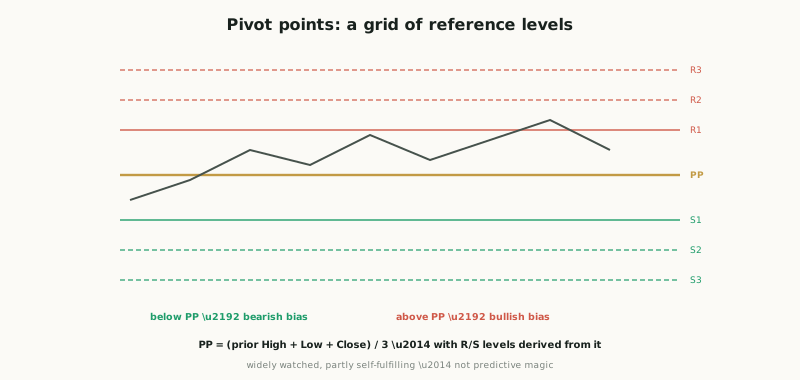
Pivot points are pre-calculated horizontal support and resistance levels derived from the prior period's high, low and close, used (especially by day traders) to anticipate intraday turning points and to gauge directional bias. The central level is the pivot point (PP); from it, a ladder of resistance levels (R1, R2, R3) extends above and support levels (S1, S2, S3) below.
Standard pivot point formula
In the standard (classic) method, the central PP = (High + Low + Close) / 3 using the prior period's values; the first levels are R1 = (2 × PP) − Low and S1 = (2 × PP) − High, the second are R2 = PP + (High − Low) and S2 = PP − (High − Low), with R3/S3 extending further. Daily pivots — the most common for forex day trading — use the previous day's high, low and close to set today's levels, though the same idea applies to weekly or monthly pivots for higher-timeframe traders. The beauty is that everyone using the standard formula gets the same levels, making them a shared, objective reference rather than a hand-drawn judgement.
How traders use them, variations, and limits
The core use is reading bias and reaction levels. The PP itself is the key reference: price trading above the PP is read as a bullish intraday bias, below as bearish. The R and S levels then act as potential support and resistance: traders watch for bounces off them (a reaction at S1 to buy, at R1 to sell), breakouts through them (a break of R1 targeting R2), and use them as ready-made profit targets or stop reference points. They're especially popular for intraday trading and around session opens, where the day's freshly-set levels frame the action. Several variations tweak the formula — Fibonacci pivots (placing levels at Fibonacci ratios of the prior range), Camarilla (tighter levels suited to mean-reversion), Woodie's (weighting the close more heavily), and DeMark (conditional on the open-close relationship) — each with its adherents, but all serving the same purpose of mapping calculated reference levels.
The honest limits keep pivots in proportion. The most important is that they're partly self-fulfilling: pivot levels tend to "work" as support and resistance in significant part because so many traders watch them and place orders around them, not because of any predictive magic in the arithmetic — a widely-watched level becomes meaningful through that shared attention, which is a real effect but a different one from the levels having inherent forecasting power. They're also static for the period (calculated once from yesterday and fixed all day), so they take no account of intraday developments, and price can and does blow straight through them in a strong trend or on news. As with every tool on this site, pivots are one input, best combined with trendlines, structural support/resistance, candlestick signals and other confluence and used with confirmation — a pivot level that coincides with an independent support zone is far more compelling than a pivot alone. Treated that way, pivot points are a genuinely useful, objective set of reference levels; treated as a crystal ball, they'll disappoint. The honest framing: pivot points are pre-calculated horizontal support/resistance levels from the prior period's high, low and close, used (especially by day traders) to anticipate intraday turning points and bias. Standard: PP = (H+L+C)/3, with R1/R2/R3 above and S1/S2/S3 below; daily pivots use the previous day's H/L/C. Use: above PP = bullish bias, below = bearish; trade bounces or breaks at the levels, or use them as targets/stops. Variations exist (Fibonacci, Camarilla, Woodie's, DeMark). Caveats: pivots are partly self-fulfilling (they matter because many traders watch them, not by predictive magic), static for the period, and price can blow straight through; combine with confirmation and other tools — a useful, objective set of reference levels, not a guarantee.
Common pivot-point strategies
Traders put pivot points to work in a few recognisable ways, all variations on treating the levels as decision points. The bias filter use is the simplest: take the PP as a dividing line and only look for long setups while price is above it (bullish bias) and short setups while below (bearish bias), letting the central pivot keep you on the right side of the intraday tide. The bounce (reversal) play looks for price to reject a level: approaching R1 or R2 in an up-move, a trader watches for signs of rejection (a reversal candle, stalling momentum) to fade the move back toward the pivot, or buys a bounce off S1/S2 in a down-move — trading the expectation that these watched levels produce reactions. The breakout play does the opposite: when price decisively breaks a level (clears R1 convincingly), the trader trades in the breakout direction, often targeting the next level (R2) and using the broken level as a stop reference. And pivots make natural ready-made targets and stops — entering near one level and aiming for the next is a clean, objective way to structure a trade's risk and reward.
Two practical refinements make these far more reliable. First, combine pivots with confirmation and confluence rather than trading a level mechanically. A pivot level that coincides with an independent signal — a structural support/resistance zone, a trendline, a round number, a Fibonacci level, or a reversal candlestick — is a much higher-quality decision point than a pivot in isolation, because multiple reasons for a reaction are stacking up (the essence of confluence). Second, match your pivot timeframe to your trading timeframe: a day trader uses daily pivots (set from yesterday) and often finds them most relevant around active session opens when fresh volume tests the new levels, while a swing trader leans on weekly pivots. A simple, disciplined approach — use the daily PP for bias, watch the R/S levels for bounces or breaks, demand confirmation and confluence before acting, and use the levels for clean targets and stops — turns pivots from a curiosity into a structured intraday framework. As always, none of this is predictive certainty: the levels matter largely because the crowd watches them, price can ignore them entirely on a trending or news-driven day, and risk management remains essential on every trade regardless of how clean the levels look.
Why so many traders watch them
It's worth understanding why pivot points became so widely used, because that history explains both their appeal and their self-fulfilling nature. Pivot points originated among floor traders, who needed a quick, pencil-and-paper way to calculate the day's likely support and resistance from the previous session's range before the open — a simple formula that required no charting software. That practicality made them ubiquitous, and ubiquity is precisely what gives them power today: because a large number of traders (and the algorithms that watch the same levels) are looking at the same calculated prices, those prices attract orders — buy orders clustering near support levels, sell orders near resistance — which makes reactions at the levels more likely to actually occur. This is the self-fulfilling mechanism in action: the levels aren't magic, but the collective attention on them is real and does influence price. It's the same reason round numbers and other widely-watched levels matter. Understanding this keeps pivots in proper perspective: they're useful because the crowd uses them, which is a genuine effect to respect but also a reminder that they hold no inherent predictive power of their own.
Pivot points are pre-calculated horizontal support/resistance levels from the prior period's high, low and close — the central PP = (H+L+C)/3, with R1–R3 above and S1–S3 below (daily pivots use yesterday's H/L/C). Read price above PP as bullish bias, below as bearish; trade bounces and breaks at the levels, or use them as targets/stops — popular for intraday trading and session opens. Variations include Fibonacci, Camarilla, Woodie's and DeMark. Caveats: pivots are partly self-fulfilling (they work because many traders watch them, not by predictive magic), static for the period, and price can blow straight through. Treat them as one objective reference among several — strongest where a pivot coincides with other support/resistance — used with confirmation, never as a standalone signal.