
London is the beating heart of the forex market — the largest, most liquid, most volatile session of the trading day, and the one that most often sets the tone for everything that follows. More currency changes hands through London than through any other centre on earth, and when London opens, the market frequently springs to life after the quieter Asian hours. If any single session deserves a trader's attention, it's this one. This guide is a deep dive into the London session: its hours, why it dominates, the key pairs, what drives it, its all-important overlap with New York, and how traders approach it.
It's one of the four sessions mapped in the forex trading sessions overview, central to the best times to trade, and home to the London breakout strategy.
Key takeaways
Q: What are the London session hours?
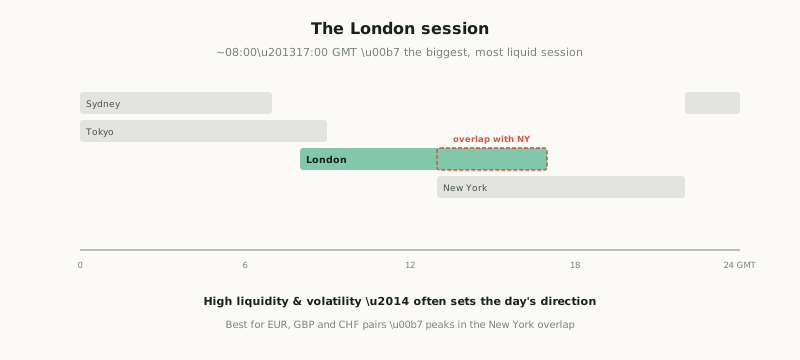
A: The London session runs roughly 08:00–17:00 GMT, covering European trading hours. Exact times shift with daylight saving (British Summer Time in the UK), so the GMT window moves by an hour for part of the year — always verify the current times for your broker and timezone.
Q: Why is the London session so important?
A: London is the world's largest forex trading centre, handling the biggest share of global currency turnover. Its session has the highest liquidity and volatility, the tightest spreads, and large institutional flows — so it often sets the day's direction, and the London open frequently produces a strong directional move.
Q: Which pairs are most active in the London session?
A: European currency pairs are most active — especially those involving the euro, pound and Swiss franc, such as EUR/USD, GBP/USD, EUR/GBP and GBP/JPY. These see their heaviest volume during London hours, with activity peaking in the afternoon overlap with New York.
The session at a glance
The table summarises the London session's key characteristics, with the detail following.
London session profile
The London session runs roughly 08:00–17:00 GMT, covering European trading hours. As with all session times, this is approximate and shifts with daylight saving — when the UK is on British Summer Time, the clock-time window moves — so always verify the exact current times for your broker and timezone rather than treating these as fixed. London's standing comes from its sheer scale: it's the world's largest forex centre, handling the biggest share of global FX turnover, which gives its session the highest liquidity and volatility of the day and the tightest spreads (the most participants competing). With large institutional flows passing through, London often sets the day's direction, and the London open in particular frequently produces a strong, directional move as the volume floods in — the phenomenon the London breakout strategy tries to exploit.
Key pairs and what drives it
Because London is the European hub, the European currency pairs are most active during its hours — those involving the euro, pound and Swiss franc. EUR/USD (the world's most-traded pair), GBP/USD, EUR/GBP, and the GBP and EUR crosses (such as GBP/JPY and EUR/JPY) all see their heaviest, most liquid trading in London hours. If you trade these pairs, the London session is typically when they're most active and their spreads tightest, which matters for both opportunity and execution cost. The session is driven by European economic data and news (UK and Eurozone releases, central-bank commentary from the Bank of England and European Central Bank), large institutional and bank flows that route through London, and the general awakening of European markets. These flows and releases supply much of the movement that makes London the day's most active session.
The single most important feature of London's rhythm is its overlap with New York. In the afternoon (roughly 13:00–17:00 GMT), the London session overlaps with the New York open — meaning the world's two biggest forex centres are open simultaneously. This overlap is the single most active, liquid and volatile window of the entire trading day (explored in depth in session overlaps), often producing the biggest moves, amplified when major US data lands in the New York morning. The London session therefore tends to build through the morning, peak in the New York overlap, and the latter part is where much of the day's significant movement concentrates. There can be a mid-session lull around the European lunch, but the open and the overlap are the energetic bookends.
How traders approach it
London's combination of high liquidity and strong movement makes it a favourite session for many traders. The liquidity means tight spreads and easy fills; the volatility means there's enough movement to provide trading opportunities (a session that barely moves offers little to work with). Strategies that need movement — breakout and trend/momentum approaches — tend to suit the London session and especially the open and the New York overlap, the prime windows. The London open move and the overlap are where a great deal of opportunity (and risk) is concentrated, so traders who can be active in those windows often focus their attention there.
The flip side of all that movement is that London's volatility cuts both ways: bigger moves mean bigger potential losses as well as gains, so the session demands sound risk management — appropriately sized positions and sensible stops that account for the larger swings (a stop that's fine in quiet Asian hours may be too tight for a volatile London open). It's also worth remembering the honest, general truth about all sessions: the London session describes when activity tends to happen — a reliable pattern of higher liquidity and volatility — but it is not a guaranteed edge in itself. Knowing that London is active doesn't tell you which way price will go; it just tells you there's likely to be movement and good liquidity. And practically, the right session to trade is the one that fits your schedule and style: London suits those who can trade European hours and who want liquidity and movement, but a trader in another timezone, or one who prefers quieter conditions, may be better served elsewhere. The honest framing: the London session (~08:00–17:00 GMT, shifting with daylight saving) is the largest, most liquid and most volatile session, often setting the day's direction, best for EUR, GBP and CHF pairs, and peaking in its overlap with New York. It offers excellent liquidity and opportunity but bigger moves that demand risk management, and it describes when activity happens rather than guaranteeing an edge — trade it if it fits your schedule and style, always with disciplined risk control.
The rhythm of a London day
It helps to picture how a typical London session unfolds, because the energy is far from uniform across the nine hours. Before London opens, the Asian session has usually left price in a relatively contained range — the quiet overnight consolidation. As London comes online around 08:00 GMT, the open brings a sharp influx of European liquidity, and this is frequently the session's first burst of energy: the volatility surge that can break the Asian range and stake out the day's early direction (the move the London breakout strategy targets). Through the mid-morning, the session often develops a direction as European flows and any UK/Eurozone data work through the market — one of the more trend-friendly stretches of the day.
There can be a noticeable lull around the European midday, as the morning's initial move matures and the market pauses before the next catalyst. Then comes the session's crescendo: from roughly 13:00 GMT, the New York open arrives and the London–New York overlap begins, lifting liquidity and volatility to the day's peak — often re-energising or extending the move, especially when US data lands in the NY morning. London's final hours (toward 17:00 GMT) trade within this overlap before the European market winds down and hands the baton to New York alone. The practical upshot for a London-session trader is that the open and the overlap are the two highest-energy windows, separated by a calmer midday — so many focus their attention on those two periods. A trader drawn to the volatility of the open might concentrate on the first hour or two; one who prefers the deepest liquidity and the chance of news-driven moves might focus on the overlap. Either way, knowing the rhythm — quiet Asian range, energetic open, mid-morning trend, midday lull, overlap peak — lets you align your trading with the session's natural flow rather than fighting it, and reminds you to size and stop appropriately for whichever part of the day you're in (the open and overlap being more volatile than the midday lull).
A note on trading the open
One practical caution specific to the London open deserves emphasis. Because the open's volatility surge is so reliable, it attracts a great deal of attention — and the first move is not always the real move. It's common to see an initial thrust at the open that reverses as the session finds its true direction (a false start, sometimes after an apparent break of the Asian range that doesn't hold). Traders who pile into the very first candle can be caught by these early reversals. A measured approach — letting the open settle for a short while, waiting for confirmation that a move has genuine follow-through rather than chasing the first spike, or using the retest of a broken level — tends to serve better than reacting instantly to the open's first flicker. The general principle holds across the session: London's energy is an opportunity, but it's also where impatience is punished, so pairing the session's movement with patience and confirmation, and always with sensibly-sized stops that respect the open's volatility, is the disciplined way to harness it.
The London session (~08:00–17:00 GMT, shifting with daylight saving — verify exact times) is the largest, most liquid and most volatile session, since London is the world's biggest FX centre. It has the tightest spreads, large institutional flows, and often sets the day's direction — the London open frequently makes a strong move. It's best for EUR, GBP and CHF pairs (EUR/USD, GBP/USD, EUR/GBP), driven by European data and bank flows. Its defining feature is the afternoon overlap with New York (~13:00–17:00 GMT) — the day's most active, liquid window. It suits breakout and trend strategies and traders who can work European hours, but its volatility cuts both ways, demanding risk management. Like all sessions, it describes when activity happens, not a guaranteed edge — trade it if it fits your schedule and style.